
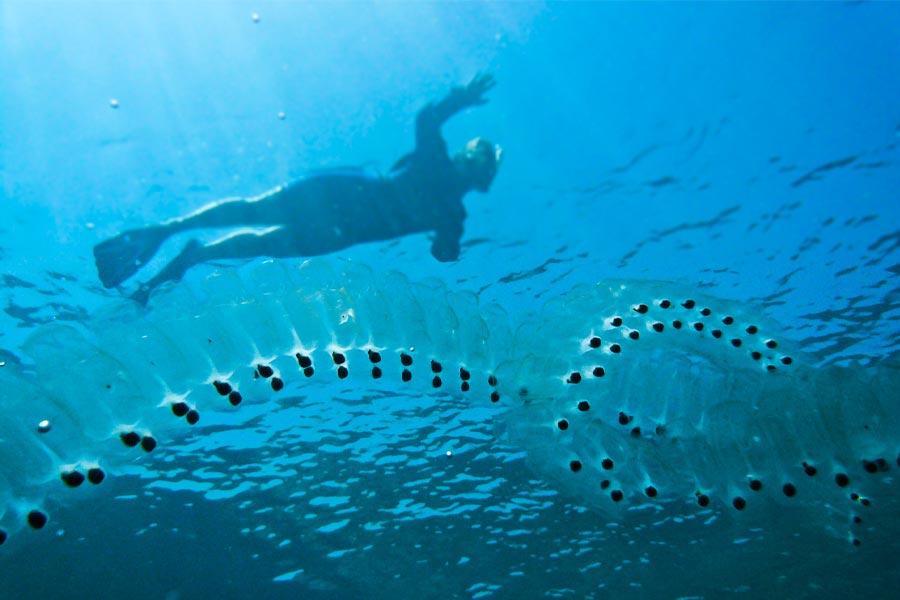
Salps compete with protists, not krill, altering previous assumptions about their ecological impact and potentially boosting both carbon sequestration and marine food chains.
Florida State University researchers have more insight into a strange sea creature found in oceans around the world and what their presence means for the health of a marine ecosystem.
Scientists have thought that salps — small marine organisms that look like clear, gelatinous blobs — competed for resources with krill, shrimp-like creatures that are an important food source for many marine animals. But new research published in Limnology and Oceanography suggests that salps are actually competing for food with an organism known as a protist.
“These fascinating and bizarre animals are becoming more abundant in the vast and warming Southern Ocean, so we sought to understand how their presence changes marine ecosystems,” said Michael Stukel, a researcher with FSU’s Center for Ocean-Atmospheric Prediction Studies and an associate professor in the Department of Earth, Ocean and Atmospheric Science.
Though salps might resemble jellyfish, they are one of the earliest examples of chordates to evolve, and therefore are more closely related to humans.
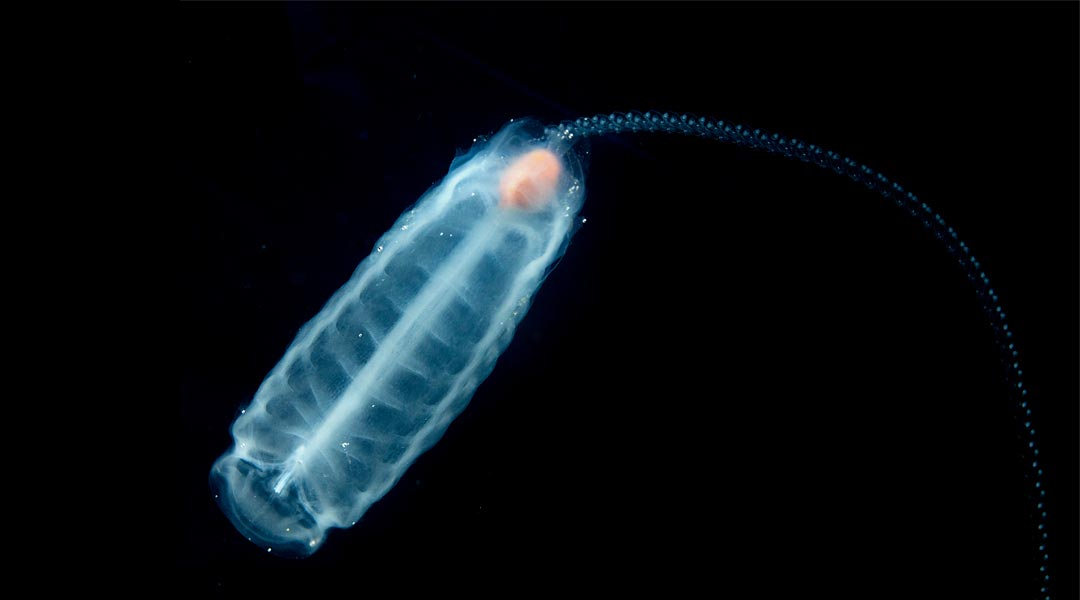
More Than Jellyfish Look-Alikes
These organisms live in oceans around the world and feed on phytoplankton. When their food source is abundant, salps rapidly multiply with the help of an unusual reproductive cycle, forming large blooms made of thousands of organisms. They remove carbon dioxide from the atmosphere by eating algae and then compacting them into tiny pellets that sink to the bottom of the ocean.
Salps are also a food source for some marine animals, but they don’t provide much nutrition. Their importance to the marine food web is eclipsed by krill, which are nutritious food for all sorts of animals, from tiny anchovies to enormous whales. The old theory was that salp blooms crowded out krill, leading to more carbon sequestration but less food for marine organisms.
Instead, salps are probably replacing minuscule protists that are not an important food source for large organisms in the ocean. Although salps are much larger than those protists, they feed on the same microscopic algae. Imagine an elephant that eats the same food as an ant, Stukel said.
To understand what size prey the salps were eating, the researchers built a circular tank and filled it with salps and seawater, which contained their prey. They measured the fluorescence glowing from the salps’ prey living in the water and tracked how it changed over time to understand what size prey were being eaten.
Because the protists are the same size as their prey, they needed to use a different method to see what size prey they were eating. The researchers filled one bottle with seawater, which held a typical amount of protists and prey, and another with diluted seawater, which decreased the frequency with which predator and prey met. After 24 hours, they could use the same fluorescence measuring technique to see what kind of prey the protists ate.
Rethinking Ocean Food Webs and Climate Impact
Learning that salps are likely competing with protists, and not with krill, is reason to rethink the role of salp blooms in the ocean ecosystem.
“If we get more of these really weird organisms, how is that going to change the way the ocean works — for everything in the ocean, but also for humans?” Stukel said. “Our results suggest that salps are not even really competing with krill. They’re going to be replacing protists, so if that happens, you’ll get a lot more carbon sequestration and you’ll probably even get a little bit more food availability, because although salps are not as good a prey as krill, they’re still better prey than protists.”
Reference: “Size-specific grazing and competitive interactions between large salps and protistan grazers” by Michael R. Stukel, Moira Décima, Karen E. Selph and Andres Gutiérrez-Rodríguez, 5 May 2021, Limnology and Oceanography.
DOI: 10.1002/lno.11770
Researchers from the National Institute of Water and Atmospheric Research in New Zealand, Scripps Institution of Oceanography at the University of California San Diego, and the University of Hawaii at Manoa were co-authors on this paper. This research was supported by the National Science Foundation, by New Zealand’s Ministry for Business, Innovation and Employment, by the National Institute of Water and Atmospheric Research, and by the Royal Society of New Zealand.
Never miss a breakthrough: Join the SciTechDaily newsletter.
Follow us on Google and Google News.
13 Comments
Protists are protozoans. There are a great many in plankton that secrete carbonate shells. Foraminifera for example.. Replacing them willl not help CO2 sequestration, it will decrease it because the carbonate shells sink to the bottom while cellular carbon is recycled.
Good job Florida State, I watched a documentary detailing exactly these findings on Amazon Prime about 18 months ago.
I’m curious about the ability to harvest and consume Slaps, the article states they are not as good a prey as krill but how would they fair for humans? Could they be a new delicacy in the near future or should we be avoiding them at all costs?
That’s great, so can we as humans not eat it, torture it or put it in a zoo and just leave the damn thing alone?
I wonder the other implications, if we’ve learnt nothing about ecosystems they’re complex. Like how whales affect global warming. I wonder what other small organisms rely on protists as a food source, and what relies on these.
I ate a booger once
Interesting, but if they make a vaccination out of it, I am not getting it.
Would have found the article more interesting if it had drawn some conclusions or had a hypothesis at least.
This is why goojew is no good. They didn’t want to talk about an amazing oceanic find but,of course,how THEY can use it for their own objectives. Sick
I agree with Dr. Ken Towe, I see this being a decrease. Also, no these will not be a delicacy! They are small & jelly like! So no worry there guys… I’m just waiting for a new discovery of a giant plastic eating organism:( The state of our oceans make me sick:(
Interesting. If they made a vaccine out of this, I would get it.
what in the subnautica
Leave it alone we as humans destroy everything we get curious about and that dumb ass stating could it be a new food for humans stupid its not for us Leave it be its there world not ours and we don’t appreciate this world