
A study of street names in four cities reveals gender bias, historical patterns, and cultural values encoded in urban naming practices.
A city’s street names can provide a glimpse into its cultural value system and a way to quantify cultural indicators, according to a study published June 30, 2021, in the open-access journal PLOS ONE by Melanie Bancilhon from Washington University in Saint Louis, U.S., and colleagues.
“Streetonomics” as a Quantitative Tool
Ever since named streets have existed, they have been used as a form of social engineering, mirroring a town or city’s social, cultural, political, and religious values. Building off this concept in what they term “streetonomics,” Bancilhon and colleagues used street names as an alternative route to quantify cultural indicators in four influential Western cities: Paris, Vienna, London, and New York.
Gender Disparity Across Four Cities
The authors used multiple open data sources to study 4,932 honorific streets (streets named for a person) across the four cities. Their analysis examined gender bias in street name honorees; when the honorees lived compared to the present; the most celebrated professions for honorees; and whether foreigners were recognized as street name honorees.
Vienna had the highest proportion of its streets named to honor a woman, at 54 percent; London came a relatively close second, at 40 percent. In New York, only 26 percent of all streets are named after women, and in Paris this proportion is even lower, at only 4 percent.
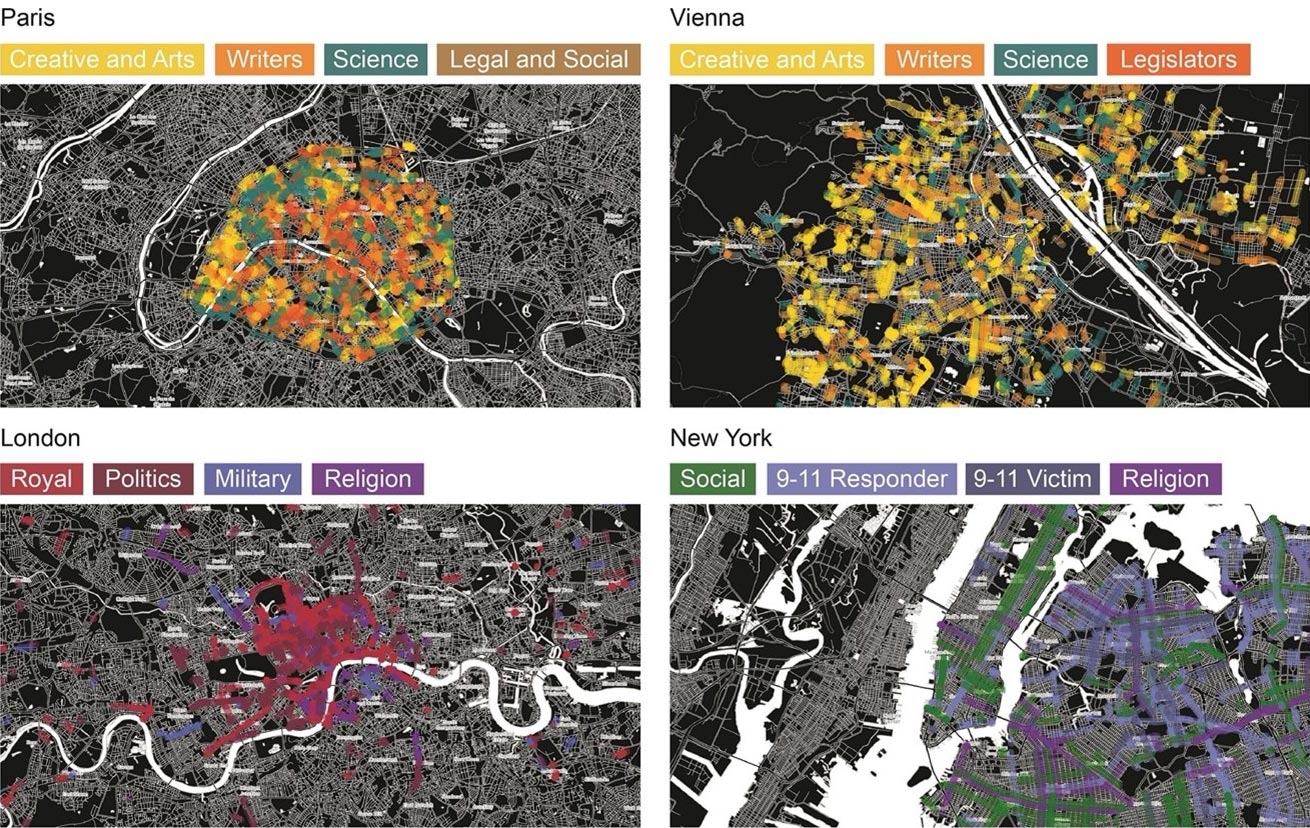
Most streets in Paris are named after people who lived in the 1860s, when urban planner Haussman worked with Napoleon III to transform Paris into the capital city of an empire. In Vienna, most of the street honorees lived through the 1900s, when the city was expanding and rebuilding after WWI. In London, streets are named mostly after people who lived through the 1700s and 1800s, following growth after the Great Fire of London and large-scale interventions promoted by King George III. In New York, most streets honor people who lived through the 1950s to 2000s, with 36 percent named specifically for 9/11 victims and emergency responders.
Street Honorees by Profession and National Origin
In terms of the types of professions held by street honorees, Paris streets honor artists, writers, scientists, and members of the military; Viennese streets also honor artists, as well as members of legal and social occupations. London’s streets celebrate the British royal family, politicians, and military professionals predominantly, and New York’s streets have consistently celebrated artists, as well as many civil servants honored post-9/11. Vienna was the city with the most streets named after foreigners, at 45 percent, followed far behind by London (14.6 percent) Paris (10.9 percent), and New York (3.2 percent).
The authors note their study has several limitations — perhaps most importantly, the open source data sources used in the analysis are themselves potentially biased. However, the implications of using this type of open data to study urban culture and track changes over time are wide, and suggest many different avenues for future work.
The authors add: “A new text mining approach is able to automatically link streets to information about their honorees, and study how a city’s cultural values changed through space and time, revealing how intangible values encoded in street names such as gender biases evolved over the centuries.”
Reference: “Streetonomics: Quantifying culture using street names” by Melanie Bancilhon, Marios Constantinides, Edyta Paulina Bogucka, Luca Maria Aiello and Daniele Quercia, 30 June 2021, PLOS ONE.
DOI: 10.1371/journal.pone.0252869
Funding: Nokia Bell Labs provided support in the form of salaries for authors [MC, LMA, DQ], but did not have any additional role in the study design, data collection and analysis, decision to publish, or preparation of the manuscript. The specific roles of these authors are articulated in the ‘author contributions’ section.
Competing Interests: Nokia Bell Labs provided support in the form of salaries for authors [MC, LMA, DQ]. This does not alter our adherence to PLOS ONE policies on sharing data and materials
Never miss a breakthrough: Join the SciTechDaily newsletter.
Follow us on Google and Google News.