
Close Menu
    Facebook X (Twitter) Instagram
    SciTechDaily
    • Biology
    • Chemistry
    • Earth
    • Health
    • Physics
    • Science
    • Space
    • Technology
    Facebook X (Twitter) Pinterest YouTube RSS
    SciTechDaily
    Home»Biology»Study Shows that Dung Beetles Use Stars for Orientation
    Biology

    Study Shows that Dung Beetles Use Stars for Orientation

    By AlphaGalileo Foundation, Wits UniversityJanuary 25, 20133 Comments3 Mins Read
    Facebook Twitter Pinterest Telegram LinkedIn WhatsApp Email Reddit
    Share
    Facebook Twitter LinkedIn Pinterest Telegram Email Reddit
    Dung-Beetles-Use-Stars-For-Orientation
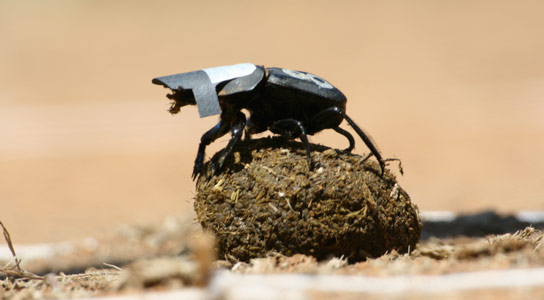
    Beetle with cap. Credit: Marcus Byrne

    Researchers at Wits University demonstrated the use of the starry sky for orientation in dung beetles and provided the first documented use of the Milky Way for orientation in the animal kingdom.

    An insect with a tiny brain and minimal computing power has become the first animal proven to use the Milky Way for orientation. Scientists from South Africa and Sweden have published findings in the journal Current Biology showing the link between dung beetles and the spray of stars that comprises our galaxy.

    Although their eyes are too weak to distinguish individual constellations, dung beetles use the gradient of light to dark provided by the Milky Way to ensure they keep rolling their balls in a straight line and don’t circle back to competitors at the dung pile.

    “The dung beetles don’t care which direction they’re going in; they just need to get away from the bun fight at the poo pile,” said Professor Marcus Byrne from Wits University.

    Byrne and his team previously proved that dung beetles use the sun, the moon and polarized light for orientation. In their experiments, they gave the beetles “caps” which blocked light from reaching their eyes. The team also discovered that the beetles climb on top of their dung balls to perform an orientation “dance” during which they locate light sources to use for orientation.

    Now, further experiments, conducted under the simulated night sky of the Wits Planetarium, have shown that the beetles also use the Mohawk of the Milky Way – giving new meaning to dancing with the stars!

    “We were sitting out in Vryburg (conducting experiments) and the Milky Way was this massive light source. We thought they have to be able to use this – they just have to!” said Byrne.

    Not all light sources are equally useful landmarks for a dung beetle. A moth keeping a constant angle between itself and a candle flame will move in a circle around the flame. However, a celestial body is too far away to change position relative to a dung beetle as it rolls its ball, with the result that the beetle keeps traveling in a straight line.

    The scientists suspect the beetles have a hierarchy of preferences when it comes to available light sources. So if the moon and the Milky Way are visible at the same time, the beetles probably use one rather than the other.

    A few other animals have been proven to use stars for orientation, but the dung beetle is the first animal proven to use the galaxy.

    Reference: “Dung Beetles Use the Milky Way for Orientation” by Marie Dacke, Emily Baird, Marcus Byrne, Clarke H. Scholtz and Eric J. Warrant, 24 January 2013, Current Biology.
    DOI: 10.1016/j.cub.2012.12.034

    Never miss a breakthrough: Join the SciTechDaily newsletter.
    Follow us on Google and Google News.

    Beetle Wits University Zoology
    Share. Facebook Twitter Pinterest LinkedIn Email Reddit

    Related Articles

    Rare Beetle Rediscovered After 55 Years

    War of the Badgers Erupts in England

    Transgendered Bellbird Discovered in New Zealand

    Chinese Soft Shelled Turtle Evacuates Majority of Urea through its Mouth

    Mother’s Presence Increases Survivability of Male Orca Offspring

    Air Pockets in Bristled Feet Allow Beetles to Walk Underwater

    A Fifth of All Invertebrates on Earth Threatened by Extinction

    Previously Thought Extinct Sri Lankan Kandyan Dwarf Toad Reappears

    Fungus Transforms North American Red Turpentine Beetle into Tree Killer in Asia

    3 Comments

    1. xABBAAA on July 31, 2020 8:00 am

      … if true, then logical question is>
      Where the Egyptians aware of this!

      Reply
    2. Kane Williamson on May 6, 2021 9:03 am

      The ancient Egyptians also believed that a dung beetle drove the movement of the sun because the sacred scarab regards: https://www.getyourpetcertified.org/

      Reply
    3. Kane Williamson on May 6, 2021 9:03 am

      The ancient Egyptians also believed that a dung beetle drove the movement of the sun, because the sacred scarab https://www.getyourpetcertified.org/

      Reply
    Leave A Reply Cancel Reply

    • Facebook
    • Twitter
    • Pinterest
    • YouTube

    Don't Miss a Discovery

    Subscribe for the Latest in Science & Tech!

    Trending News

    New Study Reveals Why Ozempic Works Better for Some People Than Others

    Climate Change Is Altering a Key Greenhouse Gas in a Way Scientists Didn’t Expect

    New Study Suggests Gravitational Waves May Have Created Dark Matter

    Scientists Discover Why the Brain Gets Stuck in Schizophrenia

    Scientists Engineer “Tumor-Eating” Bacteria That Devour Cancer From Within

    Even “Failed” Diets May Deliver Long-Term Health Gains, Study Finds

    NIH Scientists Discover Powerful New Opioid That Relieves Pain Without Dangerous Side Effects

    Collapsing Plasma May Hold the Key to Cosmic Magnetism

    Follow SciTechDaily
    • Facebook
    • Twitter
    • YouTube
    • Pinterest
    • Newsletter
    • RSS
    SciTech News
    • Biology News
    • Chemistry News
    • Earth News
    • Health News
    • Physics News
    • Science News
    • Space News
    • Technology News
    Recent Posts
    • Why Some People Reach 100: New Study Reveals Key Biological Differences
    • This Is How Ovarian Cancer Spreads Before Doctors Can Detect
    • Scientists Discover Hidden Virus Linked to Colorectal Cancer
    • Hidden Danger: Widely Used Pesticides Linked to 150% Higher Cancer Risk
    • The Mystery of the Notes: Why No One Knows How This 120-Year-Old Song Should Sound
    Copyright © 1998 - 2026 SciTechDaily. All Rights Reserved.
    • Science News
    • About
    • Contact
    • Editorial Board
    • Privacy Policy
    • Terms of Use

    Type above and press Enter to search. Press Esc to cancel.