
Close Menu
    Facebook X (Twitter) Instagram
    SciTechDaily
    • Biology
    • Chemistry
    • Earth
    • Health
    • Physics
    • Science
    • Space
    • Technology
    Facebook X (Twitter) Pinterest YouTube RSS
    SciTechDaily
    Home»Space»Study Suggests Super-Earths Are More Like Mini-Neptunes
    Space

    Study Suggests Super-Earths Are More Like Mini-Neptunes

    By Royal Astronomical SocietyFebruary 4, 2013No Comments3 Mins Read
    Facebook Twitter Pinterest Telegram LinkedIn WhatsApp Email Reddit
    Share
    Facebook Twitter LinkedIn Pinterest Telegram Email Reddit
    Are-super-Earths-mini-Neptunes
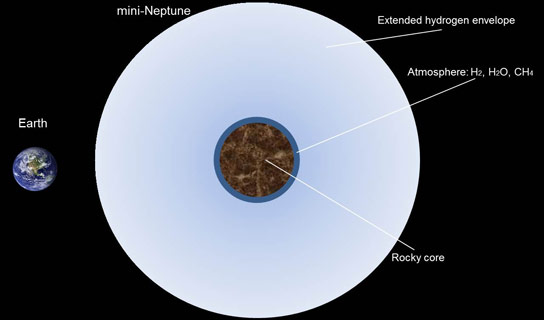
    A diagram comparing the Earth, at left, to a cross-section of a super-Earth on the right. The super-Earth has a relatively small rocky core, an atmosphere of methane, water, and hydrogen and an extended hydrogen envelope. Credit: H. Lammer

    A newly published study suggests that super-Earths are surrounded by extended hydrogen-rich envelopes and that they are more like mini-Neptunes than Earth.

    In the last two decades, astronomers have found hundreds of planets in orbit around other stars. One type of these so-called ‘exoplanets‘ is the super-Earths that are thought to have a high proportion of rock but at the same time are significantly bigger than our own world. Now a new study led by Helmut Lammer of the Space Research Institute (IWF) of the Austrian Academy of Sciences suggests that these planets are actually surrounded by extended hydrogen-rich envelopes and that they are unlikely to ever become Earth-like. Rather than being super-Earths, these worlds are more like mini-Neptunes. The scientists published their work in the journal Monthly Notices of the Royal Astronomical Society.

    ‘Super-Earths’ follow a different evolutionary track to the planets found in our Solar system but an open question is whether they can evolve to become rocky bodies like the ‘terrestrial planets’ Mercury, Venus, Earth and Mars. To try to answer this, Dr. Lammer and his team looked at the impact of radiation on the upper atmospheres of super-Earths orbiting the stars Kepler-11, Gliese 1214 and 55 Cancri.

    This group of planets are all a few times more massive and slightly larger than the Earth. They orbit very close to their respective stars. The way in which the mass of planets scales with their sizes suggests that they have solid cores surrounded by hydrogen or hydrogen-rich atmospheres, probably captured from the clouds of gas and dust (nebulae) from which the planets formed.

    The new model suggests that the short wavelength extreme ultraviolet light (much ‘bluer’ than the blue light we see with our eyes) of the host stars heats up the gaseous envelopes of these worlds, so that they expand up to several times the radius of each planet and gas escapes from them fairly quickly. Nonetheless most of the atmosphere remains in place over the whole lifetime of the stars they orbit.

    “Our results indicate that, although material in the atmosphere of these planets escapes at a high rate, unlike lower mass Earth-like planets many of these super-Earths may not get rid of their nebula-captured hydrogen-rich atmospheres,” says Dr. Lammer.

    Rather than becoming more like the Earth, the super-Earths may more closely resemble Neptune, which together with Uranus, is a smaller ‘gas giant’ in our Solar system. If the scientists’ results are right, then super-Earths further out from their stars in the ‘habitable zone‘, where the temperature would allow liquid water to exist, would hold on to their atmospheres even more effectively. If that happens, they would be much less likely to be habitable.

    The team’s findings will be put to the test in 2017 when the European Space Agency launches the CHaracterising ExOPlanets Satellite (CHEOPS). This will study super-Earths in more detail and should be able to tell whether some of these exotic worlds could one day be more like our own.

    Reference: “Probing the blow-off criteria of hydrogen-rich ‘super-Earths’” by H. Lammer, N. V. Erkaev, P. Odert, K. G. Kislyakova, M. Leitzinger and M. L. Khodachenko, 29 January 2013, Monthly Notices of the Royal Astronomical Society.
    DOI: 10.1093/mnras/sts705

    Never miss a breakthrough: Join the SciTechDaily newsletter.
    Follow us on Google and Google News.

    Astronomy Planetary Science Royal Astronomical Society Super-Earth
    Share. Facebook Twitter Pinterest LinkedIn Email Reddit

    Related Articles

    Star Vanishes for 200 Days in One of the Longest Cosmic Dimming Events Ever Recorded

    Simulations Shows Traces of Life on Nearest Exoplanets May Be Hidden

    Planet 2MASS J2126 is 1 Trillion Kilometers Away from Its Parent Star

    Study Predicts Building Blocks for Earth-Like Planets in Every Exoplanet System in the Milky Way

    Astronomers Discover of a Ring of Rocks Poised to Make Planets

    Study Details Why Super-Earths Have Long-Lasting Oceans

    Study Reveals It’s Almost Impossible for Life to Exist on ‘Super-Earths’

    Red Dwarf Stars Could Leave Habitable Earth-Like Planets Vulnerable to Radiation

    New e-MERLIN Image of Betelgeuse Reveals Mysterious Hot Spots

    Leave A Reply Cancel Reply

    • Facebook
    • Twitter
    • Pinterest
    • YouTube

    Don't Miss a Discovery

    Subscribe for the Latest in Science & Tech!

    Trending News

    The Universe Is Expanding Too Fast and Scientists Can’t Explain Why

    “Like Liquid Metal”: Scientists Create Strange Shape-Shifting Material

    Early Warning Signals of Esophageal Cancer May Be Hiding in Plain Sight

    Common Blood Pressure Drug Shows Surprising Power Against Deadly Antibiotic-Resistant Superbug

    Scientists Uncover Dangerous Connection Between Serotonin and Heart Valve Disease

    Scientists Discover a “Protector” Protein That Could Help Reverse Hair Loss

    Bone-Strengthening Discovery Could Reverse Osteoporosis

    Scientists Uncover Hidden Trigger Behind Stem Cell Aging

    Follow SciTechDaily
    • Facebook
    • Twitter
    • YouTube
    • Pinterest
    • Newsletter
    • RSS
    SciTech News
    • Biology News
    • Chemistry News
    • Earth News
    • Health News
    • Physics News
    • Science News
    • Space News
    • Technology News
    Recent Posts
    • The Simple Habit That Could Help Prevent Cancer
    • Forgotten Medicinal Plant Shows Promise in Fighting Dangerous Superbugs
    • Millions Take These IBS Drugs, But a New Study Finds Serious Risks
    • 5 Common Myths About Learning a New Language, Debunked
    • The Neanderthal “Love Story” Isn’t What It Seems
    Copyright © 1998 - 2026 SciTechDaily. All Rights Reserved.
    • Science News
    • About
    • Contact
    • Editorial Board
    • Privacy Policy
    • Terms of Use

    Type above and press Enter to search. Press Esc to cancel.