
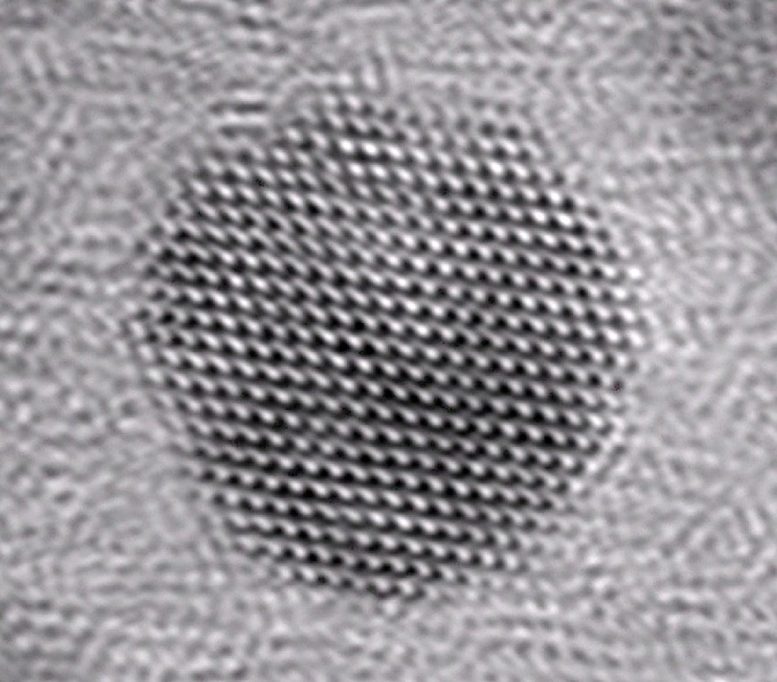
MIT scientists have developed a new process for creating quantum dots with four important qualities, high particle uniformity, high photoluminescence quantum yields, narrow and symmetric emission spectral lineshapes and minimal single-dot emission intermittency, which should result in improved quantum-dot performance.
Quantum dots — tiny particles that emit light in a dazzling array of glowing colors — have the potential for many applications, but have faced a series of hurdles to improve performance. But an MIT team says that it has succeeded in overcoming all these obstacles at once, while earlier efforts have only been able to tackle them one or a few at a time.
Quantum dots — in this case, a specific type called colloidal quantum dots — are tiny particles of semiconductor material that are so small that their properties differ from those of the bulk material: They are governed in part by the laws of quantum mechanics that describe how atoms and subatomic particles behave. When illuminated with ultraviolet light, the dots fluoresce brightly in a range of colors, determined by the sizes of the particles.
First discovered in the 1980s, these materials have been the focus of intense research because of their potential to provide significant advantages in a wide variety of optical applications, but their actual usage has been limited by several factors. Now, research published this week in the journal Nature Materials by MIT chemistry postdoc Ou Chen, Moungi Bawendi, the Lester Wolfe Professor of Chemistry, and several others raises the prospect that these limiting factors can all be overcome.
The new process developed by the MIT team produces quantum dots with four important qualities: uniform sizes and shapes; bright emissions, producing close to 100 percent emission efficiency; a very narrow peak of emissions, meaning that the colors emitted by the particles can be precisely controlled; and an elimination of a tendency to blink on and off, which limited the usefulness of earlier quantum-dot applications.
Multicolored biological dyes
For example, one potential application of great interest to researchers is as a substitute for conventional fluorescent dyes used in medical tests and research. Quantum dots could have several advantages over dyes — including the ability to label many kinds of cells and tissues in different colors because of their ability to produce such narrow, precise color variations. But the blinking effect has hindered their use: In fast-moving biological processes, you can sometimes lose track of a single molecule when its attached quantum dot blinks off.
Previous attempts to address one quantum-dot problem tended to make others worse, Chen says. For example, in order to suppress the blinking effect, particles were made with thick shells, but this eliminated some of the advantages of their small size.
The small size of these new dots is important for potential biological applications, Bawendi explains. “[Our] dots are roughly the size of a protein molecule,” he says. If you want to tag something in a biological system, he says, the tag has got to be small enough so that it doesn’t overwhelm the sample or interfere significantly with its behavior.
Quantum dots are also seen as potentially useful in creating energy-efficient computer and television screens. While such displays have been produced with existing quantum-dot technology, their performance could be enhanced through the use of dots with precisely controlled colors and higher efficiency.
Combining the advantages
So recent research has focused on “the properties we really need to enhance [dots’] application as light emitters,” Bawendi says — which are the properties that the new results have successfully demonstrated. The new quantum dots, for the first time, he says, “combine all these attributes that people think are important, at the same time.”
The new particles were made with a core of semiconductor material (cadmium selenide) and thin shells of a different semiconductor (cadmium sulfide). They demonstrated very high emission efficiency (97 percent) as well as small, uniform size and narrow emission peaks. Blinking was strongly suppressed, meaning the dots stayed “on” 94 percent of the time.
A key factor in getting these particles to achieve all the desired characteristics was growing them in solution slowly, so their properties could be more precisely controlled, Chen explains. “A very important thing is synthesis speed,” he says, “to give enough time to allow every atom to go to the right place.”
The slow growth should make it easy to scale up to large production volumes, he says, because it makes it easier to use large containers without losing control over the ultimate sizes of the particles. Chen expects that the first useful applications of this technology could begin to appear within two years.
Taeghwan Hyeon, director of the Center for Nanoparticle Research at Seoul National University in Korea, who was not involved in this research, says, “It is very impressive, because using a seemingly very simple approach — that is, maintaining a slow growth rate — they were able to precisely control shell thickness, enabling them to synthesize highly uniform and small-sized quantum dots.” This work, he says, solves one of the “key challenges” in this field, and “could find biomedical imaging applications, and can be also used for solid-state lighting and displays.”
Reference: “Compact high-quality CdSe–CdS core–shell nanocrystals with narrow emission linewidths and suppressed blinking” by Ou Chen, Jing Zhao, Vikash P. Chauhan, Jian Cui, Cliff Wong, Daniel K. Harris, He Wei, Hee-Sun Han, Dai Fukumura, Rakesh K. Jain and Moungi G. Bawendi, 3 February 2013, Nature Materials.
DOI: 10.1038/nmat3539
In addition to Chen and Bawendi, the team included seven other MIT students and postdocs and two researchers from Massachusetts General Hospital and Harvard Medical School. The work was supported by the National Institutes of Health, the Army Research Office through MIT’s Institute for Soldier Nanotechnologies, and by the National Science Foundation through the Collaborative Research in Chemistry Program.
Never miss a breakthrough: Join the SciTechDaily newsletter.
Follow us on Google and Google News.