
Close Menu
    Facebook X (Twitter) Instagram
    SciTechDaily
    • Biology
    • Chemistry
    • Earth
    • Health
    • Physics
    • Science
    • Space
    • Technology
    Facebook X (Twitter) Pinterest YouTube RSS
    SciTechDaily
    Home»Space»Stunning New Image of the Center of Our Galaxy Hints at Previously Unknown Interstellar Energy Source
    Space

    Stunning New Image of the Center of Our Galaxy Hints at Previously Unknown Interstellar Energy Source

    By University of Massachusetts AmherstMay 31, 20212 Comments4 Mins Read
    Facebook Twitter Pinterest Telegram LinkedIn WhatsApp Email Reddit
    Share
    Facebook Twitter LinkedIn Pinterest Telegram Email Reddit
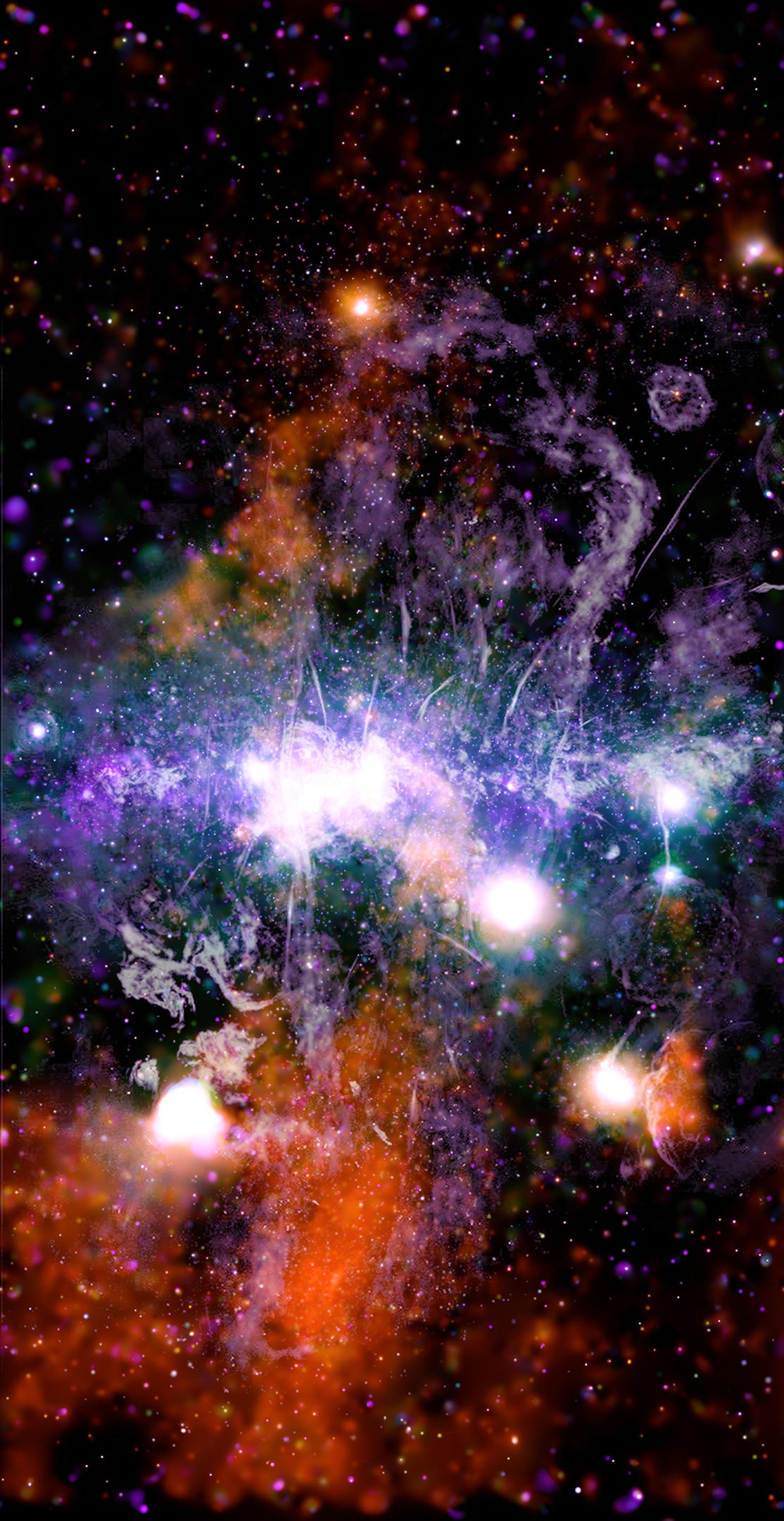
    Chandra Survey of Galactic Center
    A panorama of the Galactic Center builds on previous surveys from Chandra and other telescopes. This latest version expands Chandra’s high-energy view farther above and below the plane of the galaxy – that is, the disk where most of the galaxy’s stars reside – than previous imaging campaigns. In the first two images, X-rays from Chandra are orange, green, and purple, showing different X-ray energies, and the radio data from MeerKAT are gray. Credit: X-ray: NASA/CXC/UMass/Q.D. Wang; Radio: NRF/SARAO/MeerKAT

    Astronomer Reveals Never-Before-Seen Detail of the Center of Our Galaxy

    New image made using NASA’s Chandra X-Ray Observatory hints at previously unknown interstellar energy source at the Milky Way center.

    New research by University of Massachusetts Amherst astronomer Daniel Wang reveals, with unprecedented clarity, details of violent phenomena in the center of our galaxy. The images, published recently in Monthly Notices of the Royal Astronomical Society, document an X-ray thread, G0.17-0.41, which hints at a previously unknown interstellar mechanism that may govern the energy flow and potentially the evolution of the Milky Way.

    “The galaxy is like an ecosystem,” says Wang, a professor in UMass Amherst’s astronomy department, whose findings are a result of more than two decades of research. “We know the centers of galaxies are where the action is and play an enormous role in their evolution.” And yet, whatever has happened in the center of our own galaxy is hard to study, despite its relative proximity to Earth, because, as Wang explains, it is obscured by a dense fog of gas and dust. Researchers simply can’t see the center, even with an instrument as powerful as the famous Hubble Space Telescope. Wang, however, has used a different telescope, NASA’s Chandra X-Ray Observatory, which “sees” X-rays, rather than the rays of visible light that we perceive with our own eyes. These X-rays are capable of penetrating the obscuring fog — and the results are stunning.
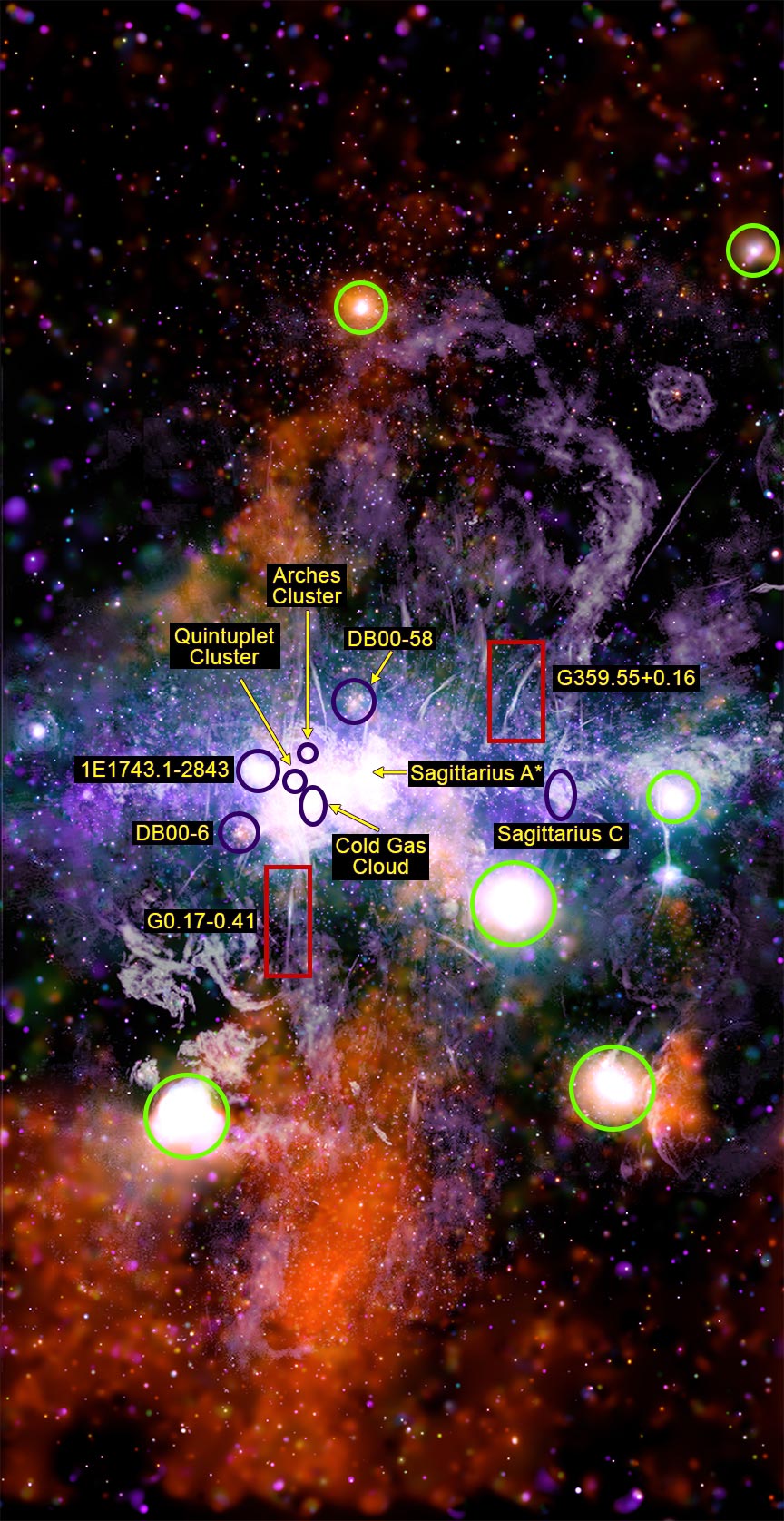
    Chandra Survey of Galactic Center Labeled
    This version of the image highlights several key features of this new Galactic Center survey. The threads are labeled with red rectangles in the image, while X-rays reflected from dust around bright X-ray sources (green circles), Sagittarius A*. In purple circles and ellipses, the Arches and Quintuplet Clusters, DB00-58 and DB00-6, 1E 1743.1-28.43, the Cold Gas Cloud and Sagittarius C are outlined. Credit: X-ray: NASA/CXC/UMass/Q.D. Wang; Radio: NRF/SARAO/MeerKAT

    Twin X-Ray Plumes and a Mysterious Thread

    Wang’s findings, which were supported by NASA, give the clearest picture yet of a pair of X-ray-emitting plumes that are emerging from the region near the massive black hole lying at the center of our galaxy. Even more intriguing is the discovery of an X-ray thread called G0.17-0.41, located near the southern plume. “This thread reveals a new phenomenon,” says Wang. “This is evidence of an ongoing magnetic field reconnection event.” The thread, writes Wang, probably represents “only the tip of the reconnection iceberg.”

    A magnetic field reconnection event is what happens when two opposing magnetic fields are forced together and combine with one another, releasing an enormous amount of energy. “It’s a violent process,” says Wang, and is known to be responsible for such well-known phenomena as solar flares, which produce space weather powerful enough to disrupt power grids and communications systems here on Earth. They also produce the spectacular Northern Lights. Scientists now think that magnetic reconnection also occurs in interstellar space and tends to take place at the outer boundaries of the expanding plumes driven out of our galaxy’s center.

    “What is the total amount of energy outflow at the center of the galaxy? How is it produced and transported? And how does it regulate the galactic ecosystem?” These, says Wang, are the fundamental questions whose answers will help to unlock the history of our galaxy. Though much work remains to be done, Wang’s new map points the way. For more information, including additional images and video, visit the Chandra X-Ray Observatory’s Galactic Center website.

    For more on this discovery, see Unprecedented New Panorama of the Center of Our Milky Way Reveals Magnetized Threads Weaving Spectacular Galactic Tapestry.

    Reference: “Chandra large-scale mapping of the Galactic center: Probing high-energy structures around the central molecular zone” by Q. Daniel Wang, 27 April 2021, Monthly Notices of the Royal Astronomical Society.
    DOI: 10.1093/mnras/stab801

    Never miss a breakthrough: Join the SciTechDaily newsletter.
    Follow us on Google and Google News.

    Astronomy Astrophysics Popular University of Massachusetts Amherst
    Share. Facebook Twitter Pinterest LinkedIn Email Reddit

    Related Articles

    Did a Black Hole Just Explode? Physicists Say It Might Explain Everything

    90% Chance: Physicists Predict a Black Hole Could Explode This Decade

    Monster Galaxy Discovered by Accident – “Just the Tip of the Iceberg?” [Video]

    Lonestar Supercomputer Helps Explore Dark Matter

    Astronomers Obtain Precise Measurements of the Two Kepler-16 Stars

    Possible Death of Solar System Seen in White Dwarf Stars

    Ancient Galactic Collision Created Stellar Swirls of NGC 5907

    The Bolshoi Simulation: Boxing the Universe

    Scientists Convene to Take a Picture of the Supermassive Black Hole at the Center of the Milky Way

    2 Comments

    1. JY on June 7, 2021 3:54 pm

      Stunning new image of CGI fakery…lmbo

      Reply
    2. Michael Lesnak on June 8, 2021 10:22 am

      Absolutely incredible.

      Reply
    Leave A Reply Cancel Reply

    • Facebook
    • Twitter
    • Pinterest
    • YouTube

    Don't Miss a Discovery

    Subscribe for the Latest in Science & Tech!

    Trending News

    Scientists Finally Uncover How a “Forever Chemical” Causes Birth Defects

    Scientists Uncover the Earliest Brain Changes That May Predict Alzheimer’s Decades Before Symptoms

    Surprising New Study Challenges a Century-Old Theory of Habit Formation

    Scientists Turn Seawater Into Drinking Water Without Toxic Brine

    Vitamin D Drug Shows Surprising Promise Against One of the Deadliest Cancers

    NASA’s X-59 Sonic Boom Killer Is Ready for Its Biggest Test Yet

    The Best Exercise Combination for Longevity, According to a 30-Year Study

    Popular Weight-Loss Drug Found To Slow Biological Aging in Landmark Human Trial

    Follow SciTechDaily
    • Facebook
    • Twitter
    • YouTube
    • Pinterest
    • Newsletter
    • RSS
    SciTech News
    • Biology News
    • Chemistry News
    • Earth News
    • Health News
    • Physics News
    • Science News
    • Space News
    • Technology News
    Recent Posts
    • The Probiotic Breakthrough for Natural Anxiety Relief and Better Mental Health
    • Animal vs. Plant Protein: Scientists Found a Surprising Nutritional Difference
    • Tiny Genetic Change Turns Female Mice Into Males, Scientists Discover
    • Scientists Discover Strange New Spider Species That Disguises Itself as a Fungus
    • This Simple Drink Could Help Calm the Inflammation Behind Many Diseases
    Copyright © 1998 - 2026 SciTechDaily. All Rights Reserved.
    • Science News
    • About
    • Contact
    • Editorial Board
    • Privacy Policy
    • Terms of Use

    Type above and press Enter to search. Press Esc to cancel.