
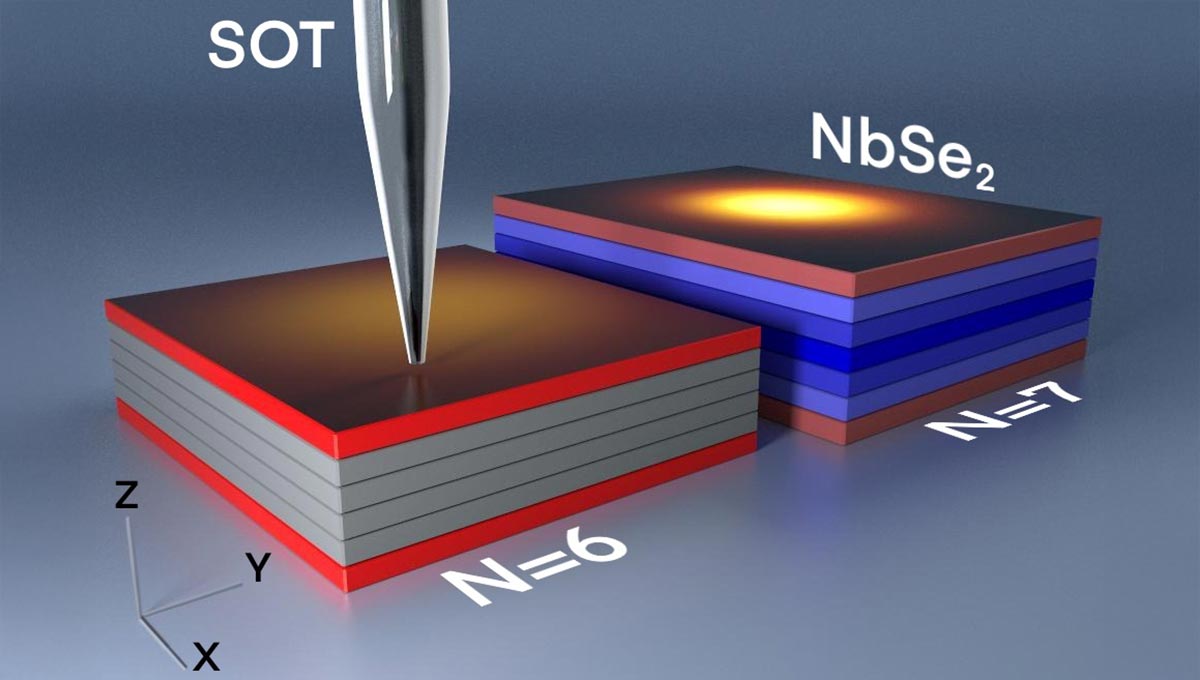
A team of physicists uncovered a strange twist in how superconductors behave when they’re reduced to just a few atomic layers.
Using powerful magnetic imaging, they found that superconductivity in ultra-thin materials doesn’t follow the usual rules – it becomes surface-based rather than distributed throughout the material. This surprising discovery could reshape how scientists understand superconductivity and inspire new technologies in quantum computing and nanoscale devices.
Surprising Twist in Superconductivity
Researchers at the Hebrew University of Jerusalem have made a surprising discovery about how superconductivity behaves in extremely thin materials. Superconductors are materials that allow electric current to flow without resistance, which makes them incredibly valuable for technology. Usually, the properties of superconductors change predictably when the materials become thinner; however, this study found something unexpected.
The team, led by Ph.D. student Nofar Fridman under the guidance of Prof. Yonathan Anahory from the Racah Institute of Physics and the Nano Center at Hebrew University looked closely at thin films made from niobium diselenide (NbSe2), a special type of layered superconducting material, which can be assembled into structures where thickness is precisely controlled down to the few layer limit. By using advanced magnetic imaging techniques, the researchers measured how these materials respond to magnetic fields as their thickness decreased.
Breaking the Rules of Thickness
Typically, scientists expect the ability of a superconducting material to expel magnetic fields to become stronger as the material becomes thicker. Here, this length is gauged by a physical property called the Pearl length. This study confirmed that rule for samples thicker than ten atomic layers. However, when the films became extremely thin—just three to six layers (2-4 nm) —the researchers observed something unexpected: the Pearl length sharply increased and became thickness independent, breaking the expected pattern.
A Strange New Behavior Emerges
“Our findings reveal something completely unexpected that could be ubiquitous in superconducting materials,” explained Nofar Fridman, the Ph.D. student leading the study. “In very thin samples, superconductivity behaves differently from what we’ve known. It seems that below a certain thickness, superconductors host current mostly at their top and bottom surfaces, rather than throughout their volume. This finding opens up exciting new questions about superconductivity in ultra-thin materials.”
The team’s supervisor, Prof. Yonathan Anahory, emphasized the importance of their method, saying, “Our high-resolution magnetic imaging allowed us to see details that previous methods couldn’t detect. By finding this unique surface superconductivity, we’ve expanded our understanding of how superconducting materials behave at extremely small scales. This could have significant implications for future research and technologies.”
Rethinking Superconductivity at the Nanoscale
This discovery sheds new light on superconductivity in very thin films and challenges previously held theories. It also highlights how specialized measurement techniques can uncover surprising new physical phenomena, potentially opening avenues for innovative applications in quantum technology.
Reference: “Anomalous thickness dependence of the vortex pearl length in few-layer NbSe2” by Nofar Fridman, Tomer Daniel Feld, Avia Noah, Ayelet Zalic, Maya Markman, T. R. Devidas, Yishay Zur, Einav Grynszpan, Alon Gutfreund, Itai Keren, Atzmon Vakahi, Sergei Remennik, Kenji Watanabe, Takashi Taniguchi, Martin Emile Huber, Igor Aleiner, Hadar Steinberg, Oded Agam and Yonathan Anahory, 31 March 2025, Nature Communications.
DOI: 10.1038/s41467-025-57817-3
Never miss a breakthrough: Join the SciTechDaily newsletter.
Follow us on Google and Google News.
1 Comment
Maybe it’s time to let time-space to emerge in front of warp drive instead of forcing the reality to bend