

Close Menu
    Facebook X (Twitter) Instagram
    SciTechDaily
    • Biology
    • Chemistry
    • Earth
    • Health
    • Physics
    • Science
    • Space
    • Technology
    Facebook X (Twitter) Pinterest YouTube RSS
    SciTechDaily
    Home»Physics»Revolutionizing Electronics: The 2D Twist That Defied Scientific Predictions
    Physics

    Revolutionizing Electronics: The 2D Twist That Defied Scientific Predictions

    By University of GroningenJanuary 4, 20252 Comments2 Mins Read
    Facebook Twitter Pinterest Telegram LinkedIn WhatsApp Email Reddit
    Share
    Facebook Twitter LinkedIn Pinterest Telegram Email Reddit
    Physics 2D Materials Layers Concept
    Exploring 2D materials, scientists discovered unexpected behavior in twisted tungsten disulfide, paving the way for future electronics innovations. Credit: SciTechDaily.com

    Scientists are exploring 2D materials — sheets just one atom thick — with unique and promising electronic properties.

    When two of these sheets are layered at specific angles, they can exhibit remarkable behaviors, such as superconductivity. Antonija Grubišić-Čabo, a materials scientist at the University of Groningen, and her colleagues investigated one such “twisted” material and found that it behaved in ways that defied existing theoretical predictions.

    2D Materials and Superconductivity

    Grubišić-Čabo, along with collaborators from Poland, Germany, France, and Italy, studied sheets of a 2D material called tungsten disulfide. Theoretical predictions suggested that when two sheets, or a bilayer, are stacked at a precise angle of 4.4 degrees, the electrons within the material should exhibit collective behavior.

    “And when they are so closely connected, their collective behavior can create new, fascinating effects,” explains Giovanna Feraco, first author of the study.
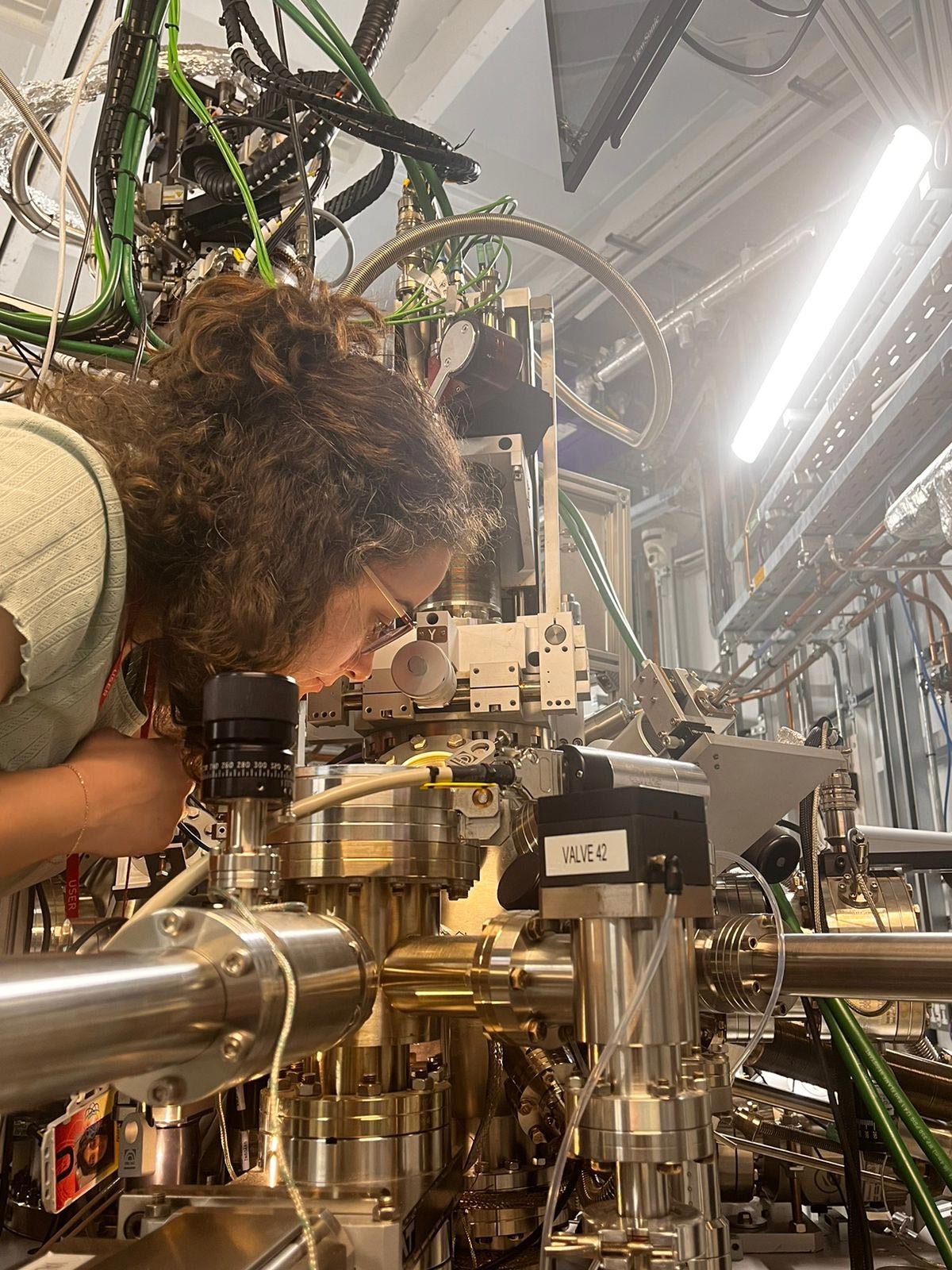
    Giovanna Feraco
    This picture shows first author Giovanna Feraco (Zernike Institute for Advanced Materials, University of Groningen, the Netherlands), operating an Ultra-High Vacuum (UHV) system at a synchrotron facility. Credit: University of Groningen

    Unexpected Results in Electron Behavior

    However, experiments did not reveal this predicted behavior. This discrepancy is linked to the interactions between atoms in the bilayer, which the twist is supposed to enhance.

    “But by studying the electronic structure in the bilayer, we discovered that this material tends to ‘relax’ into large, untwisted regions,” Feraco explains. In other words, the twisted bilayer partially reverts to a more stable, lower-energy untwisted state, challenging prior assumptions.
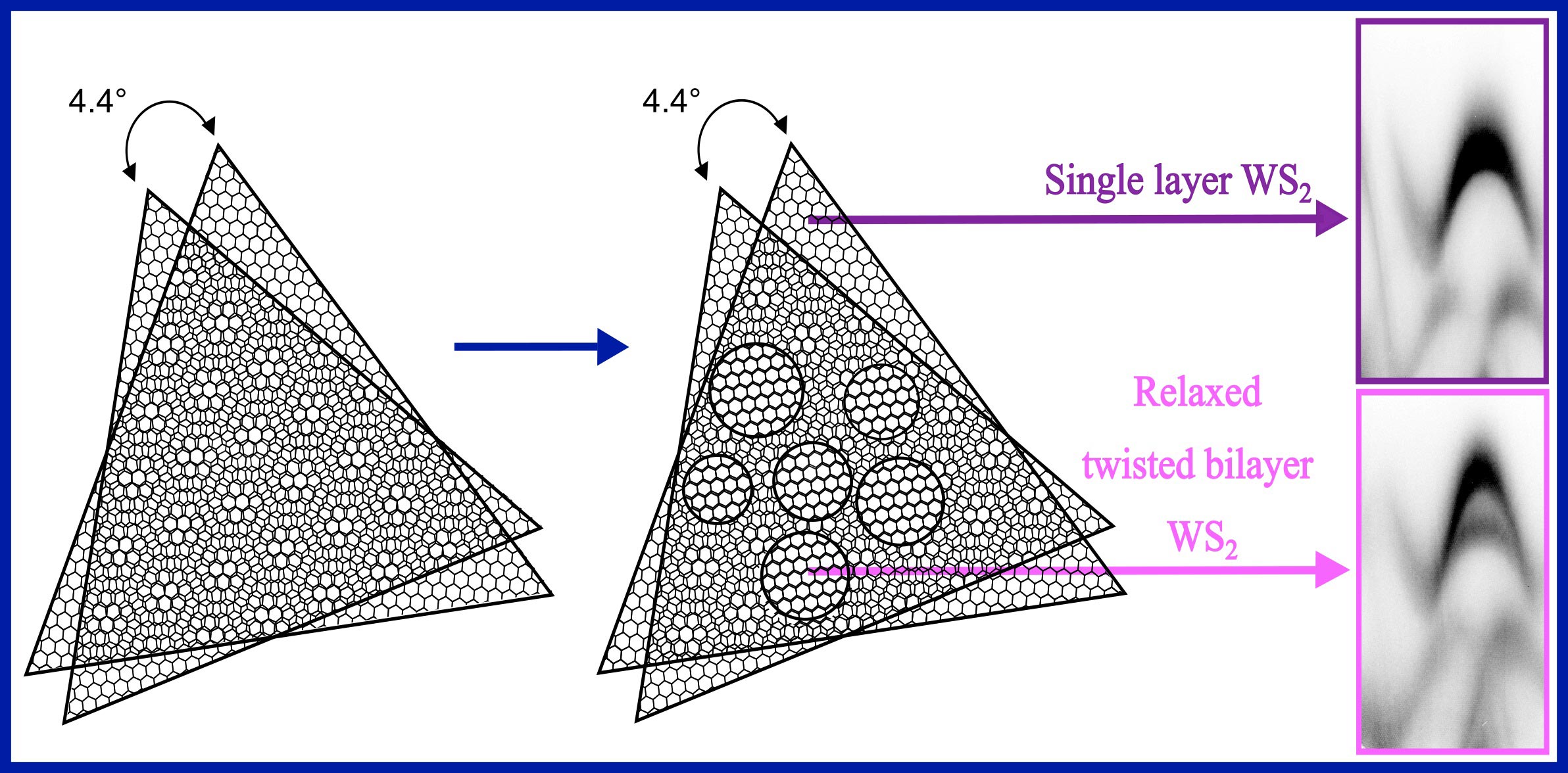
    Twisted Bilayer Relaxed Domains Formation
    This illustration shows the formation of relaxed domains within the twisted bilayer WS2. Credit: University of Groningen

    This finding highlights the importance of understanding how the two sheets of the bilayer form different regions with varying properties. The study has also enhanced scientists’ ability to predict and manipulate the behavior of 2D structures, paving the way for future applications in different types of electronics.

    Reference: “Nano-ARPES investigation of structural relaxation in small angle twisted bilayer tungsten disulfide” by Giovanna Feraco, Oreste De Luca, Przemysław Przybysz1,2, Homayoun Jafari, Oleksandr Zheliuk, Ying Wang, Philip Schädlich, Pavel Dudin, José Avila, Jianting Ye, Thomas Seyller, Paweł Dąbrowski, Paweł J. Kowalczyk, Jagoda Sławińska, Petra Rudolf and Antonija Grubišić-Čabo, 26 December 2024, Physical Review Materials.
    DOI: 10.1103/PhysRevMaterials.8.124004

    Never miss a breakthrough: Join the SciTechDaily newsletter.
    Follow us on Google and Google News.

    2D Materials Materials Science Nanotechnology Superconductivity University of Groningen
    Share. Facebook Twitter Pinterest LinkedIn Email Reddit

    Related Articles

    MIT Physicists Forge a Five-Lane Quantum Superhighway for Electrons

    Discovery of Strong Electron Correlation in a 2D Material Could Help Engineer Unconventional Superconductivity

    Mechanism Discovered for Making Superconductors More Resistant to Magnetic Fields

    Moiré Patterns Facilitate Discovery of Unexpected New Insulating Phases

    Kitchen Temperature Superconductivity From Stacked 2D Materials

    Electrons Caught Behaving Collectively in Experiments With Twisted 2D Materials

    Higher-Order Topology Found in 2D Crystal – “A Variety of Exciting Physics to Be Explored”

    Physics Process Yielding Nanolasers in 2D Semiconductors Could Be Game-Changer for High Speed Communications

    New Zoo of Previously Unobserved States in Twisted Bi-Layer Graphene

    2 Comments

    1. Jojo on January 4, 2025 2:33 pm

      We’ve been hearing about 1 atom thick materials like graphene for years now and all the miraculous things they can do.

      But WHEN are we going to see these products moved out of the laboratory and used in real products?

      Reply
    2. Ralph Johnson on January 4, 2025 6:00 pm

      The learning curve of the 2D conductor for superconductivity needs more work from engineering of geometrical construction tactics , If you could make a conductor with the same surface area as a conductor that transmits high voltage for long distances and maintain the strength , electrons can move freely when in one atom thick metals , not so in bundles of large stranded twisted conductors . I would propose that a spiraled conductor that starts from the outside and pinwheels to the center each one atom section would be insulated from the adjacent with the termination being collective for the additive kilowatt need .

      Reply
    Leave A Reply Cancel Reply

    • Facebook
    • Twitter
    • Pinterest
    • YouTube

    Don't Miss a Discovery

    Subscribe for the Latest in Science & Tech!

    Trending News

    New “Nanozyme Hypothesis” Could Rewrite the Story of Life’s Origins

    Anatomy Isn’t Finished: The Human Body Still Holds Secrets

    “Pretty Close to Home”: The Hidden Earthquake Threat Beneath Seattle

    The Surprising Reason You Might Want To Sleep Without a Pillow

    Scientists Say This Natural Hormone Reverses Obesity by Targeting the Brain

    35-Million-Year-Old Mystery: Strange Arachnid Discovered Preserved in Amber

    Is AI Really Just a Tool? It Could Be Altering How You See Reality

    JWST Reveals a “Forbidden” Planet With a Baffling Composition

    Follow SciTechDaily
    • Facebook
    • Twitter
    • YouTube
    • Pinterest
    • Newsletter
    • RSS
    SciTech News
    • Biology News
    • Chemistry News
    • Earth News
    • Health News
    • Physics News
    • Science News
    • Space News
    • Technology News
    Recent Posts
    • Scientists Capture Hidden Electron Patterns Inside Quantum Materials
    • New Study Challenges Alzheimer’s Theories: It’s Not Just About Plaques
    • Scientists Discover Way To Treat Lung Cancer and Its Deadly Side Effect Together
    • Artificial Sweeteners May Harm Future Generations, Study Suggests
    • The Ocean Current Stronger Than All Rivers Changed Earth Forever
    Copyright © 1998 - 2026 SciTechDaily. All Rights Reserved.
    • Science News
    • About
    • Contact
    • Editorial Board
    • Privacy Policy
    • Terms of Use

    Type above and press Enter to search. Press Esc to cancel.