
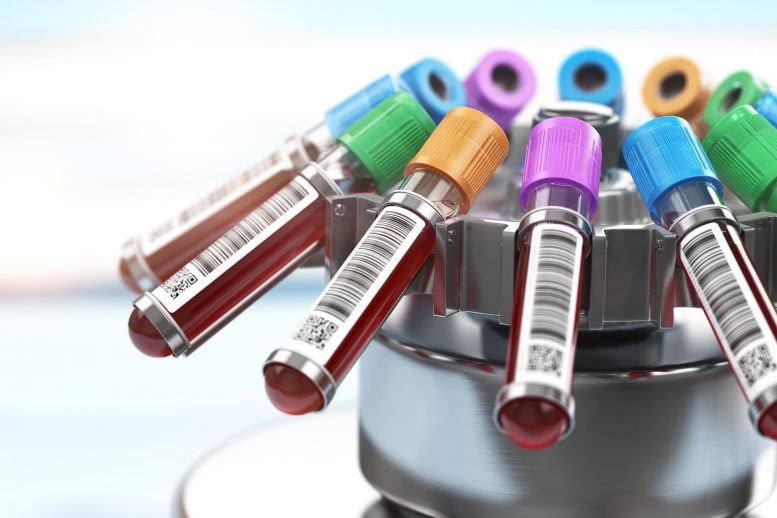
We love coffee, tea, chocolate, and soft drinks so much, caffeine is literally in our blood.
Scientists at Oregon State University may have proven how much people love coffee, tea, chocolate, soda, and energy drinks as they validated their new method for studying how different drugs interact in the body.
100% of samples tested positive for caffeine, 72% for anti-anxiety drug Xanax, and 44% for cough suppressant dextromethorphan.
In conducting mass spectrometry research, Richard van Breemen and Luying Chen worked with various biomedical suppliers to purchase 18 batches of supposedly pure human blood serum pooled from multiple donors. Biomedical suppliers get their blood from blood banks, who pass along inventory that’s nearing its expiration date.
All 18 batches tested positive for caffeine. Also, in many of the samples, the researchers found traces of cough medicine and an anti-anxiety drug. The findings point to the potential for contaminated blood transfusions, and also suggest that blood used in research isn’t necessarily pure.
“From a ‘contamination’ standpoint, caffeine is not a big worry for patients, though it may be a commentary on current society,” said Chen, a Ph.D. student. “But the other drugs being in there could be an issue for patients, as well as posing a problem for those of us doing this type of research because it’s hard to get clean blood samples.”
The study was published on November 10, 2019, in the Journal of Pharmaceutical and Biomedical Analysis.

In addition to caffeine, the research also involved testing pooled serum for alprazolam, an anti-anxiety medicine sold under the trade name Xanax; dextromethorphan, an over-the-counter cough suppressant; and tolbutamide, a medicine used to treat type 2 diabetes.
All of the pooled serum was free of tolbutamide, but eight samples contained dextromethorphan and 13 contained alprazolam — possibly meaning that if you ever need a blood transfusion, your odds of also receiving caffeine, cough medicine, and an anti-anxiety drug are pretty good.
“The study leads you in that direction, though without doing a comprehensive survey of vendors and blood banks we can only speculate on how widespread the problem is,” said van Breemen, the director of OSU’s Linus Pauling Institute. “Another thing to consider is that we found drugs that we just happened to be looking for in doing the drug interaction assay validation — how many others are in there too that we weren’t looking for?”
The purpose of the study by Chen and van Breemen was to test a new method for evaluating the potential for interactions between botanical dietary supplements and drug metabolism.
The method involves rapid protein precipitation and ultra high pressure liquid chromatography and is being used to support clinical studies. In the clinical studies, participants take a drug cocktail along with a botanical supplement — hops, licorice or red clover — to see if the supplement causes any of the drugs to be metabolized differently than they otherwise would.
“Botanicals basically contain natural products with drug-like activities,” van Breemen said. “Just as a drug may alter the drug-metabolizing enzymes, so can natural products. It can become a real problem when someone takes a botanical supplement and is also on prescription drugs — how do those two interact? It’s not straightforward or necessarily predictable, thus the need for methods to look for these interactions. The odd thing, in this case, was finding all the tainted blood.”
Two individual donors who agreed to abstain from caffeinated foods and beverages had to be enlisted so the research could be completed.
Reference: “Validation of a sensitive UHPLC-MS/MS method for cytochrome P450 probe substrates caffeine, tolbutamide, dextromethorphan, and alprazolam in human serum reveals drug contamination of serum used for research” by Luying Chen and Richard B. van Breemen, 10 November 2019, Journal of Pharmaceutical and Biomedical Analysis.
DOI: 10.1016/j.jpba.2019.112983
The National Institutes of Health’s Office of Dietary Supplements and the NIH’s National Center for Complementary and Integrative Health supported this research.
Never miss a breakthrough: Join the SciTechDaily newsletter.
Follow us on Google and Google News.