

A llama carved from a spondylus shell and a cylindrical laminated gold foil object were the contents of a carved stone box — an offering — found at the bottom of Lake Titicaca, according to researchers from Penn State and the Université libre de Bruxelles, Belgium. The offering, found near an island in the lake, was not located where others had found offerings in the past.
“We knew they (Inca) did some form of ritual offerings and that they did them in the lake,” said Jose Capriles, assistant professor of anthropology, Penn State. “The 16th and 17th century chronicles indicate there were submerged offerings.”
Lake Titicaca is located in the Andes between Bolivia and Peru. It is the largest lake in South America and was important to many cultures, including the Tiwanaku and the Inca.
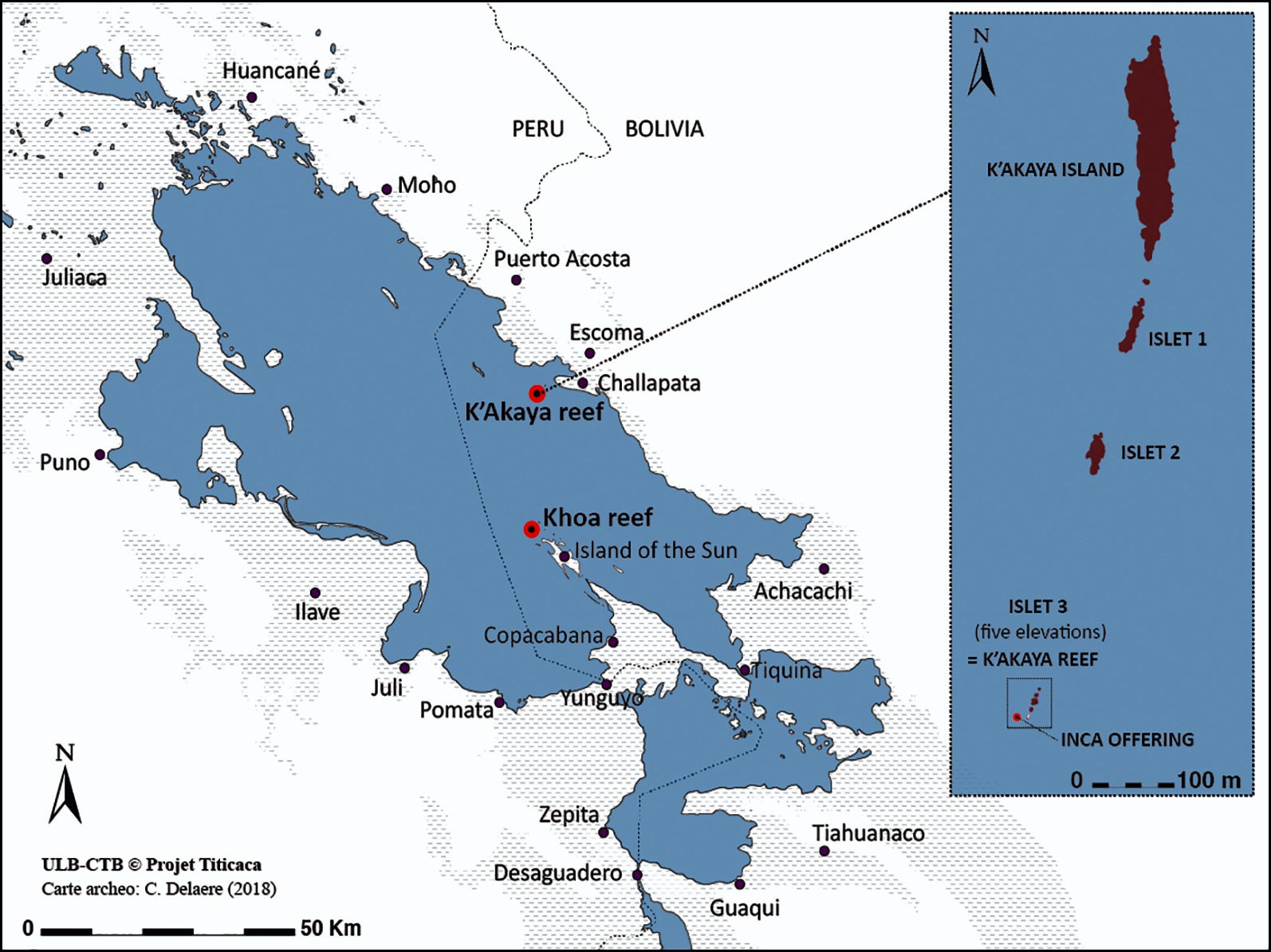
Amateur divers in 1977 found other offerings, or artifacts that could be part of offering bundles near the Island of the Sun, but these were not intact offerings. Professional divers between 1988 and 1992 investigated the area of the Khoa reef and found pre-Inca and Inca artifacts including stone boxes with miniature figures. Recent excavations show that the Khoa reef was an important ceremonial site for the Inca and prior societies; however, this new group of artifacts was not found on the Khoa reef, but on the K’akaya reef.
Capriles and Christophe Delaere, junior research fellow, Université libre de Bruxelles, report their findings today (August 4, 2020) in Antiquity.
“Since 2012, the Université libre de Bruxelles has implemented a research program with the goal of locating and inventorying the underwater heritage of Lake Titicaca,” said Delaere. “Our team has systematically surveyed around the islands and reefs in the Bolivian side of Lake Titicaca.”
The K’akaya Archipelago is west of Challapata Bay in the eastern shore of Lake Titicaca and is a series of a main island and three small ones. K’akaya reef is the last islet of the small chain and is covered in bird droppings.
The divers retrieved the box intact although currents had eroded one side. The box was tightly sealed, but not watertight. Resting in the box, beneath the silt that had filtered in, was the spondylus shell llama and the rolled gold foil.
One indication that these boxes contain artifacts valuable enough for offerings, beside the gold foil, is the spondylus shell llama. The closest location where the Inca could obtain this spiny oyster shell was in warm coastal ocean waters off the coast of Ecuador.
Finding this box in a new location suggests to the researchers that Lake Titicaca was a locus of ritual and ceremonial activity by the Inca. Similar offerings are found in other parts of what was the Inca Empire, some on land and some on water, but the researchers think that the lake was important in the consolidation of the empire.
According to Capriles, as the Inca radiated out from Cuzco in Peru, Lake Titicaca became a focal point. Prior archaeological evidence indicates that many of the islands, reefs and archipelagos contain ruins of temples and other monumental architecture.
“Most of what we know outside of archaeology is from the Spanish,” said Capriles. “Indications were that Lake Titicaca was a pilgrimage center for the Inca, but also served as a focal point for alliances with other groups.”
Spanish myths about the Inca dumping their gold into Lake Titicaca are apparently untrue, but the lake holds much more information still to be uncovered, said the researchers.
The artifacts reside with the Bolivian municipality of Escoma, which has jurisdiction over the area in which they were found.
“One of the goals of our underwater archaeological survey was to identify the existence of similar sites and to our surprise we found at least one,” said Delaere. “It presents not only one of the rare intact discoveries of an Inca underwater offering, but also that it was found at another place in the lake, which has an important implication for understanding the relationship between the expanding Inca empire, the local communities who lived in the lake, and Lake Titicaca itself prior to European contact.
“The inland underwater world remains largely unexplored and offers outstanding opportunities to understand prehistoric societies,” said Delaere. “The underwater heritage of Lake Titicaca still has many surprises to reveal.”
Reference: “The context and meaning of an intact Inca underwater offering from Lake Titicaca” by Christophe Delaere and José M. Capriles, 4 August 2020, Antiquity.
DOI: 10.15184/aqy.2020.121
Université libre de Bruxelles and Wiener-Anspach Foundation supported this work.
Never miss a breakthrough: Join the SciTechDaily newsletter.
Follow us on Google and Google News.