

Close Menu
    Facebook X (Twitter) Instagram
    SciTechDaily
    • Biology
    • Chemistry
    • Earth
    • Health
    • Physics
    • Science
    • Space
    • Technology
    Facebook X (Twitter) Pinterest YouTube RSS
    SciTechDaily
    Home»Science»Swallows & Homing Pigeons Monitor Environmental Factors
    Science

    Swallows & Homing Pigeons Monitor Environmental Factors

    By SciTechDailyNovember 20, 2012No Comments3 Mins Read
    Facebook Twitter Pinterest Telegram LinkedIn WhatsApp Email Reddit
    Share
    Facebook Twitter LinkedIn Pinterest Telegram Email Reddit
    homing-pigeons-china
    Homing pigeon racing. Credit: Chris Arnade

    A new study indicates that nesting birds that feed on insects that hatch in lake or stream-bed sediments make good biological monitors for pollution.

    The scientists published their findings in the journal Environmental Toxicology and Chemistry. This could help track environmental changes. The contamination in the sediments will make its way into the food web, and into birds as well as their young.
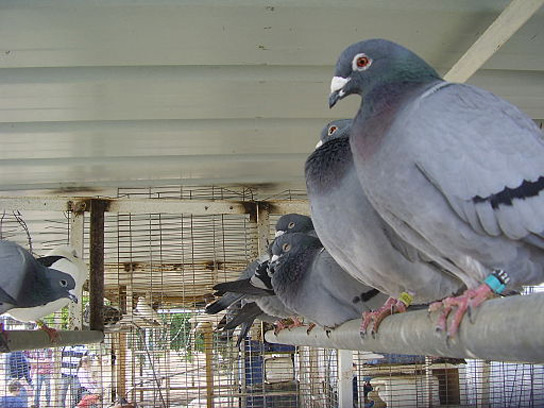
    homing-pigeon-resting
    Photo from NJ Kegstand

    In southern Illinois, the tree swallow (Tachycineta bicolor) still shows significant quantities of polychlorinated biphenols, a toxic chemical, in its eggs and chicks seven years after remediation efforts started at a capacitor-manufacturing plant. The findings prompted further sediment removal.

    Thomas Custer, from the US Geological Survey’s Upper Midwest Environmental Sciences Center in La Crosse, Wisconsin, presented his findings at the annual meeting of the Society of Environmental Toxicology and Chemistry in Long Beach, California, last week. Custer and his group used swallows to monitor a 2010 project intended to remove contaminated sediments from Ohio’s Ottawa River, near Toledo. The birds indicate that this is no longer a hotspot.

    Swallows forage over small distances, rarely more than 500 meters (1,640 feet) from their nests, indicating localized contamination. Researchers can also attract them to areas of interest by putting out nesting boxes on poles, because nesting sites are the birds’ most important environmental limit.

    This can be easily replicated in a variety of different environments to monitor pollution and contamination remedial efforts, instead of relying on samples gathered from randomly collected animals.

    The presence of nesting boxes also improves the birds’ habitat. The loss of a few eggs and nestling isn’t likely to hurt the species as a whole and it’s rare for more than 50% of the nestlings to survive.

    Wildlife toxicologists also use homing pigeons to monitor air quality. These birds are still bred by hobbyists around the world. Many birds are kept in lofts, and in cities, on the top of many apartment buildings, so they breathe ambient air. Most of the homing pigeons’ life history is well known, something that isn’t possible for wild birds.

    In a pilot study involving homing pigeons purchased from hobbyists in China, the Philippines, and the USA, researchers found shocking health-related differences, which were related to air quality. In Beijing and Manila, the scientists found black lungs and enlarged testes in the pigeons.

    The lungs and livers from the birds from Beijing contained three or four times more polycyclic aromatic hydrocarbons, common by-products of fossil-fuel burning, than did those from areas with better air quality. “This suggests that other species, including humans, may also have adverse effects” from these environmental contaminants.

    Reference: “Evaluation of polychlorinated biphenyl remediation at a superfund site using tree swallows (Tachycineta bicolor) as indicators” by Brian L. Spears, Michael W. Brown and Cyrus M. Hester, 9 December 2009, Environmental Toxicology and Chemistry.
    DOI: 10.1897/07-625.1

    Never miss a breakthrough: Join the SciTechDaily newsletter.
    Follow us on Google and Google News.

    Biomonitor Birds Environmental Ornithology Pollution Toxicology
    Share. Facebook Twitter Pinterest LinkedIn Email Reddit

    Related Articles

    Poisoning From Lead Ammunition Is Stunting Bald Eagle Rebound

    Late Pleistocene Humans May Have Hatched and Raised “World’s Most Dangerous Bird” 18,000 Years Ago

    A Very Rare Discovery: 25-Million-Year-Old Ancient Eagle Ruled the Roost in Australia

    Researchers Find Clean Air Act Saved 1.5 Billion Birds Over the Last 40 Years

    Noise and Light Pollution Changes Which Species of Birds Visit Our Backyards

    Mummified Parrots Found by Archaeologists Point to Trade in the Ancient Atacama Desert

    Prolonged Exposure to Weedkiller Roundup Can Cause Significant Harm to Keystone Species

    “Dancing Cat Fever” – New Culprit Identified for Minamata Mercury Poisoning Tragedy

    Exposomics Looks to Tie Environmental Exposure to Biological Triggers of Disease

    Leave A Reply Cancel Reply

    • Facebook
    • Twitter
    • Pinterest
    • YouTube

    Don't Miss a Discovery

    Subscribe for the Latest in Science & Tech!

    Trending News

    JWST Finds a “Star” 100 Billion Times Brighter Than Any Star Should Be

    Scientists Find a Hidden Biological Link Across Different Forms of Autism

    Astronomers Discover a Ghostly River of Stars That Could Reveal Dark Matter

    Why Is Colorectal Cancer Rising in People Under 50? New Clues Point to the Environment

    Quantum Fluctuations Break a Crystal’s Symmetry Rules

    Why Does an Irregular Heartbeat Strike 40 Years Early in Some People?

    Scientists Reveal How ADHD Could Fuel Creative Thinking

    Scientists Find Just 3 Minutes of Sprinting Can Transform Blood Chemistry

    Follow SciTechDaily
    • Facebook
    • Twitter
    • YouTube
    • Pinterest
    • Newsletter
    • RSS
    SciTech News
    • Biology News
    • Chemistry News
    • Earth News
    • Health News
    • Physics News
    • Science News
    • Space News
    • Technology News
    Recent Posts
    • Common Vape Flavor May Disrupt Early Human Development
    • Ultra-Processed Foods Linked to 30% Higher Prostate Cancer Risk
    • More Screen Time, Better Thinking? An 8-Year Study Finds a Surprising Link
    • A Vast Clean Energy Source May Be Hiding Beneath Australia’s Red Soil
    • Scientists Uncover Signs of an Ancient Climate “Tipping Point”
    Copyright © 1998 - 2026 SciTechDaily. All Rights Reserved.
    • Science News
    • About
    • Contact
    • Editorial Board
    • Privacy Policy
    • Terms of Use

    Type above and press Enter to search. Press Esc to cancel.