
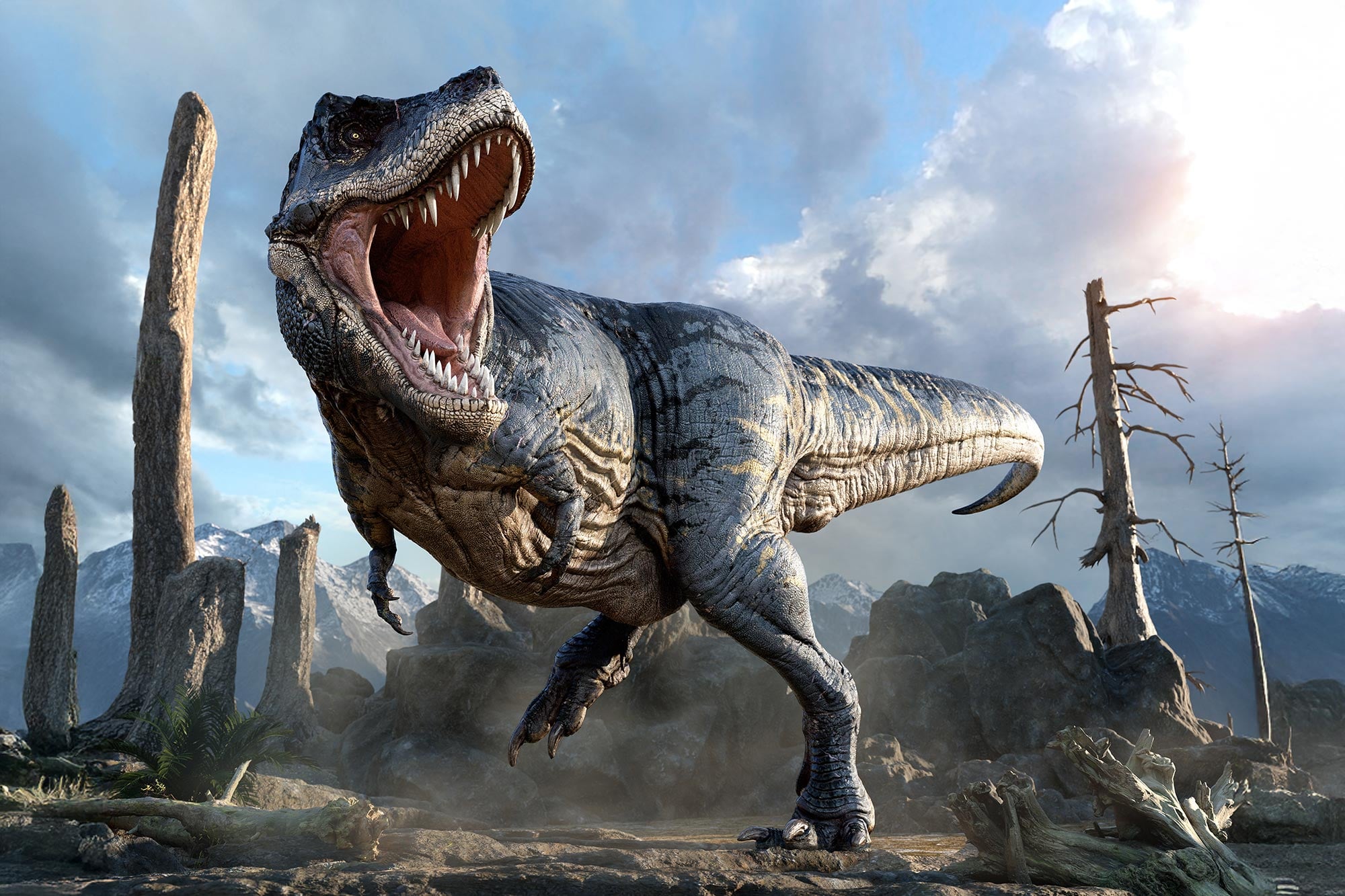
Tyrannosaurus rex may have been the ultimate bone-crusher, but new research shows that other massive carnivorous dinosaurs followed very different hunting strategies.
By using 3D skull scans of 18 species, scientists discovered that while T. rex evolved a crocodile-like skull built for immense bite force, predators such as spinosaurs and allosaurs relied on slashing, tearing, and precision attacks instead.
Bite Force Showdown Among Dinosaur Giants
A detailed study of the bite forces in 18 species of meat-eating dinosaurs has revealed striking differences in their hunting abilities. While the skull of Tyrannosaurus rex was built for delivering fast, extremely powerful bites comparable to those of modern crocodiles, other large, two-legged predators such as spinosaurs and allosaurs had much weaker bites and were better adapted for slicing and tearing flesh. Published on August 4 in the journal Current Biology, the findings show that even among similarly massive predators, evolution produced a variety of skull structures and feeding styles rather than a single optimal design.
“Carnivorous dinosaurs took very different paths as they evolved into giants in terms of feeding biomechanics and possible behaviors,” said Andrew Rowe of the University of Bristol, UK.
“Tyrannosaurs evolved skulls built for strength and crushing bites, while other lineages had comparatively weaker but more specialized skulls, suggesting a diversity of feeding strategies even at massive sizes. In other words, there wasn’t one ‘best’ skull design for being a predatory giant; several designs functioned perfectly well.”
No One-Size-Fits-All Skull Design
Rowe, who has long been fascinated by giant carnivorous dinosaurs, sees them as ideal subjects for exploring fundamental questions in organismal biology. Together with co-author Emily Rayfield, he set out to investigate how walking on two legs (bipedalism) might have shaped skull mechanics and hunting techniques.
It was already known that large predatory dinosaurs reached similar body sizes in different parts of the world and at different points in time, yet their skulls varied greatly in shape. This led Rowe and Rayfield to wonder whether these skulls functioned in the same way beneath the surface, or if they reflected very different hunting behaviors. Since there are no living examples of massive, bipedal meat-eaters—the last of them vanished in the end-Cretaceous mass extinction—the researchers note that studying these ancient predators offers rare insights into a vanished way of life.
3D Skull Scans Reveal Feeding Secrets
To examine the relationship between body size and skull biomechanics, the authors used 3D technologies, including CT scans and surface scans, to analyze the skull mechanics, quantify the feeding performance, and measure the bite strength across 18 species of theropod, a group of carnivorous dinosaurs ranging from small to giant. While they expected some differences between species, they were surprised when their analyses showed clear biomechanical divergence.
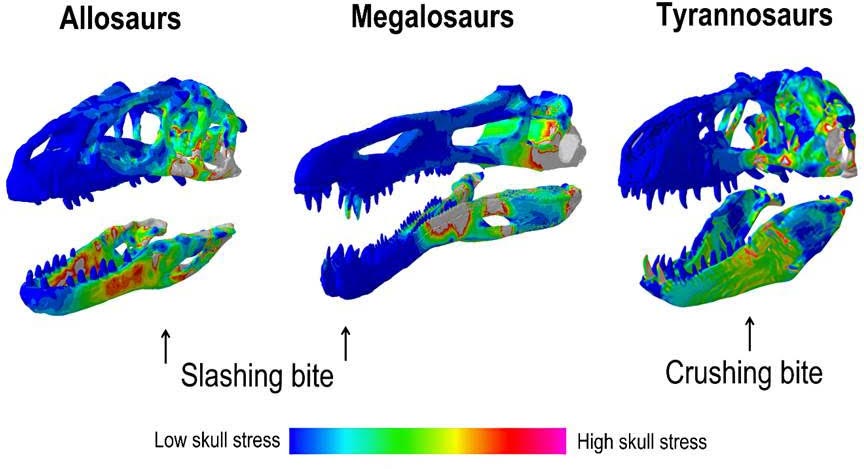
“Tyrannosaurids like T. rex had skulls that were optimized for high bite forces at the cost of higher skull stress,” Rowe says. “But in some other giants, like Giganotosaurus, we calculated stress patterns suggesting a relatively lighter bite. It drove home how evolution can produce multiple ‘solutions’ to life as a large, carnivorous biped.”
Bigger Didn’t Always Mean Stronger
Skull stress didn’t show a pattern of increase with size. Some smaller therapods experienced greater stress than some larger species due to increased muscle volume and bite forces. The findings show that being a predatory biped didn’t always equate to being a bone-crushing giant. Unlike T. rex, some dinosaurs, including the spinosaurs and allosaurs, became giants while maintaining weaker bites more suited for slashing at prey and stripping flesh.
“I tend to compare Allosaurus to a modern Komodo dragon in terms of feeding style,” Rowe says. “Large tyrannosaur skulls were instead optimized like modern crocodiles with high bite forces that crushed prey. This biomechanical diversity suggests that dinosaur ecosystems supported a wider range of giant carnivore ecologies than we often assume, with less competition and more specialization.”
Reference: “Carnivorous dinosaur lineages adopt different skull performances at gigantic size” by Andre J. Rowe and Emily J. Rayfield, , Current Biology.
DOI: 10.1016/j.cub.2025.06.051
This research was supported by funding from the Biotechnology and Biological Sciences Research Council.
Never miss a breakthrough: Join the SciTechDaily newsletter.
Follow us on Google and Google News.
2 Comments
This isn’t exactly a groundbreaking new discovery, this has been widely accepted in the field of paleontology for decades.
Hm, evolved. All the dozens found tyrannosaurs are 100 per cent tyrannosaurs, neither less nor more. As to the age when they lived, I know of at least three their finely preserved track(way)s, which certainly couldn’t last much long. Suffice to google for them, and turn on logic.