
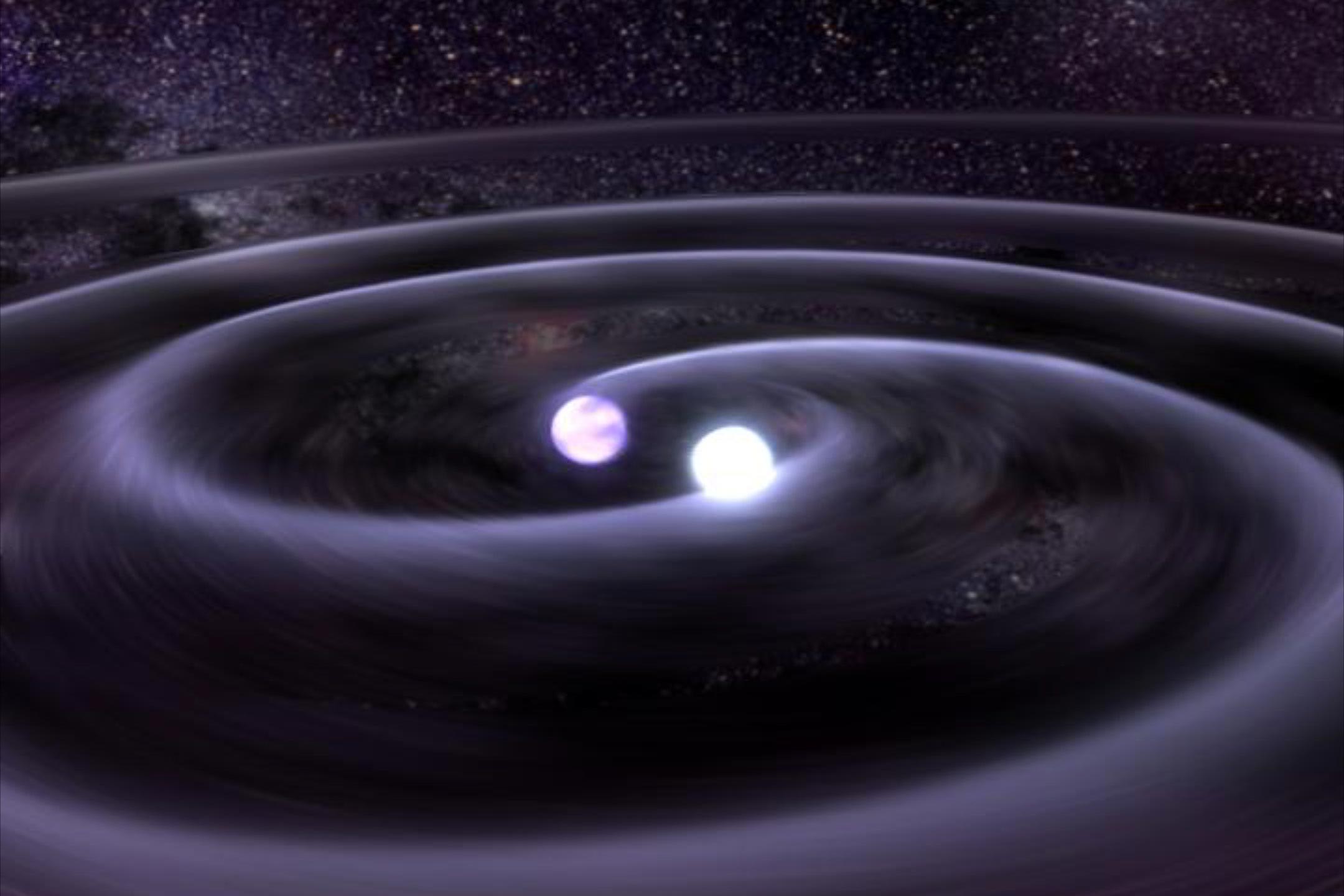
Tiny diamond crystals could be used as an incredibly sensitive and small gravitational detector capable of measuring gravitational waves, suggests new UCL-led research.
Predicted by Einstein’s general theory of relativity, gravitational waves are ripples in space-time generated by certain movements of massive objects. They are important to study because they allow us to detect events in the universe that would otherwise leave little or no observable light, like black hole collisions.
In 2015, the Laser Interferometer Gravitational-Wave Observatory (LIGO) and the Virgo collaborations made the first direct observation of gravitational waves. The waves were emitted from a 1.3 billion-year-old collision between two supermassive black holes and were detected using 4-km-long (2.5-mile-long) optical interferometers as the event caused ripples in the Earth’s space-time.
Researchers from UCL, University of Groningen, and University of Warwick propose a detector based on quantum technology that is 4000 times smaller than the detectors currently in use and could detect mid-frequency gravitational waves.
The study, published today in New Journal of Physics, details how state-of-the-art quantum technologies and experimental techniques can be used to build a detector capable of measuring and comparing the strength of gravity in two locations at the same time.
It would work by using nano-scale diamond crystals weighing 10-17 kg. The crystals would be placed in a quantum spatial superposition using Stern-Gerlach interferometry. Spatial superposition is a quantum state where the crystals exist in two different places at the same time.
Quantum mechanics allows for an object, however big, to be spatially delocalized in two different places at once. Despite being counter-intuitive and in direct conflict with our everyday experience, the superposition principle of quantum mechanics has been experimentally verified using neutrons, electrons, ions, and molecules.
Corresponding author Ryan Marshman (UCL Physics & Astronomy and UCLQ), said: “Quantum gravitational sensors already exist using the superposition principle. These sensors are used to measure Newtonian gravity and make for incredibly accurate measurement devices. The quantum masses used by current quantum gravitational sensors are much smaller such as atoms, but experimental work is progressing the new interferometry techniques needed to make our device work to study gravitational waves.
“We found that our detector could explore a different range of frequencies of gravitational waves compared to LIGO. These frequencies might only be available if scientists build large detectors in space with baselines that are hundreds of thousands of kilometers in size.”
The team envisions that their proposed smaller detector could be used to build a network of detectors that would be capable of picking out gravitational wave signals from background noise. This network would also be potentially useful giving precise information on the location of the objects that are creating the gravitational waves.
Co-author, Professor Sougato Bose (UCL Physics & Astronomy and UCLQ), said: “While the sensor we have proposed is ambitious in its scope, there does not appear to be any fundamental or insurmountable obstacle to its creation using current and near-future technologies.
“All the technical elements to make this detector have been individually realized in different experiments around the world: the forces required, the quality of the vacuum required, the method to place the crystals in superposition. The difficulty will come in putting it all together and making sure the superposition stays intact.”
The next step is for the team to collaborate with experimentalists to start building prototypes of the device. Importantly, the same class of detectors can also contribute to detecting whether gravity is a quantum force, as shown in recent work at UCL and elsewhere.
Ryan Marshman said: “Indeed our initial ambition was to develop the device to explore nonclassical gravity. But, since it would be a considerable effort to realize such a device, we thought it was really important to examine the efficacy of such a device also for measuring very weak classical gravity such as gravitational waves and found out that it is promising!”
Reference: “Mesoscopic Interference for Metric and Curvature (MIMAC) & Gravitational Wave Detection” by Ryan James Marshman, Anupam Mazumdar, Gavin Morley, Peter F Barker, Steven Hoekstra and Sougato Bose, Accepted 23 June 2020, New Journal of Physics.
DOI: 10.1088/1367-2630/ab9f6c
The work was funded by the Netherlands Organization for Scientific Research, the Royal Society, and the Engineering and Physical Sciences Research Council.
Never miss a breakthrough: Join the SciTechDaily newsletter.
Follow us on Google and Google News.
4 Comments
You are sending this page onto my computer 20 or more times a day.
I cannot close the page you send me without also closing the work I’m doing.
There is no way to unsubscribe.
I am filing a complaint with the FCC
Wheeler – Weiss conflict
According to this article gravitational waves were first observed directly in 2015, when the LIGO observatory in the US picked the emission from a pair of merging black holes. These black holes broadcast a series of ripples through space-time that caused the pairs of perpendicular arms making up LIGO’s interferometers to undergo a series of miniscule expansions and contractions. Those tiny changes were registered as variations in the interference between laser beams sent along the arms.
Above description shows that the STC can indeed sustain / send ripples to other place because it is flexible – according to John Wheelr’s famous quotation. But Rainer Weiss asserted in the interview that STC is very stiff and cannot be squished, visit – http://www.nobelprize.org/prizes/physics/2017/weiss/interview/ .
In short, it is high time astrophysicists decide whether STC is Real or Imaginary and whether it is Flexible or Stiff before taking a decision on / funding / refunding / no funding / a particular technique.
We live in a quantum world and the brain is a giant quantum computer that decodes it and makes us live relatively. When we take DMT we go into the quantum world as our relative mind becomes disengaged. A quantum computer as you know can be made very small. Our brains are small, with all of known history encoded In it.
Never heard this idea!
Uroborus
Indeed it will be very interesting to see how a quantum phenomena like superposition reacts to a gravitation field that is different in each of the locations