
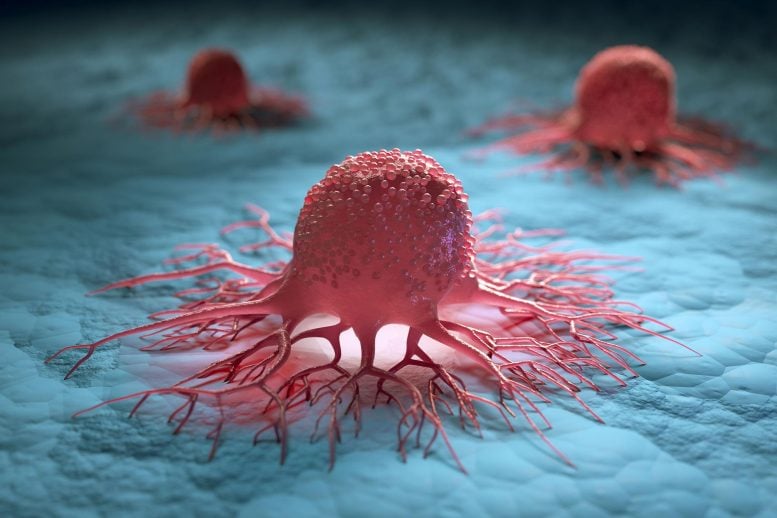
Cancer cells “hibernate” to survive chemotherapy using a primitive survival program. Targeting this state may prevent resistance and regrowth.
Tapping into an ancient evolutionary survival mechanism, cancer cells enter into a sluggish, slow-dividing state to survive the harsh environment created by chemotherapy or other targeted agents.
In research published on January 7, 2021, in Cell, Princess Margaret Scientist Dr. Catherine O’Brien and team discovered that when under threat, all cancer cells — rather than just a subset — have the ability to transition into this protective state, where the cells “rest” until the threat, or chemotherapy, is removed.
It is the first study to identify that cancer cells hijack an evolutionary conserved program to survive chemotherapy. Furthermore, the researchers show that novel therapeutic strategies aimed at specifically targeting cancer cells in this slow-dividing state can prevent cancer regrowth.
Hijacking a Dormancy Program from Nature
“The tumor is acting like a whole organism, able to go into a slow-dividing state, conserving energy to help it survive,” says Dr. O’Brien, who is also an Associate Professor in the Department of Surgery at the University of Toronto.
“There are examples of animals entering into a reversible and slow-dividing state to withstand harsh environments.
“It appears that cancer cells have craftily co-opted this same state for their survival benefit.”
Cancer Cells Hibernate Like Bears
Dr. Aaron Schimmer, Director of the Research Institute and Senior Scientist at Princess Margaret Cancer Centre, notes that this research shows that cancer cells hibernate, like “bears in winter.”
He adds: “We never actually knew that cancer cells were like hibernating bears. This study also tells us how to target these sleeping bears so they don’t hibernate and wake up to come back later, unexpectedly.
“I think this will turn out to be an important cause of drug resistance, and will explain something we did not have a good understanding of previously.”
Using human colorectal cancer cells, the researchers treated them with chemotherapy in a petri dish in the laboratory.
This induced a slow-dividing state across all the cancer cells in which they stopped expanding, requiring little nutrition to survive. As long as the chemotherapy remained in the dish, the cancer cells remained in this state.
Borrowing a Survival Strategy from Embryos
In order to enter this low-energy state, the cancer cells have co-opted an embryonic survival program used by more than 100 species of mammals to keep their embryos safe inside their bodies in times of extreme environmental conditions, such as high or low temperatures or lack of food.
In this state, there is minimal cell division, greatly reduced metabolism, and embryo development is put on hold. When the environment improves, the embryo is able to continue normal development, with no adverse effects on the pregnancy.
Dr. O’Brien, who is a surgeon specializing in gastrointestinal cancer, explains that cancer cells under attack by the harsh chemotherapy environment are able to adopt the embryonic survival strategy.
“The cancer cells are able to hijack this evolutionarily conserved survival strategy, even as it seems to be lost to humans,” she says, adding that all of the cancer cells enter this state in a co-ordinated manner, in order to survive.
Remembering a talk three years ago on cellular mechanisms driving this survival strategy in mouse embryos, Dr. O’Brien had an “Aha!” insight.
“Something clicked for me when I heard that talk,” she said. “Could the cancer cells be hijacking this survival mechanism to survive chemotherapy?”
So Dr. O’Brien contacted the Toronto Mt. Sinai Hospital researcher Dr. Ramalho-Santos who had given the original talk at Princess Margaret.
She compared the gene expression profile of the cancer cells in the chemotherapy-induced, slow-dividing state to the paused mouse embryos in Dr. Ramalho-Santos’ lab, and found that they were strikingly similar.
Blocking Autophagy: A New Weakness Found
Similar to embryos, cancer cells in the slow-dividing state require activation of the cellular process called autophagy, meaning “self-devouring”. This is a process in which the cell “devours” or destroys its own proteins or other cellular components to survive in the absence of other nutrients.
Dr. O’Brien tested a small molecule that inhibits autophagy, and found that the cancer cells did not survive. The chemotherapy killed the cancer cells without this protective mechanism.
“This gives us a unique therapeutic opportunity,” says Dr. O’Brien. “We need to target cancer cells while they are in this slow-cycling, vulnerable state before they acquire the genetic mutations that drive drug resistance.
“It is a new way to think about resistance to chemotherapy and how to overcome it.”
Reference: “Colorectal Cancer Cells Enter a Diapause-like DTP State to Survive Chemotherapy” by Sumaiyah K. Rehman, Jennifer Haynes, Evelyne Collignon, Kevin R. Brown, Yadong Wang, Allison M.L. Nixon, Jeffrey P. Bruce, Jeffrey A. Wintersinger, Arvind Singh Mer, Edwyn B.L. Lo, Cherry Leung, Evelyne Lima-Fernandes, Nicholas M. Pedley, Fraser Soares, Sophie McGibbon, Housheng Hansen He, Aaron Pollet, Trevor J. Pugh, Benjamin Haibe-Kains, Quaid Morris, Miguel Ramalho-Santos, Sidhartha Goyal, Jason Moffat and Catherine A. O’Brien, 7 January 2021, Cell.
DOI: 10.1016/j.cell.2020.11.018
Dr. Ramalho-Santos, who is also a Professor in the Department of Molecular Genetics, University of Toronto, is a co-senior author on this paper.
This research was supported by funds from the Canadian Institutes for Health Research and the Terry Fox Research Institute.
Dr. Jason Moffat, Professor, Donnelly Centre, University of Toronto, is a shareholder in Northern Biologics and Pionyr Immunotherapeutics, and advisor for Century Therapeutics and Aelian Biotechnology.
Never miss a breakthrough: Join the SciTechDaily newsletter.
Follow us on Google and Google News.