
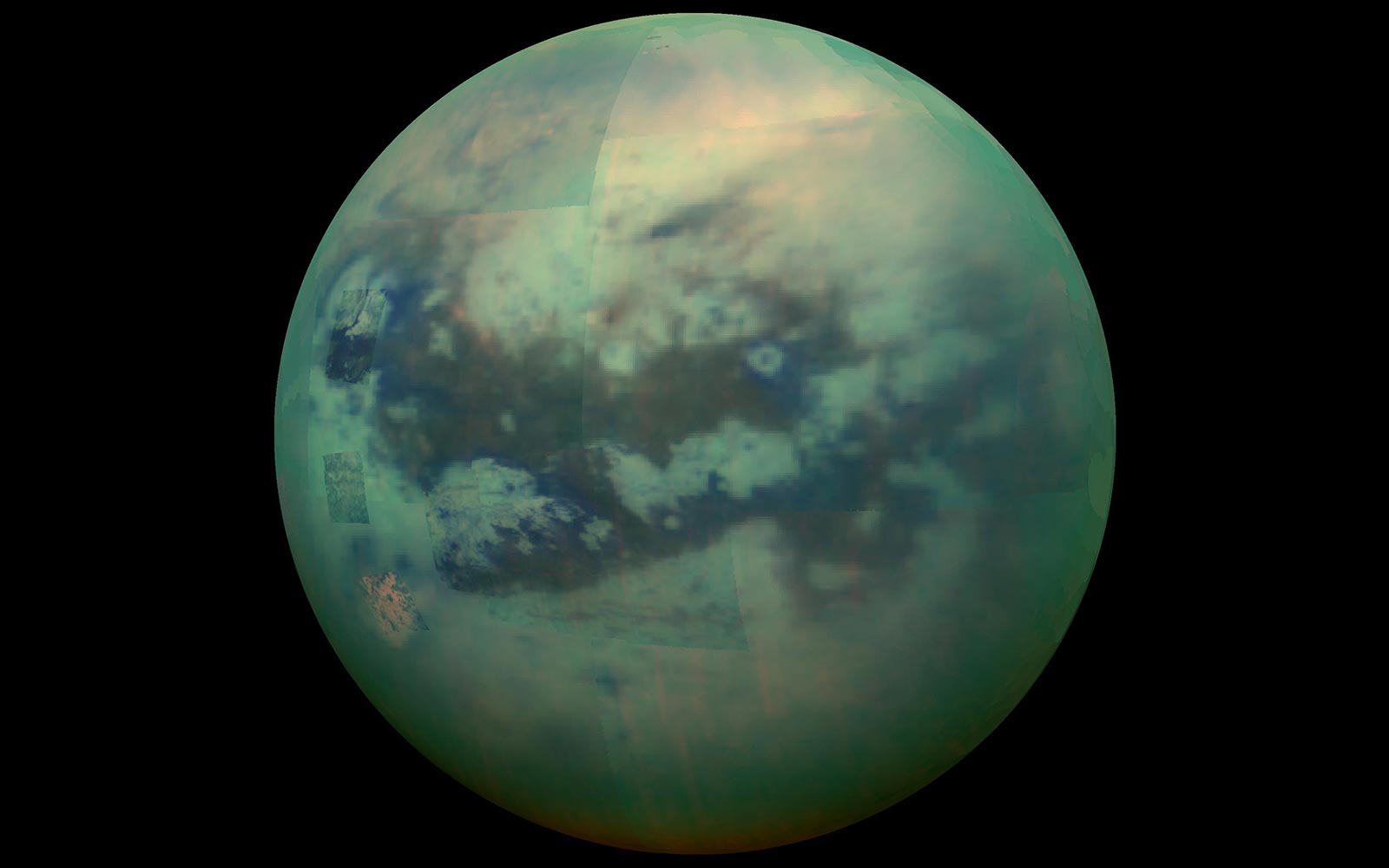
A team led by a University of Hawaii at Mānoa chemistry professor and researcher has been able to provide answers to key questions about the surface of Saturnʻs moon Titan.
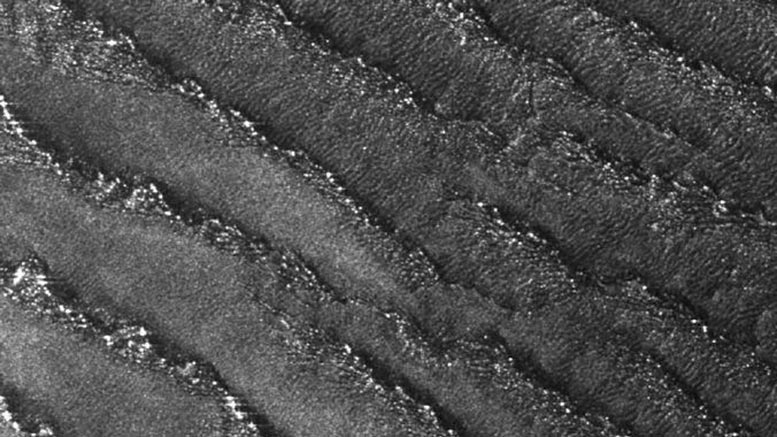
Physical chemist Ralf I. Kaiser and fellow researchers examined remote sensing data regarding NASA’s Cassini–Huygens mission to Titan—the only solar system body besides Earth with a solid surface, lakes, and a thick atmosphere with a pressure of about 1.5 atmospheres at surface level. Images and data from Cassini-Huygens exposed the existence of vast longitudinal dunes on Titan’s surface across the equatorial deserts reaching heights of up to 100 meters, close to the size of the Egyptian pyramids of Giza. Whereas Earth’s dunes are made of silicates or the largest class of minerals, imaging studies revealed that Titan’s dunes contain dark organics of until now undetermined origin and chemical composition.
The University of Hawaii Mānoa team, which also consisted of Matthew Abplanalp, a former chemistry graduate student at UH’s W.M. Keck Research Laboratory in Astrochemistry, exposed acetylene ice—a chemical that is used on Earth in welding torches and exists at Titan’s equatorial regions—at low temperatures to proxies of high-energy galactic cosmic rays. The researchers exposed a rapid cosmic-ray-driven chemistry that converts simple molecules like acetylene to more complex organic molecules like benzene and naphthalene—a compound which is found in mothballs—on Titan’s surface. These processes also happen in the interstellar medium—the space between stars—on hydrocarbon-rich layers of interstellar nanoparticles.
“Titan’s dunes represent the dominating surface sink of carbon in Titan’s organic chemistry,” said Abplanalp, a current researcher at the Naval Air Warfare Center Weapons Division at China Lake. “Therefore, unraveling the origin and chemical pathways to form this organic dune material is vital not only to understand Titan’s chemical evolution, but also to grasp how alike the chemistries on Titan and on Earth might have been like before life emerged on Earth 3.5 million years ago.”
“These processes eventually furnish the molecular building blocks not only for Titan’s organic dunes, but also for organics on airless bodies in general such as on Kuiper Belt Objects like dwarf planet Makemake,” outlined Kaiser. “The low temperature synthesis of polycyclic aromatic hydrocarbons (PAHs) from acetylene ices represents a fundamental shift from currently accepted perceptions that PAH formation takes place solely in the gas phase at elevated temperatures of a few 1,000 K such as in combustion processes.”
Findings impact next Titan mission
These findings, which were published in Science Advances on October 16, 2019, will have unprecedented implications for the next space mission to Titan. NASA aims to land a flying robot, Dragonfly, on the surface of Titan, the top target in the search for alien life and its molecular precursors. The car-sized quadcopter, equipped with instruments capable of identifying large organic molecules, is slated to launch on a rocket in 2026, arrive at its destination in 2034, and then fly to multiple locations hundreds of miles apart. Dragonfly will land near Titan’s equator close to the organic dunes thus providing an in situ glimpse of potentially biorelevant organics at a frozen stage—boldly going where no one has gone before.
“Overall, this study advances our understanding of the complex organics and fundamental chemical processing of simple molecules in deep space and provides a scientifically sound and proven mechanism of formation of aromatic structures in extreme environments in low temperature ices,” Kaiser concluded. “Since Titan is nitrogen-rich, the incorporation of nitrogen in these PAHs may also lead to carbon-nitrogen moieties (parts of a molecule) prevailing in contemporary biochemistry such as in DNA- and RNA- based nitrogen-bases.”
Reference: “Low-temperature synthesis of polycyclic aromatic hydrocarbons in Titan’s surface ices and on airless bodies” by Matthew J. Abplanalp, Robert Frigge and Ralf I. Kaiser, 16 October 2019, Science Advances.
DOI: 10.1126/sciadv.aaw5841
Never miss a breakthrough: Join the SciTechDaily newsletter.
Follow us on Google and Google News.