
Close Menu
    Facebook X (Twitter) Instagram
    SciTechDaily
    • Biology
    • Chemistry
    • Earth
    • Health
    • Physics
    • Science
    • Space
    • Technology
    Facebook X (Twitter) Pinterest YouTube RSS
    SciTechDaily
    Home»Technology»TEMPO Space-Based Pollution Monitoring Instrument Passes NASA Review
    Technology

    TEMPO Space-Based Pollution Monitoring Instrument Passes NASA Review

    By Harvard-Smithsonian Center for AstrophysicsMay 13, 20151 Comment3 Mins Read
    Facebook Twitter Pinterest Telegram LinkedIn WhatsApp Email Reddit
    Share
    Facebook Twitter LinkedIn Pinterest Telegram Email Reddit
    Pollution Monitoring Instrument Passes Critical NASA Review
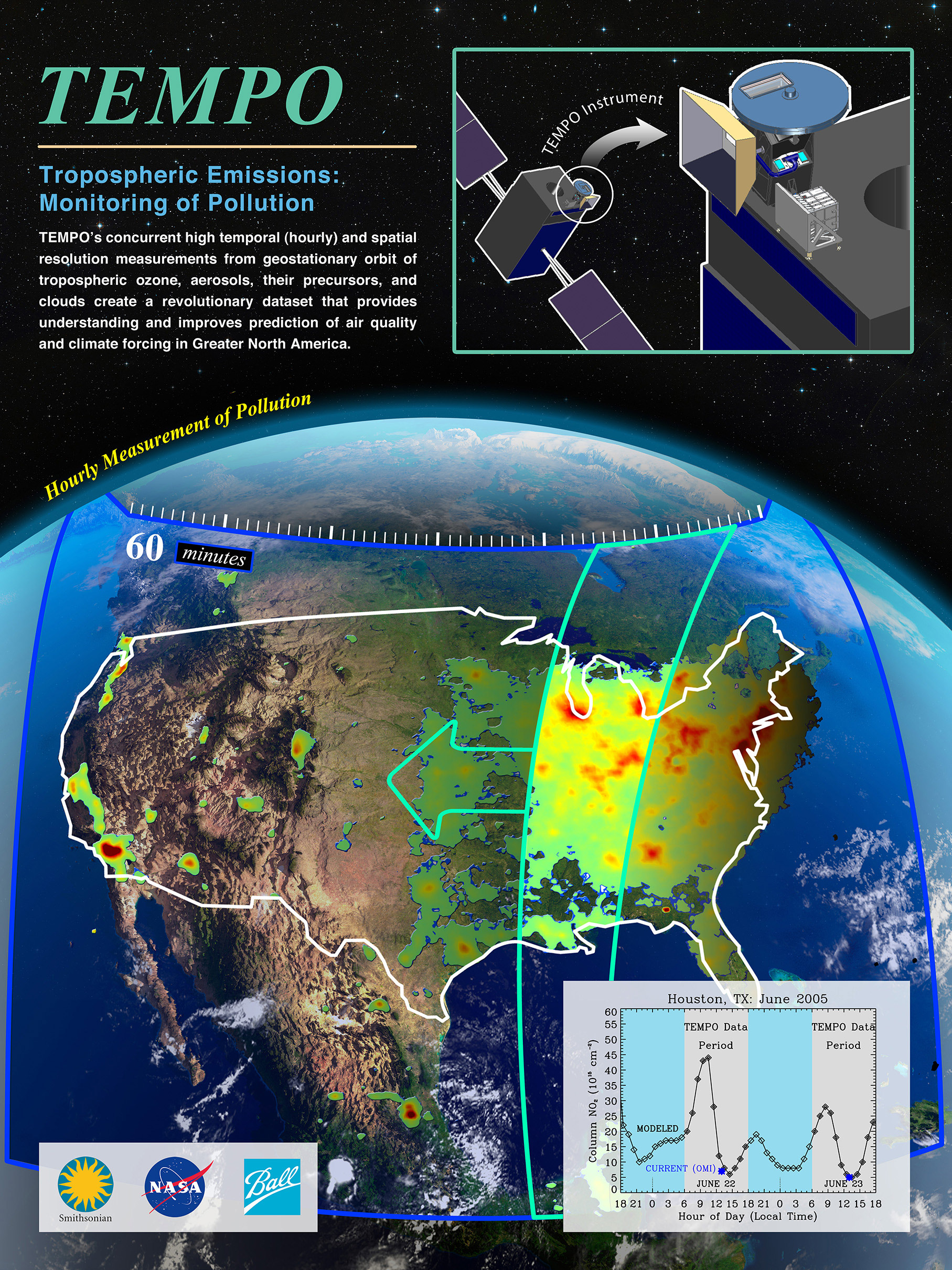
    Scheduled for completion in 2017, TEMPO is a pollution monitoring instrument that will ride aboard a commercial satellite that’s to be launched no later than 2021. Credit: NASA

    A new space-based instrument that will monitor major air pollutants across North America on an hourly basis has successfully completed a critical review by NASA.

    The Tropospheric Emissions: Monitoring of Pollution (TEMPO) instrument passed a major milestone on April 10, 2015, by successfully completing a critical NASA confirmation review. It has been confirmed by NASA’s Science Mission Directorate to continue into the Phase C part of the project, in which the team completes the design that meets the science and measurement requirements, fabricates the instrument, and develops the ground system. TEMPO will measure North American air pollution hourly from geostationary orbit.

    TEMPO will be completed in 2017 at a cost of no more than $93.2 million, excluding the launch vehicle and integration to the selected satellite platform. It will share a ride on a commercial satellite as a hosted payload.

    Once deployed, TEMPO will acquire spectra of the Earth’s atmosphere in ultraviolet and visible wavelengths. These will provide measurements of key pollution concentrations in the Earth’s lower atmosphere, the troposphere. Measurements include ozone, nitrogen dioxide, formaldehyde, sulfur dioxide, and aerosols.

    TEMPO was competitively selected as the first NASA Earth Venture Instrument. Earth Venture missions, part of the Earth System Science Pathfinder program, are small, targeted science investigations that complement NASA’s larger research missions. TEMPO is led by Principal Investigator Kelly Chance and Deputy Principal Investigator Xiong Liu, both at the Smithsonian Astrophysical Observatory in Cambridge, MA. The Instrument Project Manager, Wendy Pennington, and the Project Scientist, David Flittner, are at NASA Langley Research Center in Hampton, VA.

    “The team is looking forward to continuing to the next phase of the project to build the TEMPO instrument that will serve as the North American geostationary component for air-quality monitoring,” said Pennington.

    According to Chance, “TEMPO exploits thirty years of our development of ultraviolet and visible atmospheric spectroscopy to make air quality measurements at revolutionary spectral and spatial scales.”

    The TEMPO instrument is being built by Ball Aerospace & Technologies Corporation under Project Manager Dennis Nicks. In addition to the Smithsonian Astrophysical Observatory and NASA Langley Research Center, TEMPO includes NASA Goddard Space Flight Center, the Environmental Protection Agency, the National Oceanic and Atmospheric Administration, Carr Astronautics, RT Solutions, and a number of U.S. universities. It also has strong Canadian and Mexican involvement in the Science Team.

    Headquartered in Cambridge, Massachusetts, the Harvard-Smithsonian Center for Astrophysics (CfA) is a joint collaboration between the Smithsonian Astrophysical Observatory and the Harvard College Observatory. CfA scientists, organized into six research divisions, study the origin, evolution, and ultimate fate of the universe.

    Never miss a breakthrough: Join the SciTechDaily newsletter.
    Follow us on Google and Google News.

    Harvard-Smithsonian Center for Astrophysics NASA Pollution TEMPO
    Share. Facebook Twitter Pinterest LinkedIn Email Reddit

    Related Articles

    NASA Explores OMEGA System for Alternative Aviation Fuels

    NuSTAR’s 9,000 Mirrors are Only 200 Microns Thick

    NASA Engineers Test J-2X Powerpack

    Researchers Discover First Intermediate-Mass Black Hole

    SCaN Testbed Headed for International Space Station Later This Year

    NASA Searching for Green Propellant Technology

    NASA Mobile Launcher Reacted as Expected During Move to Launch Pad 39B

    NASA Reviews Ideas for Greener Aircraft

    “Pollution Glue” May Improve London’s Air Quality

    1 Comment

    1. John on May 16, 2015 5:16 pm

      another fantastic achievement by NASA!

      Reply
    Leave A Reply Cancel Reply

    • Facebook
    • Twitter
    • Pinterest
    • YouTube

    Don't Miss a Discovery

    Subscribe for the Latest in Science & Tech!

    Trending News

    Popular Supplement Ingredient Linked to Shorter Lifespan in Men

    Scientists May Have Found a Way To Repair Nerve Damage in Multiple Sclerosis

    “Totally Unexpected” – Scientists Discover Pancreatic Cancer’s Fatal Addiction

    A Strange Quantum Effect May Explain One of Biology’s Greatest Mysteries

    James Webb Telescope Reveals the Universe’s Hidden Cosmic Web in Stunning Detail

    Scientists Identify Simple Supplement That Greatly Reduces Alzheimer’s Damage

    You May Have a Dangerous Type of Cholesterol Even if Your Tests Look Normal

    Your Blood Pressure Reading Could Be Wrong Because of One Simple Mistake

    Follow SciTechDaily
    • Facebook
    • Twitter
    • YouTube
    • Pinterest
    • Newsletter
    • RSS
    SciTech News
    • Biology News
    • Chemistry News
    • Earth News
    • Health News
    • Physics News
    • Science News
    • Space News
    • Technology News
    Recent Posts
    • After 50 Years of Mystery, Researchers Identify New Human Blood Group
    • Leading Climate Scientist Rebuts “Factually Incorrect” US Government Climate Claims
    • You’re Breathing Plastic: Study Finds 4% of City Air Pollution Is Microplastics
    • Cancer Mystery Solved: Scientists Discover How Melanoma Becomes “Immortal”
    • Scientists Uncover Cancer-Fighting Power of Popular Fatty Liver Drug
    Copyright © 1998 - 2026 SciTechDaily. All Rights Reserved.
    • Science News
    • About
    • Contact
    • Editorial Board
    • Privacy Policy
    • Terms of Use

    Type above and press Enter to search. Press Esc to cancel.