

Close Menu
    Facebook X (Twitter) Instagram
    SciTechDaily
    • Biology
    • Chemistry
    • Earth
    • Health
    • Physics
    • Science
    • Space
    • Technology
    Facebook X (Twitter) Pinterest YouTube RSS
    SciTechDaily
    Home»Chemistry»The Future of Solar Cells and More – Japanese Chemists Develop Glowing, Self-Healing Material
    Chemistry

    The Future of Solar Cells and More – Japanese Chemists Develop Glowing, Self-Healing Material

    By RIKENApril 10, 2024No Comments3 Mins Read
    Facebook Twitter Pinterest Telegram LinkedIn WhatsApp Email Reddit
    Share
    Facebook Twitter LinkedIn Pinterest Telegram Email Reddit
    Quantum States in 2D Materials Concept Art
    A breakthrough self-healing, fluorescent material developed by RIKEN CSRS researchers offers potential for more durable organic solar cells and broad applications, aligning with sustainable consumption and production goals. (Artist’s concept).

    A research team at the RIKEN Center for Sustainable Resource Science (CSRS) has succeeded in developing a self-healing material that is also capable of emitting a high amount of fluorescence when absorbing light. Detailed in the Journal of the American Chemical Society, this development paves the path for inventing new materials like organic solar cells, offering enhanced durability compared to existing versions.

    In 2019, Zhaomin Hou and his team at RIKEN CSRS successfully copolymerized ethylene and anisylpropylene using a rare-earth metal catalyst. The resulting binary copolymer displayed remarkable self-healing properties against damage. The copolymer’s soft components, alternating units of ethylene and anisylpropylene, coupled with hard crystalline units of ethylene-ethylene chains, acted as physical cross-linking points, forming a nano-phase-separated structure that proved crucial for self-healing.
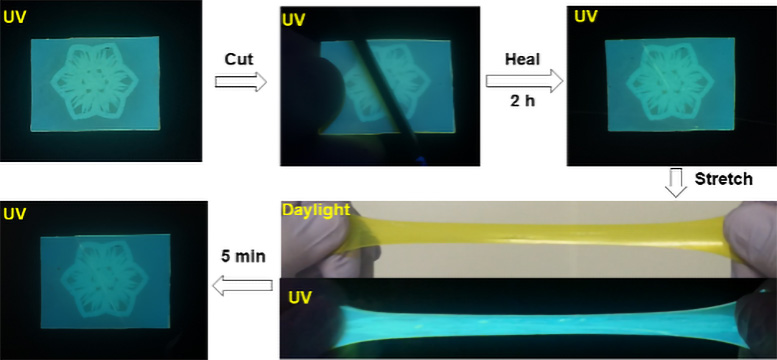
    Tough and Fluorescent Self Healing Material
    Fluorescence and self-healing property of the flower-printed film of terpolymer composed of ethylene, anisylpropylene, and pyrenylethenyl-substituted styrene. Credit: RIKEN

    Building upon this success, they incorporated a luminescent unit, styrylpyrene, into a monomer and then formed polymers that also included anisylpropylene and ethylene. This process led to the synthesis, in a single step, of a self-healing material with fluorescence characteristics.

    “Fluorescent materials are very useful, as they can be used for organic light-emitting diodes (OLEDs), organic field-effect transistors (OFETs), and solar cells. One of the main problems of these materials, however, is their short lifetime during usage. Our new material can be expected to afford a longer lifetime of the products and increased reliability,” says Masayoshi Nishiura, Hou’s collaborator for this study.

    Enhanced Properties and Applications

    There was an added surprise. The resulting copolymer not only proved to be tough, but also exhibited self-healing without external stimuli or energy. Its tensile strength fully recovered within 24 hours, demonstrating a high self-healing speed compared to binary copolymers. The material was able to self-heal even in water, acidic, and alkaline solutions giving it potential uses in a variety of environments.

    The copolymer’s network structure, which involves physical cross-linking points formed by the styrylpyrene units and crystalline ethylene-ethylene nanodomains and soft segments composed of the alternating units, facilitated the self-repair.

    The material also showed an added property. The research team was able to successfully transfer a two-dimensional image onto the fluorescent self-healing film through photolithography. Although the image remained invisible under natural light, it became recognizable under ultraviolet light, suggesting potential applications for the film as an information storage device. The film maintained its excellent self-healing and elastomeric properties even with the images.

    “The material we synthesized, through a one-step reaction, gave us the ability to control its optical and mechanical properties by adjusting the composition of the monomer. We think it could contribute significantly to the development of novel functional materials with high self-healing capabilities in various practical environments,” says Hou. This research aligns with the United Nations’ Sustainable Development Goals (SDGs), particularly contributing to “Goal 12: Ensure sustainable consumption and production patterns.”

    Reference: “Synthesis of Tough and Fluorescent Self-Healing Elastomers by Scandium-Catalyzed Terpolymerization of Pyrenylethenylstyrene, Ethylene, and Anisylpropylene” by Lin Huang, Yang Yang, Jingjing Shao, Gang Xiong, Haobing Wang, Masayoshi Nishiura and Zhaomin Hou, 18 January 2024, Journal of the American Chemical Society.
    DOI: 10.1021/jacs.3c12342

    Never miss a breakthrough: Join the SciTechDaily newsletter.
    Follow us on Google and Google News.

    Chemical Engineering Materials Science Popular RIKEN
    Share. Facebook Twitter Pinterest LinkedIn Email Reddit

    Related Articles

    This Wonder Material Could Revolutionize Renewable Energy

    Revolutionizing EV Batteries: Innovative New Binder Doubles Performance

    Scientists Astonished by Strange Material That Can Be Made Like Plastic but Conducts Like Metal

    New Insulation Material Enables More Efficient Electricity Distribution

    Polymer-Eating Enzymes Make “Biodegradable” Plastics Truly Compostable

    Solar Flow Battery: Single Device Generates, Stores and Redelivers Renewable Electricity From the Sun

    New Material Provides an Elastic “Second Skin”

    Scientists Synthesize an Entirely New Form of Silicon

    Liquid Metal Used in Ultra-Stretchable Conducting Wires

    Leave A Reply Cancel Reply

    • Facebook
    • Twitter
    • Pinterest
    • YouTube

    Don't Miss a Discovery

    Subscribe for the Latest in Science & Tech!

    Trending News

    Collapsing Plasma May Hold the Key to Cosmic Magnetism

    This Breakthrough Solar Panel Generates Power From Both Sunlight and Raindrops

    Scientists Uncover New Metabolic Effects Beyond Weight Loss of Mounjaro

    Scientists Discover Cancer Tumors Are “Addicted” to This Common Antioxidant

    1,800 Miles Down: Scientists Uncover Mysterious Movements at the Edge of Earth’s Core

    Scientists Discover Hidden “Good Fats” in Green Rice That Could Transform Nutrition

    Your Child’s Clothes Could Contain Toxic Lead, Study Finds

    Researchers Break a 150-Year-Old Math Law With a Surprising Donut Discovery

    Follow SciTechDaily
    • Facebook
    • Twitter
    • YouTube
    • Pinterest
    • Newsletter
    • RSS
    SciTech News
    • Biology News
    • Chemistry News
    • Earth News
    • Health News
    • Physics News
    • Science News
    • Space News
    • Technology News
    Recent Posts
    • Scientists Discover 132-Million-Year-Old Dinosaur Tracks on South Africa’s Coast
    • Scientists Uncover the Secret Ingredient Behind the Spark That May Have Started Life on Earth
    • Natural Oils vs. Antibiotics: The Swine Study That Could Change Farming
    • The Biggest Volcanic Event in Earth’s History Transformed an Entire Oceanic Plate
    • Scientists Warn: Humanity Has Pushed the Planet Past Its Limits
    Copyright © 1998 - 2026 SciTechDaily. All Rights Reserved.
    • Science News
    • About
    • Contact
    • Editorial Board
    • Privacy Policy
    • Terms of Use

    Type above and press Enter to search. Press Esc to cancel.