
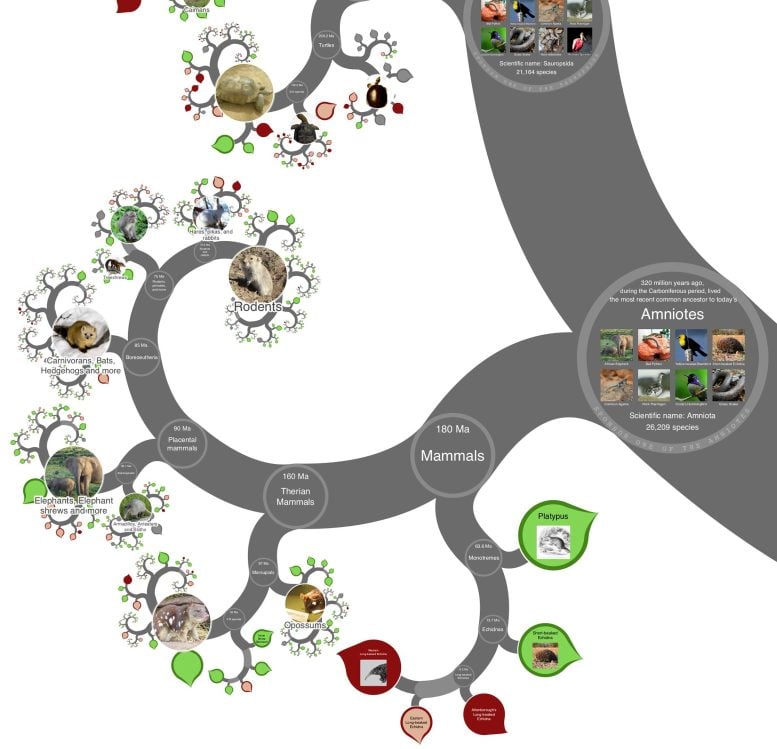
OneZoom is a one-stop site for exploring all life on Earth, its evolutionary history, and how much of it is threatened with extinction.
The OneZoom explorer – available at onezoom.org – maps the connections between 2.2 million living species, the closest thing yet to a single view of all species known to science. The interactive tree of life allows users to zoom in to any species and explore its relationships with others, in a seamless visualization on a single web page. The explorer also includes images of over 85,000 species, plus, where known, their vulnerability to extinction.
OneZoom was developed by Imperial College London biodiversity researcher Dr. James Rosindell and University of Oxford evolutionary biologist Dr. Yan Wong. In a paper published today in Methods in Ecology and Evolution, Drs Wong and Rosindell present the result of over ten years of work, gradually creating what they regard as “the Google Earth of biology.”
Dr. Wong, from the Big Data Institute at the University of Oxford, said: “By developing new algorithms for visualization and data processing, and combining them with ‘big data’ gathered from multiple sources, we’ve created something beautiful. It allows people to find their favorite living things, be they golden moles or giant sequoias, and see how evolutionary history connects them together to create a giant tree of all life on Earth.”
Dr. Rosindell, from the Department of Life Sciences at Imperial, said: “We have worked hard to make the tree easy to explore for everyone, and we also hope to send a powerful message: that much of our biodiversity is under threat.”
The ‘leaves’ representing each species on the tree are color-coded depending on their risk of extinction: green for not threatened, red for threatened, and black for recently extinct. However, most of the leaves on the tree are grey, meaning they have not been evaluated, or scientists don’t have enough data to know their extinction risk. Even among the species described by science, only a tiny fraction have been studied or have a known risk of extinction.
Big Data Integration Unlocks Evolutionary Insights
Dr. Wong added: “It’s extraordinary how much research there is still to be done. Building the OneZoom tree of life was only possible through sophisticated methods to gather and combine existing data – it would have been impossible to curate all this by hand.”
The OneZoom explorer is configured to work with touchscreens, and the developers have made the software free to download and use by educational organizations such as museums and zoos.
Dr. Rosindell commented: “Two million species can feel like a number too big to visualize, and no museum or zoo can hold all of them! But our tool can help represent all Earth’s species and allow visitors to connect with their plight. We hope that now this project is complete and available, many venues will be interested in using it to complement their existing displays.”
Education Through Evolution and Conservation
Drs Rosindell and Wong have also set up a OneZoom charity with the aim of using their tree of life to “advance the education of the public in the subjects of evolution, biodiversity, and conservation of the variety of life on Earth.”
Uniquely, to support this charity, each leaf on the tree is available for sponsorship, allowing anyone to ‘adopt’ a species and enabling OneZoom to continue its mission. More than 800 leaves have currently been sponsored by individuals and selected organizations, many with personal messages of how they feel connected to the conservation of nature.
The team have also integrated the tree with data from the Wikipedia project to reveal the ‘popularity’ of every species, based on how often their Wikipedia page is viewed. Dr. Wong said: “Perhaps unsurprisingly, humans come out on top, but it has swapped places a few times with the second most popular: the grey wolf – the ‘species’ that includes all domestic dogs.”
In the plant world, cannabis comes out on top, followed by cabbage, the potato, and the coconut. The most popular ray-finned fishes are sport fishing species, particularly salmon and trout.
Now the tree is complete, the team hopes to create bespoke ‘tours’ and experiences of species connected in imaginative new ways – such as tours of iridescent animals, medicinal plants, or even species named after celebrities. They have created a special screen capture tool for easy saving and sharing of user-generated tours.
Dr. Rosindell said: “With OneZoom, we hope to give people a completely new way to appreciate evolutionary history and the vastness of life on Earth in all its beauty.”
Reference: “Dynamic visualisation of million-tip trees: The OneZoom project” by Yan Wong and James Rosindell, Methods in Ecology and Evolution.
DOI: 10.1111/2041-210X.13766
Never miss a breakthrough: Join the SciTechDaily newsletter.
Follow us on Google and Google News.
10 Comments
… Cool…
First question id ask is what do they mean by evolution . There are like 6 definitions to evolution, now which one are they referring to ? Cause none of this stuff is true except a variety of species or kinds. Everything else about evolution is strictly religious. Atheism is a joke .
Describe all the properties of your deity – if you can? No other theist can.
Just because you don’t understand doesn’t mean it’s wrong. It just means you don’t understand.
Study it for as long as I have — we have — and you’ll get it.
Life èeegoree life.😇😆🐌🐞🐛🦋🤠merry Christmas 🎅 🎄 earthlings 💡? ❤ 💖 😃 🙂 😺 smile
Hi
Life According Commies, cool.
Can we turn comments off? It’s 2021 and we don’t need another outlet for religious zealots to poorly piss on science.
… better said, the science that is poor gives a space for a … well, I won’t say that word, that is just rood one. The science we have is deeply tainted, and it is not up for all of the challenges it is facing… not saying a thing against proper science, but unicorns balazebals etc… don’t have space in a real deal… You see, I didn’t even bothered to properly spell it… But in order to avoid grammar errors I just use VPN…
What an amazing feat! Incredible what smart people can come up with when given the resources. Great job!