
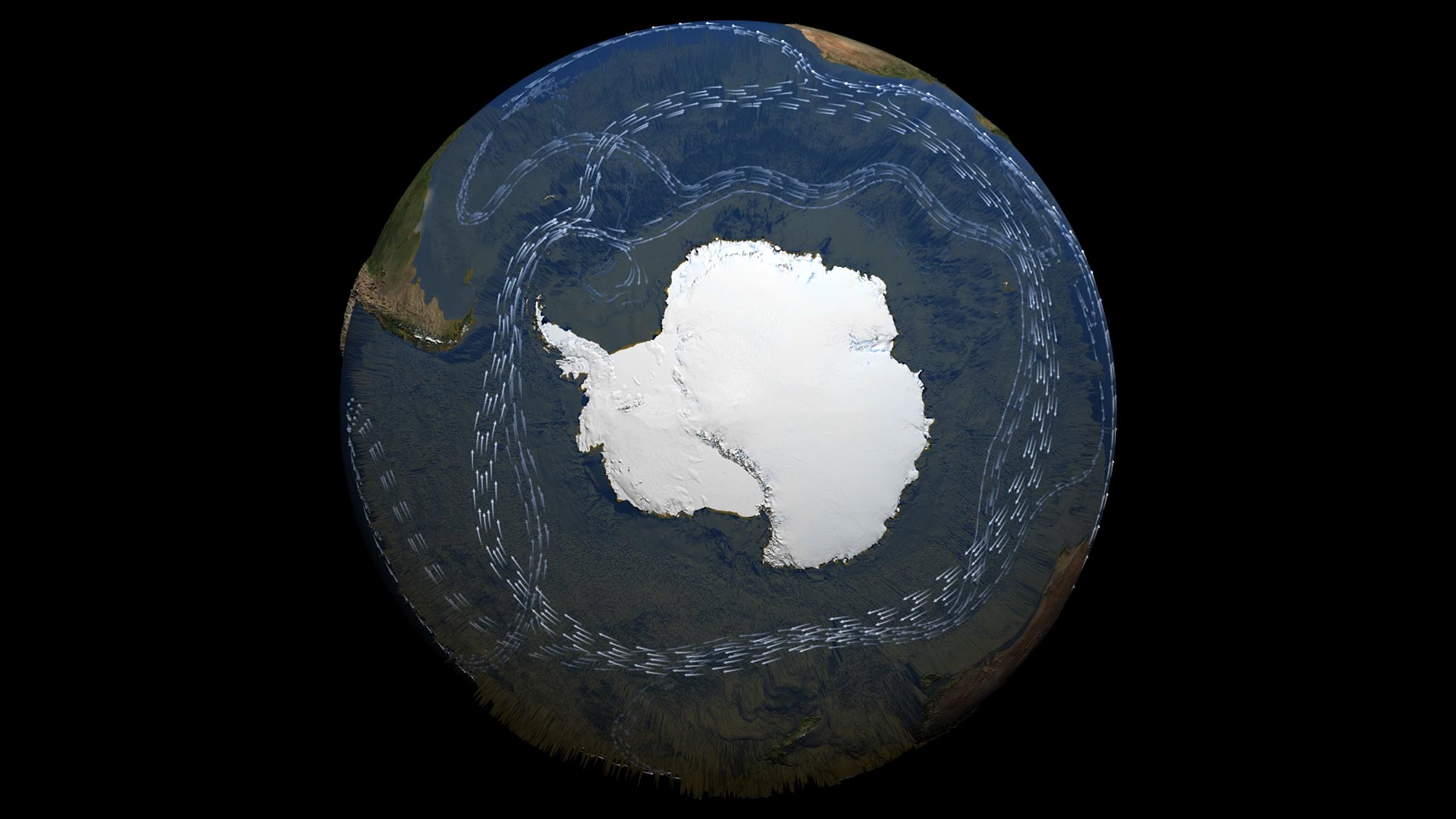
Melting Antarctic ice sheets are weakening the ACC, a vital ocean current that regulates global climate and ocean circulation.
Scientists project a 20% slowdown by 2050, which could intensify climate extremes, disrupt marine ecosystems, and reduce the ocean’s ability to absorb carbon. The weakening current may also allow invasive species to reach Antarctica, altering its food web.
Antarctic’s Mighty Current Faces Slowdown
Melting ice sheets are causing the Antarctic Circumpolar Current (ACC) — the world’s strongest ocean current — to slow down, according to new research.
This slowdown could have far-reaching consequences for the global climate, affecting sea level rise, ocean temperatures, and marine ecosystems.
Scientists from the University of Melbourne and NORCE Norway Research Centre estimate that, under a high carbon emissions scenario, the ACC could weaken by about 20 percent by 2050.
The influx of freshwater from melting ice is expected to alter the ocean’s salinity and density, disrupting circulation patterns in the Southern Ocean.
Scientists Use Cutting-Edge Simulations
To understand these changes, researchers — including Associate Professor Bishakhdatta Gayen, Dr. Taimoor Sohail, and Dr. Andreas Klocker — used high-resolution ocean and sea ice simulations. Their analysis examined how shifts in temperature, salinity, and wind conditions impact ocean currents and heat transport.
Associate Professor Gayen said: “The ocean is extremely complex and finely balanced. If this current ‘engine’ breaks down, there could be severe consequences, including more climate variability, with greater extremes in certain regions, and accelerated global warming due to a reduction in the ocean’s capacity to act as a carbon sink.”
Invasive Species Threaten Antarctica
The ACC works as a barrier to invasive species, like rafts of southern bull kelp that ride the currents, or marine-borne animals like shrimp or molluscs, from other continents reaching Antarctica.
As the ACC slows and weakens, there is a higher likelihood such species will make their way onto the fragile Antarctic continent, with a potentially severe impact on the food web, which may, for example, change the available diet of Antarctic penguins.
The ACC’s Crucial Role in Global Ocean Circulation
More than four times stronger than the gulf stream, the ACC is a crucial part of the world’s “ocean conveyor belt”, which moves water around the globe – linking the Atlantic, Pacific and Indian Oceans – and is the main mechanism for the exchange of heat, carbon dioxide, chemicals and biology across these ocean basins.
The researchers used Australia’s fastest supercomputer and climate simulator, GADI, located at Access National Research Infrastructure in Canberra. The underlying model (ACCESS-OM2-01) has been developed over a number of years by Australian researchers from various universities.
Ocean Circulation May Slow Even in Low Emission Scenarios
The projections explored in this analysis were conducted by a research team based at UNSW, who found that the transport of ocean water from the surface to the deep may also slow in the future.
Dr. Sohail said it is predicted that the slow-down will be similar under the lower emissions scenario, provided ice melting accelerates as predicted in other studies.
“The 2015 Paris Agreement aimed to limit global warming to 1.5 degrees Celsius above pre-industrial levels. Many scientists agree that we have already reached this 1.5 degree target, and it is likely to get hotter, with flow-on impacts on Antarctic ice melting,” Dr. Sohail said.
“Concerted efforts to limit global warming (by reducing carbon emissions) will limit Antarctic ice melting, averting the projected ACC slowdown.”
The Complexity of Ocean Responses
Published in Environmental Research Letters today (March 3), the research reveals that the impact of ice melting and ocean warming on the ACC is more complex than previously thought.
“The melting ice sheets dump vast quantities of fresh water into the salty ocean. This sudden change in ocean ‘salinity’ has a series of consequences – including the weakening of the sinking of surface ocean water to the deep (called the Antarctic Bottom Water), and, based on this study, a weakening of the strong ocean jet that surrounds Antarctica,” Associate Professor Gayen said.
A Shift from Acceleration to Slowdown
The new research contrasts with previous studies that suggested the ACC may be accelerating due to steeper temperature differences in different latitudes of the ocean caused by climate change, he says.
“Ocean models have historically been unable to adequately resolve the small-scale processes that control current strength. This model resolves such processes, and shows a mechanism through which the ACC is projected to actually slow down in the future. However, further observational and modelling studies of this poorly-observed region are necessary to definitively discern the current’s response to climate change.”
Reference: “Decline of antarctic circumpolar current due to polar ocean freshening” by Taimoor Sohail, Bishakhdatta Gayen and Andreas Klocker, 6 February 2025, Environmental Research Letters.
DOI: 10.1088/1748-9326/adb31c
Never miss a breakthrough: Join the SciTechDaily newsletter.
Follow us on Google and Google News.
4 Comments
thank you
“West Antarctica, an enormous ice sheet that sits on land,”. The West Antarctic ice sheet sits on the sea floor. In some places more than a mile below sea level.
This press release is contradictory and therefore confusing. They state initially, “Melting Antarctic ice sheets ARE weakening the ACC, a vital ocean current that regulates global climate and ocean circulation.” That is followed by, “Scientists … estimate (the word “project” was used earlier) that, under a high carbon emissions scenario, the ACC could weaken by about 20 percent by 2050.” From this article and two others I have read on this ‘research,’ they apparently aren’t actually measuring the ACC, but instead, are running a computer simulation based on a scenario such as RCP8.5. Others have demonstrated that the RCP8.5 scenario is improbable because of limited fossil fuel resources. That doesn’t give me confidence that these so-called ‘researchers’ are the type that pay attention to detail. Remember the old adage about how “The Devil is in the details.” They also make the broad-brush assertion about “melting Antarctic ice sheets,” implying all are melting when only melting in West Antarctica is of any concern. There is high probability that the melting in West Antarctica is the result of volcanic or geothermal activity, not anthropogenic warming from CO2. Ask yourself why they are presenting the simulation results from a high-carbon scenario instead of a scenario that better represents the actual warming history.
One of the authors is quoted as saying, “IF this current ‘engine’ breaks down, there could be severe consequences, including more climate variability, with greater extremes in certain regions, and accelerated global warming due to a reduction in the ocean’s capacity to act as a carbon sink.” If the modelers have so much confidence in their findings as to share their warning with the world, why do they say “if” rather than “when?” Good science provides probabilities along with a margin of error (or uncertainty range) instead of using imprecise lawyer words.
The article mentions that “The researchers used Australia’s fastest supercomputer and climate simulator, GADI, …” It reminds me of a true story. One of my former geologist colleagues back in the 1970s was having a problem fulfilling his teaching contact-hours obligation. Therefore the dean of instruction assigned him a ‘bone head’ math class to fill out his teaching load. During one of his classes, a student raised their hand and said, “Mr. Cotton you made a mistake in that last equation.” Without missing a beat, he replied to the student, “I may not be accurate, but I’m fast.” There is a moral to that story.
The authors end with, “Ocean models have historically been unable to adequately resolve the small-scale processes that control current strength. This model resolves such processes, and shows a mechanism through which the ACC is projected to actually slow down in the future. However, further observational and modelling studies of this poorly-observed region are necessary to definitively discern the current’s response to climate change.”
Just because a model provides a plausible answer does not mean that the answer is correct. It will require measurements over many years to verify the behavior of the ACC. Until recently, other researchers were speculating that the Gulf Stream might weaken in a similar manner. However, recent measurements have shown no evidence for the speculated slow down. Funny how that works! The authors acknowledge that the ACC is a “poorly-observed region” in their very last sentence. However, the tone of the rest of the article lacks that humility.