
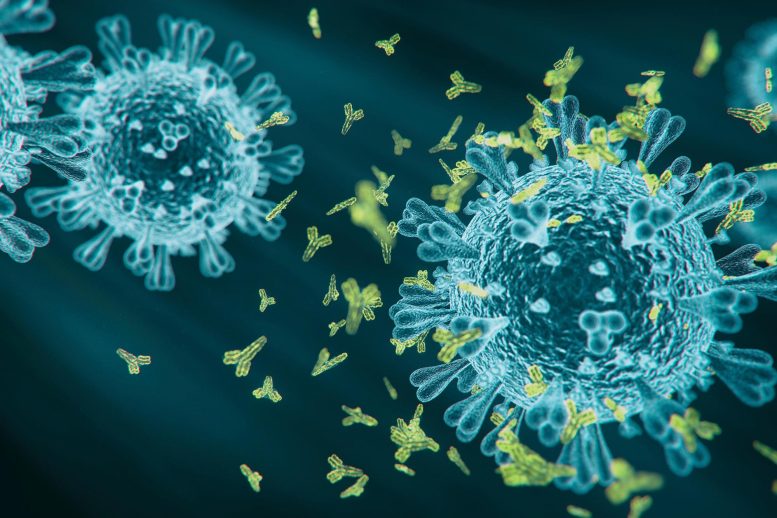
Using a tool called VirScan, Brigham investigators found that people produced shared antibody responses to certain regions of the virus, likely leading to selective pressure and new variants that can repeatedly escape detection by prior immunity.
The human body is capable of creating a vast, diverse repertoire of antibodies—the Y-shaped sniffer dogs of the immune system that can find and flag foreign invaders. Despite our ability to create a range of antibodies to target viruses, humans create antibodies that target the same viral regions again and again, according to a new study led by investigators from Brigham and Women’s Hospital, a founding member of the Mass General Brigham healthcare system, and Harvard Medical School. These “public epitopes” mean that the generation of new antibodies is far from random and that a virus may be able to mutate a single amino acid to reinfect a population of previously immune hosts. The team’s findings, which have implications for our understanding of immunity and public health, will be published today (April 6) in the journal Science.
“Our research may help explain a lot of the patterns we’ve seen during the COVID-19 pandemic, especially in terms of re-infection,” said corresponding author Stephen J. Elledge, PhD, the Gregor Mendel Professor of Genetics at the Brigham and HMS. “Our findings could help inform immune predictions and may change the way people think about immune strategies.”
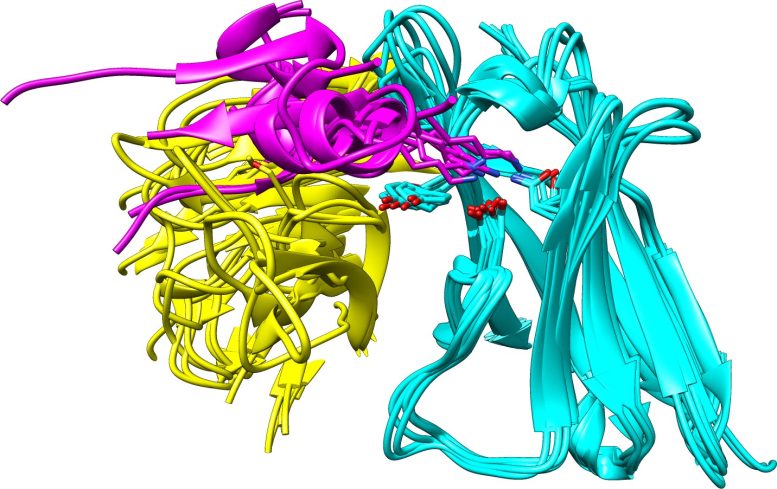
Before the team’s study, there were hints, but no clear evidence, that people’s immune systems didn’t target sites on a viral protein at random. In isolated examples, investigators had seen recurrent antibody responses across individuals—people recreating antibodies to home in on the same viral protein location (known as an epitope). But the study by Elledge and colleagues helps explain the extent and underlying mechanisms of this phenomenon.
Insights from VirScan Analysis
The team used a tool the Elledge lab developed in 2015 called VirScan, which can detect thousands of viral epitopes — sites on viruses that antibodies recognize and bind to — and give a snapshot of a person’s immunological history from a single drop of blood. For the new study, the researchers used VirScan to analyze 569 blood samples from participants in the U.S., Peru, and France. They found that recognition of public epitopes — viral regions recurrently targeted by antibodies — was a general feature of the human antibody response. The team mapped 376 of these commonly targeted epitopes, uncovering exactly where antibodies bind their targets. The team found that antibodies recognized public epitopes through germline-encoded amino acid binding (GRAB) motifs—regions of the antibodies that are particularly good at picking out one specific amino acid. So, instead of randomly choosing a target, human antibodies tend to focus on regions where these amino acids are available for binding, and thus repeatedly bind the same spots.
A small number of mutations can help a virus avoid detection by these shared antibodies, allowing the virus to reinfect populations that were previously immune.
“We find an underlying architecture in the immune system that causes people, no matter where in the world they live, to make essentially the same antibodies that give the virus a very small number of targets to evade in order to reinfect people and continue to expand and further evolve,” said lead author Ellen L. Shrock, PhD, of the Elledge lab.
Immune Strategies and Treatments
Interestingly, the team notes that nonhuman species produce antibodies that recognize different public epitopes from those that humans recognize. And, while it is more likely for a person to produce antibodies against a public epitope, some people do produce rarer antibodies, which may more effectively protect them from reinfection. These insights could have important implications for treatments developed against COVID-19, such as monoclonal antibodies, as well as for vaccine design.
“The more unique antibodies may be a lot harder to evade, which is important to consider as we think about the design of better therapies and vaccines,” said Elledge.
Reference: “Germline-encoded amino acid–binding motifs drive immunodominant public antibody responses” by Ellen L. Shrock, Richard T. Timms, Tomasz Kula, Elijah L. Mena, Anthony P. WestJr, Rui Guo, I-Hsiu Lee, Alexander A. Cohen, Lindsay G. A. McKay, Caihong Bi, Keerti, Yumei Leng, Eric Fujimura, Felix Horns, Mamie Li, Duane R. Wesemann, Anthony Griffiths, Benjamin E. Gewurz, Pamela J. Bjorkman and Stephen J. Elledge, 7 April 2023, Science.
DOI: 10.1126/science.adc9498
Funding: This research was supported by the SARS-CoV-2 Viral Variants Program and the Value of Vaccine Research Network, the MassCPR, the National Institutes of Health (1P01AI165072, K99DE031016, AI139538, AI169619, AI170715, and AI170580), the National Science Foundation (Graduate Research Fellows Program), Pemberton-Trinity Fellowship, Sir Henry Wellcome Fellowship (201387/Z/16/Z), Jane Coffin Childs Postdoctoral Fellowship, Burroughs Wellcome Career Award in Medical Sciences. Elledge is an Investigator with the Howard Hughes Medical Institute.
Disclosures: Elledge and co-author Tomasz Kula are founders of TSCAN Therapeutics and ImmuneID. Elledge is a founder of MAZE Therapeutics and Mirimus, and serves on the scientific advisory board of Homology Medicines, TSCAN Therapeutics, MAZE Therapeutics, none of which impact this work. Shrock was a consultant for ImmuneID. Elledge and Kula are inventors on a patent application filed by the Brigham and Women’s Hospital (US20160320406A) that covers the use of the VirScan library to identify pathogen antibodies in blood.
Never miss a breakthrough: Join the SciTechDaily newsletter.
Follow us on Google and Google News.
1 Comment
“Covid-19” is not a virus …