
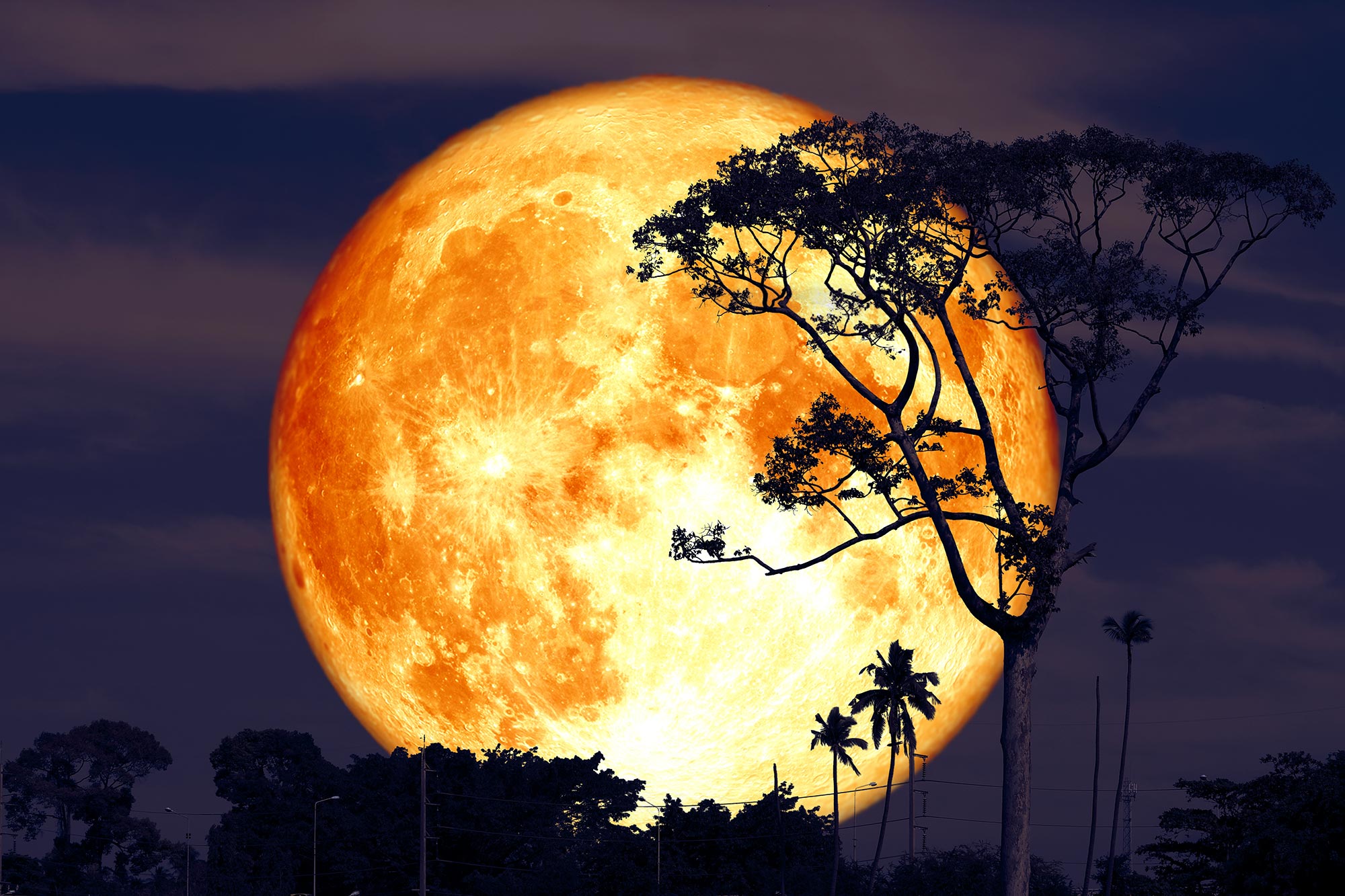
The next full Moon is called the Buck Moon, Thunder Moon, Hay Moon, Mead Moon, Rose Moon, Guru Moon, and Dharma Day. There also will be a partial penumbral lunar eclipse.
The next full Moon will be just after midnight on Sunday morning, July 5, 2020, appearing opposite the Sun (in Earth-based longitude) at 12:44 a.m. EDT. The Moon will be close enough to opposite the Sun that its northern edge will pass through the partial shadow of the Earth — called a partial penumbral eclipse.
Although visible from the Americas, this slight dimming of part of the Moon should be difficult or impossible to notice without instrumentation. The Moon will appear full for about three days around the eclipse, from Friday evening into Monday morning, making this a full Moon weekend.
The Maine Farmer’s Almanac first published “Indian” names for the full Moons in the 1930’s. According to this almanac, as the full Moon in July and the first full Moon of summer, the Algonquin tribes of what is now the northeastern United States called this full Moon the Buck Moon. Early summer is normally when the new antlers of buck deer push out of their foreheads in coatings of velvety fur. They also called this the Thunder Moon because of early summer’s frequent thunderstorms.
As usual, the wearing of suitably celebratory celestial attire is encouraged in honor of the full Moon.
Europeans called this full Moon the Hay Moon for the haymaking in June and July, and sometimes the Mead Moon (although this name and “Honey Moon” were also used for the previous full Moon). Mead is created by fermenting honey mixed with water, sometimes adding fruits, spices, grains, or hops.
Another European name is the Rose Moon, although some use this name for the previous full Moon. Some sources indicate the name “Rose Moon” comes from the roses that bloom in late June. Others report that the name comes from the color of the full Moon this time of year.

The orbit of the Moon around the Earth is almost in the same plane as the orbit of the Earth around the Sun (only about 5 degrees off). When the Sun appears highest in the sky near the summer solstice, the full Moon opposite the Sun appears low in the sky. For Europe’s higher latitudes, the full Moon nearest the summer solstice shines through more atmosphere than at other times of the year, making it more likely to have a reddish color (for the same reasons that sunrises and sunsets are red).
For 2020, this full Moon in early July is closer to the summer solstice and will be lower in the sky than the full Moon in June. For the Washington, D.C. area, on the morning of July 5, 2020, the full Moon will reach only 26.2 degrees above the southern horizon at its highest for the night, about 1.5 degrees lower in the sky than the full Moon was in early June.
For Hindus, this is the Guru Full Moon (Guru Purnima) and is celebrated as a time for clearing the mind and honoring the guru or spiritual master. For Buddhists, this full Moon is Dharma Day, also known as Asalha Puha or Esala Poya. For Theravada Buddhism this is an important festival celebrating Buddha’s first sermon.
In most lunisolar calendars the months change with the new Moon, and full Moons fall in the middle of the lunar months. This full Moon is the middle of the fifth month of the Chinese calendar and Tammuz in the Hebrew calendar. In the Islamic calendar, the months start with the first sighting of the waxing crescent Moon after the New Moon. This full Moon is near the middle of Dhu al-Qidah, one of the four sacred months during which warfare is prohibited.
Since this is the Thunder Moon, a quick note on lightning safety. Most of the lightning that strikes the ground arcs from the negatively charged bottom of the storm to the ground underneath the storm. Much rarer is positive lightning, which arcs from the top of a thunderstorm to strike the ground up to eight miles away. Positive lightning can sometimes strike areas where the sky is clear (hence the term “bolt out of the blue”). Because it arcs across a greater distance it tends to be 5 to 10 times more powerful than regular ground strikes. Because it can strike dry areas outside of the storm, positive lightning tends to start more fires than negative lightning. Although positive lightning is rare (less than 5% of all lightning strikes), the lack of warning combined with its greater power tends to make it more lethal.
A good rule to follow is, if you can hear the thunder, you can be struck by the lightning. As a former bicycle commuter (before I retired from NASA), I am well aware that the inch or so of rubber tire between my metal bicycle and the ground will make little difference to a bolt that can arc across miles of air from the top of a thunderstorm to where I am riding.
As usual, the wearing of suitably celebratory celestial attire is encouraged in honor of the full Moon. Be safe (especially during thunder storms), avoid starting wars, and take a moment to clear your mind.
Never miss a breakthrough: Join the SciTechDaily newsletter.
Follow us on Google and Google News.
20 Comments
Hmmnn, suitable celestial headgear, with mask of course. Need more time!
Sorry everyone, but we’re changing the website name to “Superstitious Codswallop Daily. Make sure you’ve got your tinfoil hats at the ready for the Thunder Moon tonight!
🤣
If you are truly retired from NASA, then you should know that it wouldn’t matter how thick your rubber tires were on your bike. A car is the safest place to be in a thunderstorm NOT because of the tires, but for the fact that you are surrounded by metal! A bike would not be safe ever, in a thunderstorm!!
Please re-read the section. He says, “I am well aware that the inch or so of rubber tire between my metal bicycle and the ground will make little difference to a bolt that can arc across miles of air from the top of a thunderstorm to where I am riding” as you can see he says it will make little difference not that the extra inch of rubber will help.
You guys commenting are dicks
I feel like they don’t even know what they’re talking about . . .
Good read, knowledge, love it!
Acts 2:38.
I’m wearing my full moon sweatshirt as I type this! And John Campbell (oh the irony that he shares a surname with Joseph) sounds like an absolute delight (that’s my sarcasm font). There is more to this world that meets the eye. If you’re so opposed to magic you’ll never ever find it. More for me!!
Interesting read, thanks!
Happy Buck Moon everyone!
Excellent article for the fact that it discusses the moon from various cultural standpoints. Sometimes the western mind is so far removed from natural cycles, people can have difficulty respecting or honoring these types of perspectives.
Thank you for the 360 on grandmother moon.
This was a informative article about the full moon thanks for the fun read
I enjoyed this article thank you. It was very informative from many points of view and cultures. Plus loved the “heads up” on positive lightening. Great sense of humor in the writing.
I loved this article. Thank you so much!
Enjoyed your article. Keep writing – love your style. Science was not my strong suit in school but even so I enjoy learning about the science of our natural world. Thank you…I’ll keep reading!
I enjoy this Article. I absolutely love the moon and all its Phases. One of God’s great wonders!
Alot more info than I thought I would get. Thank you
Great article. Good reasesrch.