
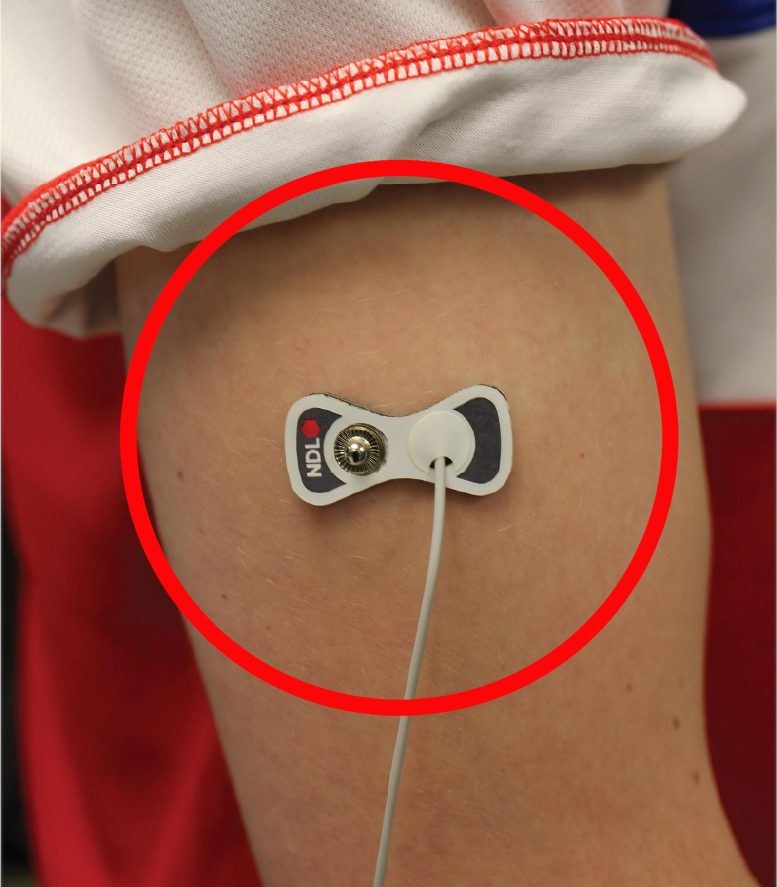
According to researchers, interstitial fluid could serve as an alternative to blood in monitoring health and wellness.
The next level of continuous health monitoring may lie just beneath the surface of the skin.
According to biomedical engineers at the University of Cincinnati, interstitial fluid, which is the fluid that surrounds cells, tissues, and organs in the body, could be a valuable resource for early disease detection or long-term health monitoring.
In a paper published in the journal Nature Biomedical Engineering, they outlined the potential advantages and technological challenges of using interstitial fluid.
“Why we see it as a valuable diagnostic fluid is continuous access. With blood, you can’t easily take continuous readings,” said UC doctoral graduate Mark Friedel, co-lead author of the study.
“Can you imagine going about your day with a needle stuck in your vein all day? So we need other tools.”
Sweat vs. Blood: A Diagnostic Comparison
Researchers are looking for alternatives to monitor a person’s health and wellness. Sweat is a good medium for measuring certain things like stress or anxiety because it contains hormones such as cortisol. But the body is stingy with other chemicals that are not so easily released in sweat, Friedel said.
“Sweat glands are big filters that don’t allow everything to pass through,” he said. “So more than half of the things we want to monitor have no access to sweat at all.”

Blood is the gold standard for health monitoring. But people also have liters of interstitial fluid that make up as much as 15% of their body weight.
“The key feature of blood that makes it so advantageous is we understand blood really well,” Friedel said. “If you have something in your blood, we know what will happen to your heart or your liver,” he said.
Interstitial Fluid as a Blood Alternative
Researchers said interstitial fluid contains many of the same chemicals in the same proportions as blood, offering a potential alternative to costly and time-consuming lab work.
The study outlined the various ways doctors can sample interstitial fluid, from applying suction to the skin to deploying microdialysis.
“As biomedical engineers, one of our greatest goals is to help people better manage their health by making diagnostics more accessible,” said co-lead author Ian Thompson at Stanford University.
“A big barrier to this accessibility is that most current diagnostics rely on blood sampling, which can be painful and requires trained personnel to perform. Thus, in recent years there has been growing interest in using interstitial fluid just under the skin as a diagnostic sample that is more accessible and less painful to extract.”
In UC College of Engineering and Applied Science professor Jason Heikenfeld’s Novel Devices Lab, students are developing sensors to measure hormones and other chemicals in interstitial fluid. They use microneedles less than 1 millimeter in length that pierce the skin through a tiny patch.
“If you had a splinter, it probably went deeper into your skin than our microneedles,” Friedel said. “They’re generally painless. I don’t feel it most of the time. The most uncomfortable part is removing the tape that holds the device down.”
But even if you don’t know it’s there, your body does, Friedel said. And this minute reaction can affect the test results.
Challenges in Measuring Interstitial Fluid
“There’s a Schrödinger’s observer effect with interstitial fluid. Any time you try to collect and measure it, you inherently change the fluid itself,” Friedel said. “If you stick a needle in your skin, your body becomes inflamed and then your [sample] levels change. For continuous biomonitoring, we want to know those concentrations as they are when you’re not being poked with a tiny needle.
“That’s why it’s such a challenging fluid that hasn’t been used outside of diabetes monitoring.”
Still, researchers say, interstitial fluid holds enormous promise for monitoring health through wearable technology. This could help doctors track the efficacy of drugs to ensure proper dosage or provide early diagnosis of illness by monitoring the immune system.
But Friedel said there is still a lot to learn.
“We’re trying to unlock the box and read the instructions inside to understand what’s in interstitial fluid and what the potentials are for exploiting it,” he said.
Reference: “Opportunities and challenges in the diagnostic utility of dermal interstitial fluid” by Mark Friedel, Ian A. P. Thompson, Gerald Kasting, Ronen Polsky, David Cunningham, Hyongsok Tom Soh and Jason Heikenfeld, 19 January 2023, Nature Biomedical Engineering.
DOI: 10.1038/s41551-022-00998-9
The study was funded through grants from the National Science Foundation, the U.S. Air Force Office of Scientific Research, and the U.S. Office of Naval Research.
Never miss a breakthrough: Join the SciTechDaily newsletter.
Follow us on Google and Google News.