
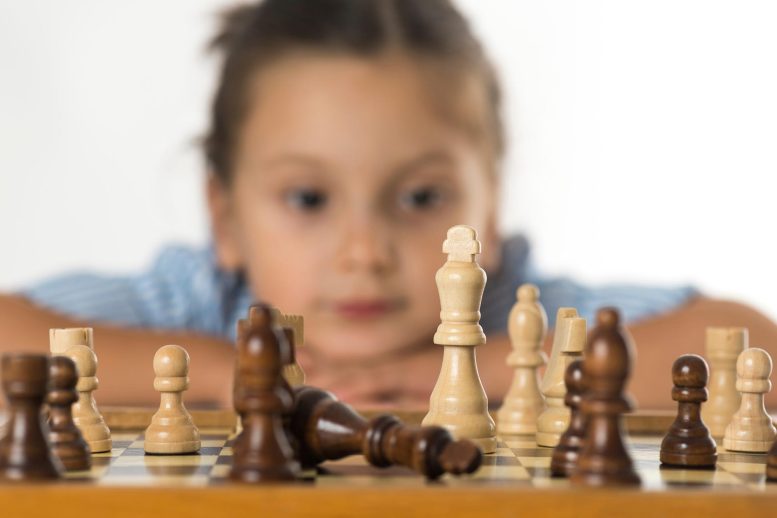
Findings of NYU study, co-authored by former US Chess champion, show barriers girls and women face when it comes to perceived intellectual ability.
“The Queen’s Gambit” miniseries portrayed the life of a fictional chess prodigy, Beth Harmon, who is continuously underestimated in male-dominated competitions. A team of New York University psychology researchers has now found some “real-life” evidence of what Harmon faced as a younger player: Parents and coaches of youth chess players peg the highest potential rating of girl players to be lower than that of boy players.
Moreover, the study’s authors, who included Jennifer Shahade, a two-time US Women’s Chess champion, found that coaches who think “brilliance” is required to succeed in chess also believe that their female mentees would be more likely to stop playing the game due to lack of ability than their male mentees would. But, at the same time, coaches and parents don’t think girls encounter a less supportive environment than do boys—or that girls might be more likely to stop playing as a result.
Real-World Underrepresentation in Chess
“While it is inspiring to see a fictional woman winning in a space dominated by men, real-world women remain underrepresented in chess,” says Sophie Arnold, an NYU doctoral student and the lead author of the paper, which appears in the Journal of Experimental Psychology: General. “This study identifies one contributing reason as to why: Parents and coaches are biased against the female youth players in their own lives.”
“It is striking that even the parents and coaches who have a vested interest in girls’ success hold biases against them and may also have some blind spots about the barriers to girls’ success,” adds Andrei Cimpian, a professor in NYU’s Department of Psychology and the paper’s senior author.
“These beliefs are likely to be harmful both to girls who already play chess and to those who could want to: Would you be interested in participating in an activity where your potential is downgraded by your parents and by your coaches before you have even started?” says NYU alumna Shahade, author of Chess Queens and Play Like a Girl!, who was involved in the study design.
In the US Chess Federation (“US Chess”), only 13% of players are women, raising questions about what drives the gender disparity. Previous studies have largely focused on potential deficits in chess ability among girls, which overlooks the role of adult leadership.
“This line of scholarship can make the overrepresentation of men in chess seem like it’s a ‘girls and women problem’ rather than a ‘chess problem,’ ” says Arnold.
Perceived Barriers and Actual Investments
In the Journal of Experimental Psychology: General work, by contrast, the researchers considered how the important people in girls’ lives—coaches and parents—may be biased against them when assessing their potential, even at a young age, and how these perceptions may help explain the huge gender gap in who plays chess.
To do so, the team interviewed nearly 300 parents and mentors—90% of whom were men—who were recruited through the US Chess Federation. In the survey, they reported their evaluations of and investment in approximately 650 youth players. In addition, parents and coaches were asked if they thought aptitude in chess requires brilliance—a measure Cimpian and his colleagues have used in the past to detect stereotyping and gender bias in academic fields.
The researchers found bias against girls across multiple measures. Parents and coaches thought that female youth players’ highest potential ratings were on average lower than those of male players—a bias that was exacerbated among parents and mentors who believed that success in chess requires brilliance. (The researchers note that the sample of mothers and female coaches was too small to analyze separately—a reflection of women’s underrepresentation in chess more generally.)
Notably, these coaches and parents didn’t recognize that their own presumptions may function as a barrier to girls succeeding in the game. Specifically, coaches who thought brilliance was required to succeed in chess also thought their female mentees would be more likely to stop playing chess due to a lack of ability than their male mentees. And, in fact, parents and coaches did not believe that girls—relative to boys—encounter a less supportive environment in chess and might stop playing chess as a result.
However, not all news was bad. For example, the researchers found no bias in the amount of resources—such as time and money—coaches and parents reported being willing to invest in female relative to male youth players.
“This study provides the first large-scale investigation of bias against young female players and holds implications for the role of parents and mentors in science and technology—areas that, like chess, are culturally associated with intellectual ability and exhibit substantial gender imbalances,” notes Arnold.
For more on this study, see The Gender Bias Game in Young Female Chess Circles.
Reference: “Checking Gender Bias: Parents and Mentors Perceive Less Chess Potential in Girls” by Sophie Arnold, April H. Bailey, Wei Ji Ma, Jennifer Shahade and Andrei Cimpian, 5 October 2023, Journal of Experimental Psychology: General.
DOI: 10.1037/xge0001466
The paper’s other authors were April Bailey, an NYU postdoctoral researcher at the time of the study and now an assistant professor of psychology at the University of New Hampshire, and Weiji Ma, a professor in NYU’s Department of Psychology and Center for Neural Science who has previously examined gender bias in chess.
Never miss a breakthrough: Join the SciTechDaily newsletter.
Follow us on Google and Google News.