
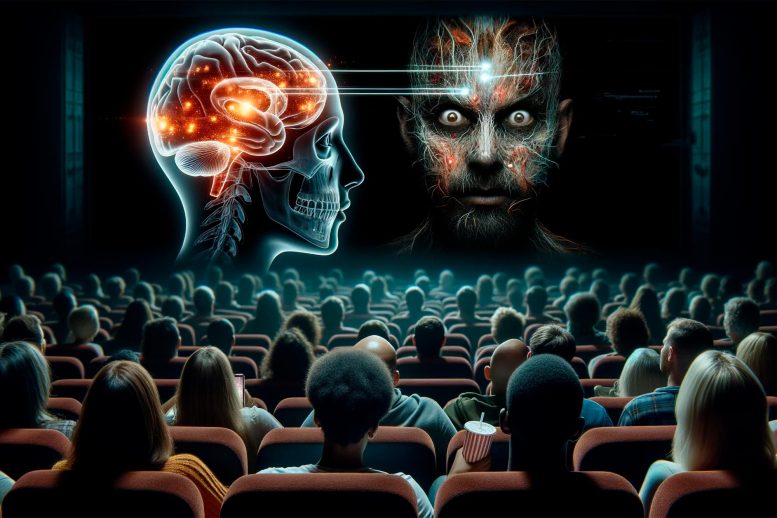
Fear has evolved to protect organisms from harm. The brain’s amygdala detects threats, while other areas provide context. While some enjoy the thrill of fear due to a sense of control, others may find it overwhelming. Disorders stemming from abnormal fear are prevalent but treatable.
Fear may be as old as life on Earth. It is a fundamental, deeply wired reaction, evolved over the history of biology, to protect organisms against perceived threat to their integrity or existence. Fear may be as simple as a cringe of an antenna in a snail that is touched, or as complex as existential anxiety in a human.
Whether we love or hate to experience fear, it’s hard to deny that we certainly revere it – devoting an entire holiday to the celebration of fear.
Thinking about the circuitry of the brain and human psychology, some of the main chemicals that contribute to the “fight or flight” response are also involved in other positive emotional states, such as happiness and excitement. So, it makes sense that the high arousal state we experience during a scare may also be experienced in a more positive light. But what makes the difference between getting a “rush” and feeling completely terrorized?

We are psychiatrists who treat fear and study its neurobiology. Our studies and clinical interactions, as well as those of others, suggest that a major factor in how we experience fear has to do with the context. When our “thinking” brain gives feedback to our “emotional” brain and we perceive ourselves as being in a safe space, we can then quickly shift the way we experience that high arousal state, going from one of fear to one of enjoyment or excitement.
When you enter a haunted house during Halloween season, for example, anticipating a ghoul jumping out at you and knowing it isn’t really a threat, you are able to quickly relabel the experience. In contrast, if you were walking in a dark alley at night and a stranger began chasing you, both your emotional and thinking areas of the brain would be in agreement that the situation is dangerous, and it’s time to flee!
But how does your brain do this?
Understanding the Brain’s Response to Fear
Fear reaction starts in the brain and spreads through the body to make adjustments for the best defense, or flight reaction. The fear response starts in a region of the brain called the amygdala. This almond-shaped set of nuclei in the temporal lobe of the brain is dedicated to detecting the emotional salience of the stimuli – how much something stands out to us.
For example, the amygdala activates whenever we see a human face with an emotion. This reaction is more pronounced with anger and fear. A threat stimulus, such as the sight of a predator, triggers a fear response in the amygdala, which activates areas involved in preparation for motor functions involved in fight or flight. It also triggers release of stress hormones and sympathetic nervous system.

This leads to bodily changes that prepare us to be more efficient in a danger: The brain becomes hyperalert, pupils dilate, the bronchi dilate and breathing accelerates. Heart rate and blood pressure rise. Blood flow and stream of glucose to the skeletal muscles increase. Organs not vital in survival such as the gastrointestinal system slow down.
A part of the brain called the hippocampus is closely connected with the amygdala. The hippocampus and prefrontal cortex help the brain interpret the perceived threat. They are involved in a higher-level processing of context, which helps a person know whether a perceived threat is real.
For instance, seeing a lion in the wild can trigger a strong fear reaction, but the response to a view of the same lion at a zoo is more of curiosity and thinking that the lion is cute. This is because the hippocampus and the frontal cortex process contextual information, and inhibitory pathways dampen the amygdala fear response and its downstream results. Basically, our “thinking” circuitry of brain reassures our “emotional” areas that we are, in fact, OK.

Learning Fear and Overcoming It
Similar to other animals, we very often learn fear through personal experiences, such as being attacked by an aggressive dog, or observing other humans being attacked by an aggressive dog.
However, an evolutionarily unique and fascinating way of learning in humans is through instruction – we learn from the spoken words or written notes! If a sign says the dog is dangerous, proximity to the dog will trigger a fear response.

We learn safety in a similar fashion: experiencing a domesticated dog, observing other people safely interact with that dog or reading a sign that the dog is friendly.
Why Do Some People Enjoy Being Scared?
Fear creates distraction, which can be a positive experience. When something scary happens, in that moment, we are on high alert and not preoccupied with other things that might be on our mind (getting in trouble at work, worrying about a big test the next day), which brings us to the here and now.
Furthermore, when we experience these frightening things with the people in our lives, we often find that emotions can be contagious in a positive way. We are social creatures, able to learn from one another. So, when you look over to your friend at the haunted house and she’s quickly gone from screaming to laughing, socially you’re able to pick up on her emotional state, which can positively influence your own.
While each of these factors — context, distraction, social learning — have potential to influence the way we experience fear, a common theme that connects all of them is our sense of control. When we are able to recognize what is and isn’t a real threat, relabel an experience, and enjoy the thrill of that moment, we are ultimately at a place where we feel in control. That perception of control is vital to how we experience and respond to fear. When we overcome the initial “fight or flight” rush, we are often left feeling satisfied, reassured of our safety and more confident in our ability to confront the things that initially scared us.
It is important to keep in mind that everyone is different, with a unique sense of what we find scary or enjoyable. This raises yet another question: While many can enjoy a good fright, why might others downright hate it?
Why Do Some People Not Enjoy Being Scared?
Any imbalance between excitement caused by fear in the animal brain and the sense of control in the contextual human brain may cause too much, or not enough, excitement. If the individual perceives the experience as “too real,” an extreme fear response can overcome the sense of control over the situation.
This may happen even in those who do love scary experiences: They may enjoy Freddy Krueger movies but be too terrified by “The Exorcist,” as it feels too real, and fear response is not modulated by the cortical brain.
On the other hand, if the experience is not triggering enough to the emotional brain, or if is too unreal to the thinking cognitive brain, the experience can end up feeling boring. A biologist who cannot tune down her cognitive brain from analyzing all the bodily things that are realistically impossible in a zombie movie may not be able to enjoy “The Walking Dead” as much as another person.
So if the emotional brain is too terrified and the cognitive brain helpless, or if the emotional brain is bored and the cognitive brain is too suppressing, scary movies and experiences may not be as fun.
What Are Disorders of Fear?
All fun aside, abnormal levels of fear and anxiety can lead to significant distress and dysfunction and limit a person’s ability for success and joy of life. Nearly one in four people experiences a form of anxiety disorder during their lives, and nearly 8 percent experience post-traumatic stress disorder (PTSD).
Disorders of anxiety and fear include phobias, social phobia, generalized anxiety disorder, separation anxiety, PTSD, and obsessive compulsive disorder. These conditions usually begin at a young age, and without appropriate treatment can become chronic and debilitating and affect a person’s life trajectory. The good news is that we have effective treatments that work in a relatively short time period, in the form of psychotherapy and medications.
Written by:
- Arash Javanbakht — Assistant Professor of Psychiatry, Wayne State University
- Linda Saab — Assistant Professor of Psychiatry, Wayne State University
Adapted from an article originally published in The Conversation.
Never miss a breakthrough: Join the SciTechDaily newsletter.
Follow us on Google and Google News.