
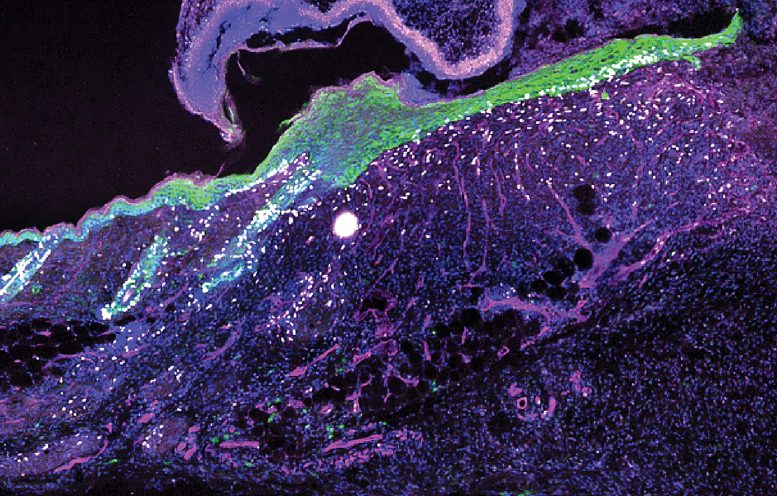
A newly identified IL24-driven mechanism helps skin and possibly other organs repair injuries by responding to hypoxia rather than pathogens. This evolutionary pathway enables efficient tissue regeneration.
The world can be a hazardous place, with various dangers lurking around us such as bacteria, viruses, accidents, and injuries. Our skin acts as the ultimate shield, providing a steadfast defense against these threats. It serves as the boundary between the internal and external environment and is the largest organ in the body, functioning nearly seamlessly to protect us.
Still, the skin is not immune to harm. It endures daily assaults and still tries to keep us safe by detecting and responding to these dangers. One method is the detection of pathogens, which activates the immune system. However, recent research conducted by Elaine Fuchs at Rockefeller University and published in the journal Cell, has uncovered a new protection mechanism that responds to injury signals in damaged tissue, such as low oxygen levels caused by blood vessel disruption and scab formation. This mechanism is activated without the need for an infection.
The study is the first to identify a damage response pathway that is distinct from but parallel to the classical pathway triggered by pathogens.
At the helm of the response is interleukin-24 (IL24), whose gene is induced in skin epithelial stem cells at the wound edge. Once unleashed, this secreted protein begins to marshal a variety of different cells to begin the complex process of healing.
“IL24 is predominately made by the wound-edge epidermal stem cells, but many cells of the skin—the epithelial cells, the fibroblasts, and the endothelial cells—express the IL24 receptor and respond to the signal. IL24 becomes an orchestrator that coordinates tissue repair,” says Fuchs, head of the Robin Chemers Neustein Laboratory of Mammalian Cell Biology and Development.
Hints From Pathogen-Induced Signaling
Scientists have long understood how the host responses protect our body from pathogen-induced threats: somatic cells recognize invading bacteria or viruses as foreign entities and induce a number of defense mechanisms with the help of signaling proteins such as type 1 interferons.
But how does the body respond to an injury that may or may not involve foreign invaders? If we cut a finger while slicing a cucumber, for example, we know it instantly—there’s blood and pain. And yet how the detection of injury leads to healing is poorly understood on a molecular basis.
While type 1 interferons rely on the signaling factors STAT1 and STAT2 to regulate the defense against pathogens, previous research by the Fuchs lab had shown that a similar transcription factor known as STAT3 makes its appearance during wound repair. Siqi Liu, a co-first author in both studies, wanted to trace STAT3’s pathway back to its origin.
IL24 stood out as a major upstream cytokine that induces STAT3 activation in the wounds.
Microbe-Independent Action
In collaboration with Daniel Mucida’s lab at Rockefeller, the researchers worked with mice under germ-free conditions and found that the wound-induced IL24 signaling cascade is independent of germs.
But what injury signals induced the cascade? Wounds often extend into the skin dermis, where capillaries and blood vessels are located.
“We learned that the epidermal stem cells sense the hypoxic environment of the wound,” says Yun Ha Hur, a research fellow in the lab and a co-first author on the paper.
When the blood vessels are severed and a scab forms, epidermal stem cells at the edge of the wound are starved of oxygen. This state of hypoxia is an alarm bell for cell health and induced a positive feedback loop involving transcription factors HIF1a and STAT3 to amplify IL24 production at the wound edge. The result was a coordinated effort by a variety of cell types expressing the IL24 receptor to repair the wound by replacing damaged epithelial cells, healing broken capillaries, and generating fibroblasts for new skin cells.
Collaborating with Craig Thompson’s group at Memorial Sloan Kettering Cancer Center, the researchers showed that they could regulate Il24 gene expression by changing oxygen levels.
Once the researchers pinpointed the origin of the tissue-repair pathway in epidermal stem cells, they studied the wound repair process in mice that had been genetically modified to lack IL24 functionality. Without this key protein, the healing process was sluggish and delayed, taking days longer than in normal mice to completely restore the skin.
They speculate that IL24 might be involved in the injury response in other body organs featuring epithelial layers, which act as a protective sheath. In recent studies, elevated IL24 activity has been spotted in epithelial lung tissue of patients with severe COVID-19 and in colonic tissue in patients with ulcerative colitis, a chronic inflammatory bowel disease.
“IL24 could be working as a cue to signal the need for injury repair in many organs,” Hur says.
Linked by Function and Evolution
“Our findings provide insights into an important tissue damage sensing and repair signaling pathway that is independent of infections,” explains Fuchs.
An analysis with evolutionary biologist Qian Cong at UT Southwestern Medical Center revealed that IL24 and its receptors share close sequence and structure homology with the interferon family. Though they may not always be working in coordination at every moment, IL24 and interferons are evolutionarily related and bind to receptors sitting near each other on the surface of cells. The researchers suspect that these signaling molecules derive from a common molecular pathway dating far back in our past.
“We think that hundreds of millions of years ago, this ancestor might have diverged into two pathways—one being pathogen defense and the other being tissue injury,” Liu says.
Perhaps the split occurred to cope with an explosion of pathogens and injuries that caused a sea of troubles for life on Earth.
Reference: “A tissue injury sensing and repair pathway distinct from host pathogen defense” by Siqi Liu, Yun Ha Hur, Xin Cai, Qian Cong, Yihao Yang, Chiwei Xu, Angelina M. Bilate, Kevin Andrew Uy Gonzales, S. Martina Parigi, Christopher J. Cowley, Brian Hurwitz, Ji-Dung Luo, Tiffany Tseng, Shiri Gur-Cohen, Megan Sribour, Tatiana Omelchenko, John Levorse, Hilda Amalia Pasolli, Craig B. Thompson, Daniel Mucida and Elaine Fuchs, 24 April 2023, Cell.
DOI: 10.1016/j.cell.2023.03.031
Never miss a breakthrough: Join the SciTechDaily newsletter.
Follow us on Google and Google News.