
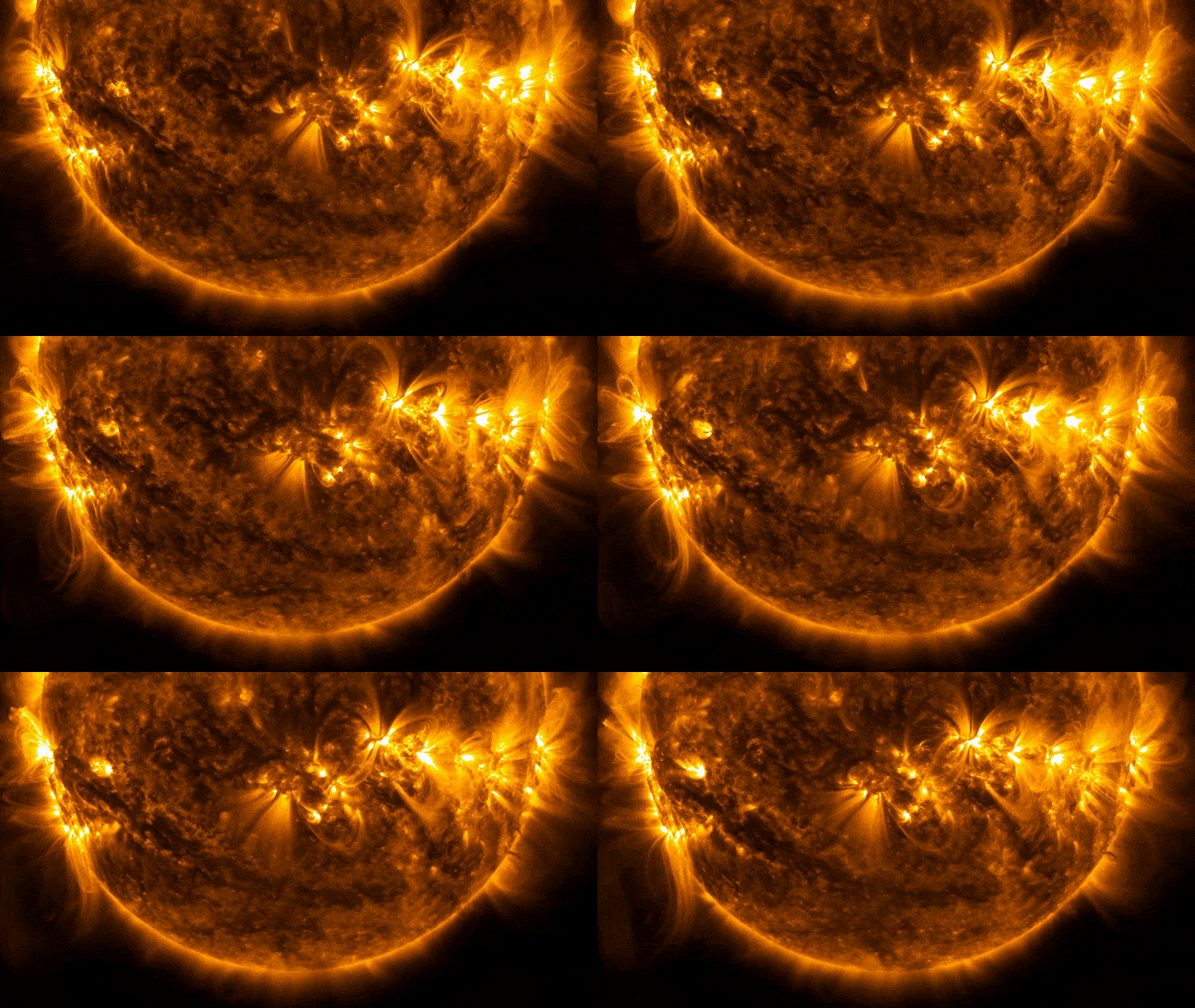
New research from University of Colorado at Boulder, could help scientists better understand the phenomena behind ‘sunspots’.
The sun has long intrigued scientists. However, this sphere of super-heated plasma—the closest star to Earth—is also notoriously difficult to study, leaving many unanswered questions.
Now, researchers have one possible answer to a long-perplexing solar phenomenon called “the convective conundrum.” The findings, recently published in the Proceedings of the National Academy of Sciences, offer a new window into the sun’s mysterious inner workings and may have future implications for understanding space weather, which affects everything from satellites to the electrical grid.
The sun has several distinct regions. One of them, the convective zone, spans roughly 200,000 kilometers (200 megameters or 124,000 miles) and makes up the outer 30% of the sun. Energy generated by nuclear fusion in the sun’s core moves outward toward the surface. When it reaches the convective zone, the energy causes fluid to swirl in eddies and spirals called convective flows.

The Elusive Giant Cells of the Convective Zone
Scientists believed that the largest of these eddies should be about the same size as the convective zone itself—200,000 kilometers—and began looking for these so-called “giant cells.” Despite searching for many years, though, researchers haven’t been able to observe convective flows that are this large, hence the conundrum.
“Why are classic giant cells not observed? And why and how do observations seem to contradict numerical models?” said Keith Julien, University of Colorado Boulder professor and department chair of applied mathematics and one of the study’s co-authors.

New research from University of Sydney’s Geoffrey Vasil (PhDAstroPhys/Atmos’08), Southwest Research Institute’s Nicholas Featherstone (PhDAstroPhys’10) and Julien suggests that the sun’s rotation is more important than researchers previously thought. Strong rotation creates elongated, oval-shaped convective flows that are actually 30,000 kilometers (30 megameters or 18,600 miles) in size, not 200,000.
They made this theoretical prediction by drawing on multi-disciplinary equations and theories used in the fields of physics, mathematics, meteorology, and oceanography.
“In essence, there are no giant cells,” said Julien. “This long-held belief or hunt for them may have been a bit of a red herring. Rotation gives a different fluid flow structure, maxing out at these scales of 30 megameters.”
Shedding Light on the Solar Dynamo
These findings are significant because they offer a solution to a scientific problem that’s existed for decades, Julien said.
But beyond that, learning more about the sun’s convection zone may help scientists better understand the sun’s magnetic field, a phenomenon called the global solar dynamo.
“The sun’s global dynamo magnetic field is responsible for space weather, and that’s a really big deal,” said Julien. “We won’t be able to say much about space weather without understanding more about how the dynamo works.”
The sun’s magnetic field is of particular interest to researchers, governments, and companies because it affects the drag on satellites and the International Space Station.
It also has the potential to cause catastrophic damage. The sun’s magnetic fields emerge onto its surface in the form of sunspots, which sometimes erupt and fling radioactive plasma at Earth.
“The sun’s global dynamo magnetic field is responsible for space weather, and that’s a really big deal.” Keith Julien
The Hidden Threat of Solar Catastrophe
“A big solar event could easily wipe out $10 trillion of global infrastructure in a matter of days,” said Vasil. “And we would only have a few hours to do something about it. It could make the pandemic that currently has a stranglehold on the globe look small by comparison. A big solar event could mean no communication or electricity globally. It’s a huge risk, and almost no one knows about it.”
These findings don’t directly answer our questions about the sun’s magnetic field, but they are an important step in the journey to understanding the global solar dynamo that other researchers can build upon.
In the near term, these findings offer a new constraint for researchers doing numerical simulations of the sun, who can now better understand the challenges for simulating rotation.
“Up to this point, dynamo models haven’t taken rotation properly into account,” said Vasil.
The researchers hope that they or other scientists can confirm their predictions mathematically and eventually actually observe the convective flows in the sun.
“For many reasons, it’s difficult to measure the kinds of flows we predict in the interior,” said Vasil. “Part of the reason is there is a lot of noise at the surface that happens to be roughly the same size as what we expect deeper down. We believe this is only a coincidence. But it means observers are going to need much more data to see what’s going on.”
More broadly, the findings get us one step closer to demystifying the sun, which sustains our existence and holds many clues about the evolution of the universe itself.
“The sun is the giver of life, but it also has many curiosities as well,” said Julien. “Our universe is built up of stars, and we know that stars are also associated with planetary systems, so understanding our nearest planetary system and our nearest star is quite important from a general scientific perspective—Where do we come from? How did we get here?”
Reference: “Rotation suppresses giant-scale solar convection” by Geoffrey M. Vasil, Keith Julien and Nicholas A. Featherstone, 29 July 2021, Proceedings of the National Academy of Sciences.
DOI: 10.1073/pnas.2022518118
Never miss a breakthrough: Join the SciTechDaily newsletter.
Follow us on Google and Google News.