
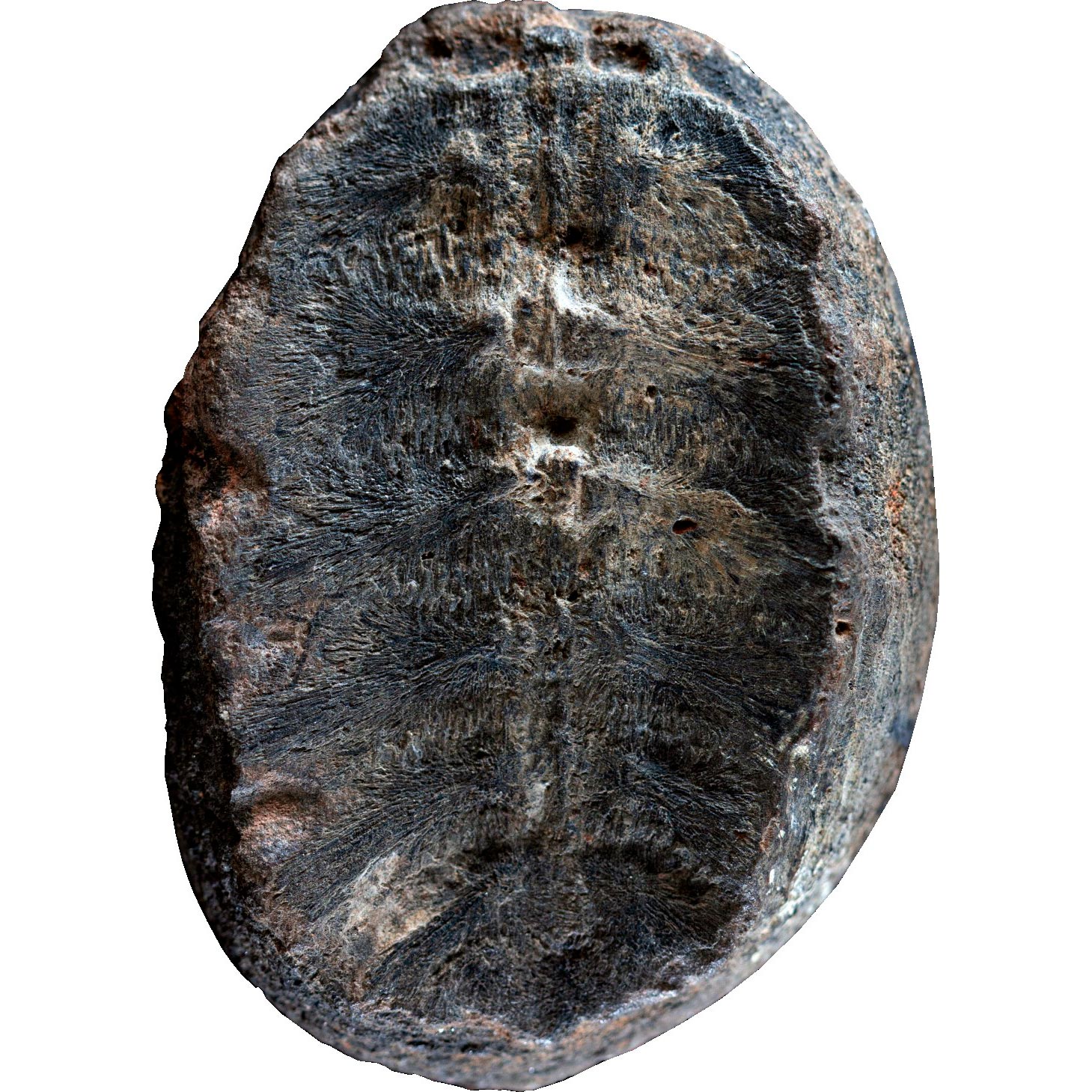
Researchers nicknamed the fossil “Turtwig” after a Pokemon that’s half-turtle, half-plant.
From the 1950s to the 1970s, a Colombian priest named Padre Gustavo Huertas collected rocks and fossils near a town called Villa de Levya. Two of the specimens he found were small, round rocks patterned with lines that looked like leaves; he classified them as a type of fossil plant. But in a new study, published in the journal Palaeontologia Electronica, researchers re-examined these “plant” fossils and found that they weren’t plants at all: they were the fossilized remains of baby turtles.
“It was truly surprising to find these fossils,” says Héctor Palma-Castro, a paleobotany student at the Universidad Nacional de Colombia.
The plants in question had been described by Huertas in 2003 as Sphenophyllum colombianum. The fossils come from Early Cretaceous rocks, between 132 and 113 million years ago, during the dinosaurs’ era. Fossils of Sphenophyllum colombianum were surprising at this time and place — the other known members of the genus Sphenophyllum died out more than 100 million years prior. The plants’ age and locality piqued the interest of Fabiany Herrera, the Negaunee assistant curator of fossil plants at the Field Museum in Chicago, and his student, Palma-Castro.
Mistaken Identity
“We went to the fossil collection at the Universidad Nacional de Colombia in Bogotá and started looking at the plants, and as soon as we photographed them, we thought, ‘this is weird,’” says Herrera, who has been collecting Early Cretaceous plants from northwestern South America, an area of the world with little paleobotanical work.
At first glance, the fossils, about 2 inches in diameter, looked like rounded nodules containing the preserved leaves of the plant Sphenophyllum. But Herrera and Palma-Castro noticed key features that weren’t quite right.
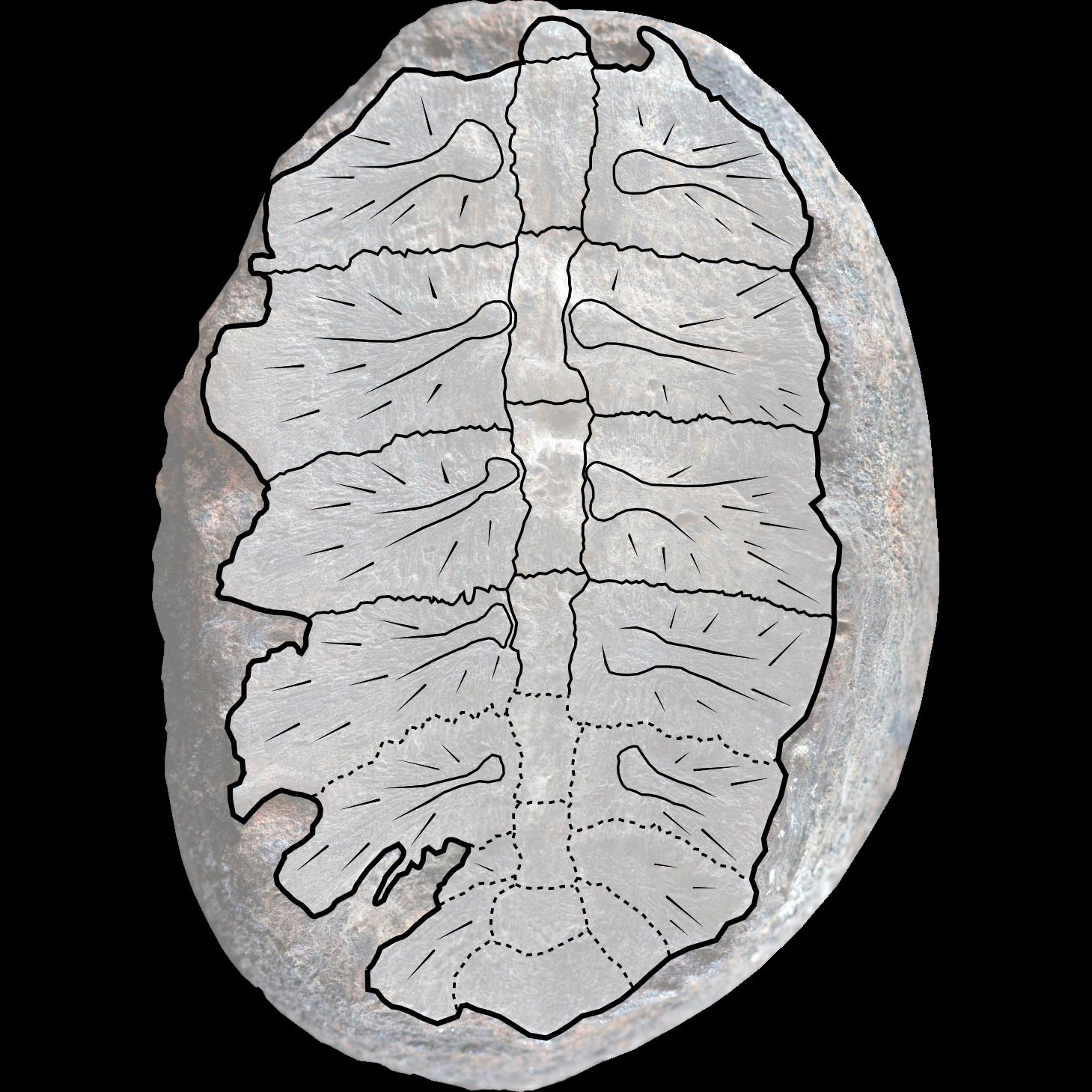
“We spent days searching through wooden cabinets for fossil plants. When we finally found this fossil, deciphering the shape and margin of the leaf proved challenging,” says Palma-Castro.
“When you look at it in detail, the lines seen on the fossils don’t look like the veins of a plant— I was positive that it was most likely bone,” says Herrera. So he reached out to an old colleague of his, Edwin-Alberto Cadena.
“They sent me the photos, and I said, “This definitely looks like a carapace’— the bony upper shell of a turtle,” says Cadena, a paleontologist who focuses on turtles and other vertebrates at the Universidad del Rosario in Bogotá. When he saw the scale of the photos, Cadena recalls, “I said, ‘Well, this is remarkable, because this is not only a turtle, but it’s also a hatchling specimen, it’s very, very small.”
Cadena and his student, Diego Cómbita-Romero of the Universidad Nacional de Colombia, further examined the specimens, comparing them with the shells of both fossil and modern turtles. “When we saw the specimen for the first time I was astonished, because the fossil was missing the typical marks on the outside of a turtle’s shell,” says Cómbita-Romero. It was a little bit concave, like a bowl. At that moment we realized that the visible part of the fossil was the other side of the carapace, we were looking at the part of the shell that is inside the turtle.”
Details in the turtle’s bones helped the researchers estimate how old it was at death. “Turtle growth rates and sizes vary,” says Cómbita-Romero, so the team looked at features like the thickness of its carapace and the spots where its ribs were knitting together into solid bone. “This is a feature uncommon in hatchlings but observed in juveniles. All this information suggests that the turtle likely died with a slightly developed carapace, between 0 to 1 years old, in a post-hatchling stage,” he says.
The Significance of the Discovery
“This is actually really rare to find hatchlings of fossil turtles in general,” says Cadena. “When the turtles are very young, the bones in their shells are very thin, so they can be easily destroyed.”
The researchers say that the rarity of fossilized baby turtles makes their discovery an important one. “These turtles were likely relatives of other Cretaceous species that were up to fifteen feet long, but we don’t know much about how they actually grew to such giant sizes,” says Cadena.
The researchers don’t fault Padre Huertas for his mistake— the preserved shells really do resemble many fossil plants. But the features that Huertas thought were leaves and stems are actually the modified rib bones and vertebrae that make up a turtle’s shell. Cómbita-Romero and Palma-Castro nicknamed the specimens as “Turtwig,” after a Pokémon that’s half-turtle, half-plant.
“In the Pokémon universe, you encounter the concept of combining two or more elements, such as animals, machines, plants, etc. So, when you have a fossil initially classified as a plant that turns out to be a baby turtle, a few Pokémon immediately come to mind. In this case, Turtwig, a baby turtle with a leaf attached to its head,” says Palma-Castro.” In paleontology, your imagination and capacity to be amazed are always put to the test. Discoveries like these are truly special because they not only expand our knowledge about the past but also open a window to the diverse possibilities of what we can uncover.”
Re-Evaluating Historical Collections
The scientists also note the importance of these fossils in the larger scheme of Colombian paleontology. “We resolved a small paleobotanical mystery, but more importantly, this study shows the need to re-study historical collections in Colombia. The Early Cretaceous is a critical time in land plant evolution, particularly for flowering plants and gymnosperms. Our future job is to discover the forests that grew in this part of the world,” says Herrera.
Reference: “An Early Cretaceous Sphenophyllum or a hatchling turtle?” by Héctor D. Palma-Castro, Diego A. Cómbita-Romero, Edwin-Alberto Cadena, Mónica R. Carvalho and Fabiany Herrera, December 2023, Palaeontologia Electronica.
DOI: 10.26879/1306
This project was supported by the National Geographic Society, grant (EC-96755R-22) Discovering Early Cretaceous Floras from Northern South America & the Negaunee Integrative Research Center, Field Museum.
Never miss a breakthrough: Join the SciTechDaily newsletter.
Follow us on Google and Google News.