
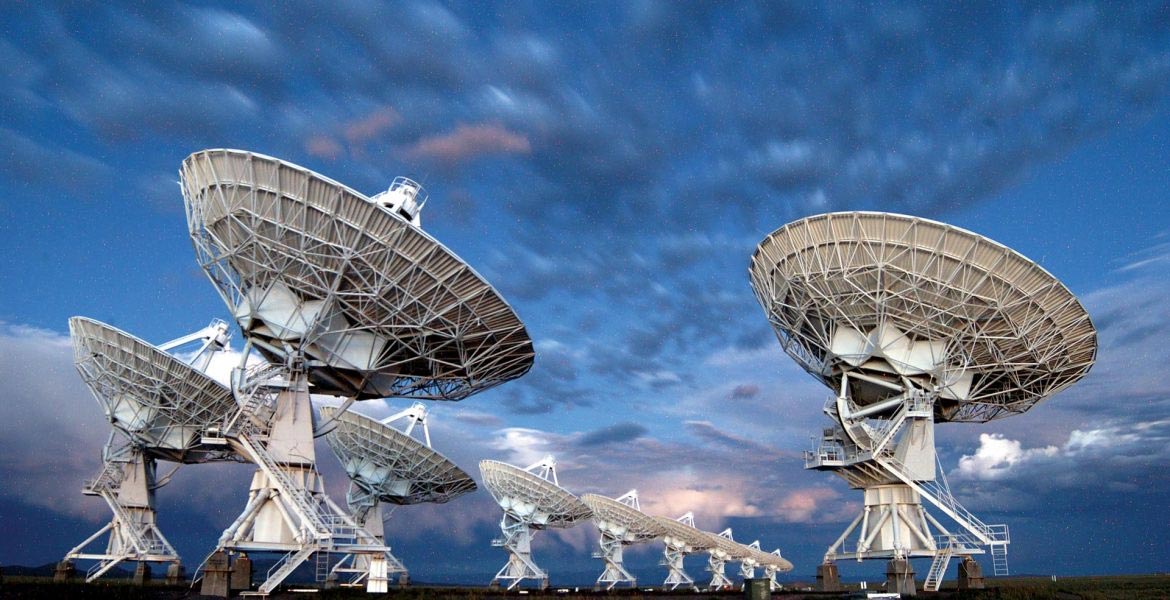
In order to study a wide range of astronomical phenomena, the VLA has several shapes or configurations, each with its own advantages.
When the Very Large Array was completed forty years ago, it was a different kind of radio telescope. Rather than having a single antenna dish, the VLA has 27. The data these antennas gather is combined in such a way that they act as a single radio telescope. As a radio array, the virtual dish of the VLA can cover an area roughly the size of Disney World. But the VLA can also do something ordinary telescopes can’t do: it can change shape.
Movable Antennas Create Multiple Telescopes in One
The antennas of the VLA are arranged along three long arms, each with nine antennas. Each arm has a rail track, allowing the antennas to be moved to different locations along the arm by a 200-ton transporter. Thus, the antennas can be spaced widely apart, or clustered close together. Although each antenna can be moved individually, they are typically positional in standard arrangements or configurations. In many ways, each configuration is its own radio telescope. By moving antennas into these different configurations, the VLA can serve as many observatories rolled into one.
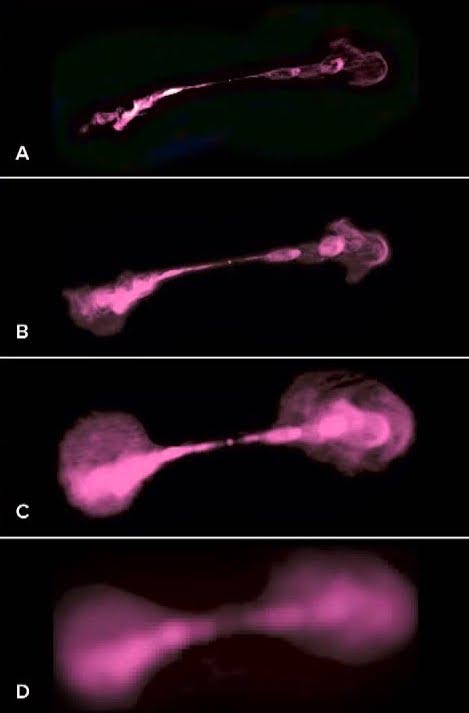
The power of a telescope largely depends upon two factors: the faintness of the light it can see, known as its sensitivity, and the sharpness of the images it can produce, known as its resolution. These two factors are often contradictory. To capture faint images a telescope needs to collect lots of light over a long time, but this can make images blurry. To capture a sharp image you often need a brighter source. It is similar to the effect of our own eyes, which adapt to brightness. It’s one of the reasons you can see clearly in bright daylight, while things can look more blurry in dim light. By arranging antennas into different configurations, the VLA can overcome this challenge, allowing it to capture both sharp images and faint objects depending on the needs of astronomers.
The Four Configurations of the VLA
There are four primary configurations used by the VLA. They are each assigned a letter A – D, depending on the spread of the antennas. Configuration A, spanning more than 22 miles, is where the antennas are most widely spaced, and Configuration D is where they are closest together, with the antennas clustered into an area less than a mile wide. The VLA cycles through these configurations, staying in each one for several months.
The largest configuration gives the VLA its highest resolution. Radio astronomers often want to see fine details in a radio image, which is why Configuration A is the most requested. But smaller configurations have their own uses. Configuration D gives the VLA the greatest sensitivity. This makes it particularly useful in the study of diffuse hydrogen gas in nearby galaxies, and in capturing images of faint radio nebulae.
Configuration B is a workhorse configuration. It is a third the width of Configuration A and therefore strikes a balance between sensitivity and resolution. It is mostly used for the VLA Sky Survey (VLASS), which is a 7-year project to map 80% of the sky in radio light. When it is finished it will have a catalog of more than 10 million radio sources. VLASS also uses an additional hybrid configuration known as BnA. In this arrangement, the antennas in the north arm are arranged in A configuration, while antennas in the other two arms are kept in B Configuration. This gives the virtual dish of the VLA an oval shape.
Configuration BnA is used to see the southernmost region of the sky. Objects in the far south of the sky are near the horizon, and their light comes in at a low angle. By stretching the northern arm, the VLA can “circularize” the images gathered so they aren’t distorted by their low angle.
The VLA’s Ever-Changing Shape
If in the future you happen to visit the VLA, you may find the antennas scattered near the horizon, or huddled close to the visitor center. If you visit at another time, you will likely see the antennas in a different configuration. All because VLA shapeshifts to see the universe in wondrous new ways.
Never miss a breakthrough: Join the SciTechDaily newsletter.
Follow us on Google and Google News.