

Close Menu
    Facebook X (Twitter) Instagram
    SciTechDaily
    • Biology
    • Chemistry
    • Earth
    • Health
    • Physics
    • Science
    • Space
    • Technology
    Facebook X (Twitter) Pinterest YouTube RSS
    SciTechDaily
    Home»Technology»Thermoelectric Material Discovery May Deliver New Forms of Electric Power in the Future
    Technology

    Thermoelectric Material Discovery May Deliver New Forms of Electric Power in the Future

    By Clemson UniversityApril 16, 20211 Comment3 Mins Read
    Facebook Twitter Pinterest Telegram LinkedIn WhatsApp Email Reddit
    Share
    Facebook Twitter LinkedIn Pinterest Telegram Email Reddit
    Thermoelectric Material Concept
    Scientists create a new and potentially paradigm-shifting high-performance thermoelectric compound.

    Clemson physicist joins forces with collaborators from China and Denmark to create hybrid compound.

    Thermoelectrics directly convert heat into electricity and power a wide array of items — from NASA’s Perseverance rover currently exploring Mars to travel coolers that chill beverages.

    A Clemson University physicist has joined forces with collaborators from China and Denmark to create a new and potentially paradigm-shifting high-performance thermoelectric compound.

    A material’s atomic structure, which is how atoms arrange themselves in space and time, determines its properties. Typically, solids are crystalline or amorphous. In crystals, atoms are in an orderly and symmetrical pattern. Amorphous materials have randomly distributed atoms.

    Clemson researcher Jian He and the international team created a new hybrid compound in which the crystalline and amorphous sublattices are intertwined into a one-of-a-kind crystal-amorphic duality.
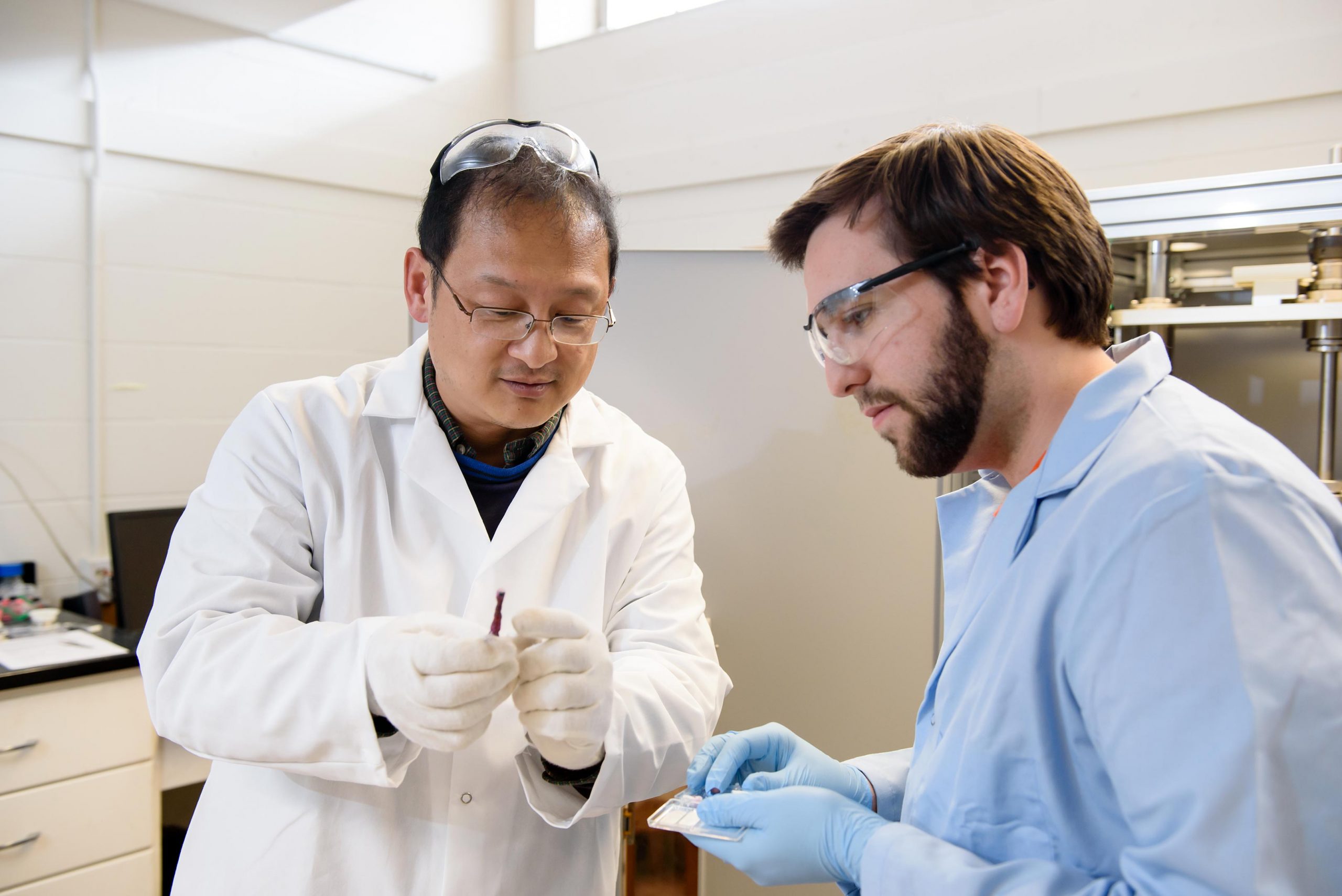
    Jian He in Lab
    Jian He is an associate professor in Clemson University’s Department of Physics and Astronomy. Credit: Clemson University College of Science

    Dual Nature of the Atomic Lattice

    “Our material is a unique hybrid atomic structure with half being crystalline and half amorphous,” said He, an associate professor in the College of Science’s Department of Physics and Astronomy. “If you have a unique or peculiar atomic structure, you would expect to see very unusual properties because properties follow structure.”

    The high-profile energy research journal Joule published their findings in a paper titled “Thermoelectric materials with crystal-amorphicity duality induced by large atomic size mismatch,” which appeared online today (April 16, 2021) ahead of the May 19 issue.

    The researchers created their hybrid material by intentionally mixing elements in the same group on the periodic table but with different atomic sizes. Here, they used the atomic size mismatches between sulfur and tellurium and between copper and silver to create a new compound (Cu1-xAgx)2(Te1-ySy) in which the crystalline and amorphous sublattices intertwine into a one-of-a-kind crystal-amorphicity duality. The new compound exhibited excellent thermoelectric performance.

    Implications for Thermoelectric Performance

    While this discovery doesn’t directly impact application now, it is likely to lead to better thermoelectrics in the future.

    “The new material performs well, but more important than that is how it achieves that level of performance,” He said. “Traditionally, thermoelectric materials are crystals. Our material is not pure crystal, and we show we can achieve the same level of performance with a material with a new atomic structure.”

    He said he expects the new material will begin affecting applications in 10 to 20 years.

    “They definitely can do something current thermoelectric materials cannot do, but not now,” He said. “However, the future of this research is bright.”

    In addition to He, the research involved scientists from Shanghai Jiaotong University, Shanghai Institute of Ceramics and SUSTech in China, and Aarhus University in Denmark.

    Reference: “Thermoelectric materials with crystal-amorphicity duality induced by large atomic size mismatch” by Kunpeng Zhao, Espen Eikeland, Dongsheng He, Wujie Qiu, Zhicheng Jin, Qingfeng Song, Tian-ran Wei, Pengfei Qiu, Jianjun Liu, Jiaqing He, Bo Brummerstedt Iversen, Jian He, Lidong Chen and Xun Shi, 16 April 2021, Joule.
    DOI: 10.1016/j.joule.2021.03.012

    Never miss a breakthrough: Join the SciTechDaily newsletter.
    Follow us on Google and Google News.

    Clemson University Energy Green Energy Materials Science Popular
    Share. Facebook Twitter Pinterest LinkedIn Email Reddit

    Related Articles

    Smelting Steel Without Fossil Fuels: Solar Power Shatters the 1,000°C Barrier for Industrial Heating

    Clean Energy 24/7: Engineers Use Nanotechnology To Harvest Electricity “From Thin Air”

    Harvesting Clean Energy From Water Evaporation – Morphing Crystals Convert Evaporation Energy Into Motion

    Breakthrough Self-Assembly Innovation Enables Cheaper Solar Energy Production

    Solar Cell Performance Boosted by Biological Material That Mimics Photosynthesis

    30x Improvement in Renewable Energy Solution Inspired by Croissant Making

    New Aluminum Batteries Increase the Range of UUVs Tenfold

    Floating Nuclear Power Plant that is Safer and Cheaper

    Nanosheet-Flower Structure Boosts Energy Storage

    1 Comment

    1. John Jakson on April 24, 2021 3:02 pm

      And this new form of TEG material has a conversion rate of what precisely ?

      As usual, no data, no use.

      Reply
    Leave A Reply Cancel Reply

    • Facebook
    • Twitter
    • Pinterest
    • YouTube

    Don't Miss a Discovery

    Subscribe for the Latest in Science & Tech!

    Trending News

    Scientists Uncover Potential Brain Risks of Popular Fish Oil Supplements

    Scientists Discover a Surprising Way To Make Bread Healthier and More Nutritious

    After 60 Years, Scientists Uncover Unexpected Brain Effects of Popular Diabetes Drug Metformin

    New Research Uncovers Hidden Side Effects of Popular Weight-Loss Drugs

    Scientists Rethink Extreme Warming After Surprising Ocean Discovery

    Landmark Study Links Never Marrying to Significantly Higher Cancer Risk

    Researchers Discover Unknown Beetle Species Just Steps From Their Lab

    Largest-Ever Study Finds Medicinal Cannabis Ineffective for Anxiety, Depression, PTSD

    Follow SciTechDaily
    • Facebook
    • Twitter
    • YouTube
    • Pinterest
    • Newsletter
    • RSS
    SciTech News
    • Biology News
    • Chemistry News
    • Earth News
    • Health News
    • Physics News
    • Science News
    • Space News
    • Technology News
    Recent Posts
    • Students Build Dark Matter Detector and Set New Experimental Limits
    • Scientists Discover Caffeine Can Repair Key Memory Circuits After Sleep Loss
    • Strange 65-Foot Dinosaur Discovered in Argentina
    • Researchers Uncover Source of Strange Deformation in Earth’s Largest Continental Rift
    • Scientists Solve Mystery of Where the Colorado River Vanished Millions of Years Ago
    Copyright © 1998 - 2026 SciTechDaily. All Rights Reserved.
    • Science News
    • About
    • Contact
    • Editorial Board
    • Privacy Policy
    • Terms of Use

    Type above and press Enter to search. Press Esc to cancel.