
Close Menu
    Facebook X (Twitter) Instagram
    SciTechDaily
    • Biology
    • Chemistry
    • Earth
    • Health
    • Physics
    • Science
    • Space
    • Technology
    Facebook X (Twitter) Pinterest YouTube RSS
    SciTechDaily
    Home»Chemistry»These “Weird” Crystals Explode in Light
    Chemistry

    These “Weird” Crystals Explode in Light

    By Michael Miller, University of CincinnatiApril 10, 2025No Comments4 Mins Read
    Facebook Twitter Pinterest Telegram LinkedIn WhatsApp Email Reddit
    Share
    Facebook Twitter LinkedIn Pinterest Telegram Email Reddit
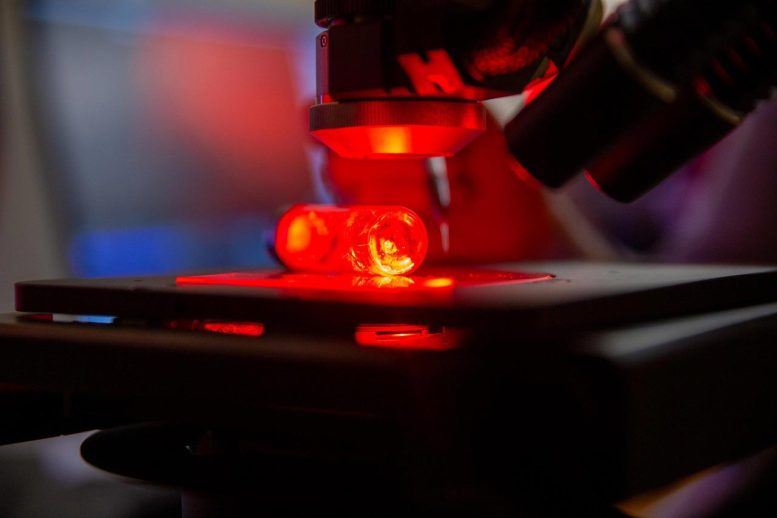
    Crystals in Action Under Light
    University of Cincinnati chemistry students are studying the properties of photoexplosive crystals that bend, twist, or explode under white light. Credit: Andrew Higley

    Chemists are investigating the bizarre properties of certain materials that could be used to develop oxygen safety systems and support future space travel.

    Chemistry students at the University of Cincinnati are studying lab-grown crystals that react in remarkable ways when exposed to light.

    They bend. They twist. They bounce. And sometimes, they explode.

    Professor Anna Gudmundsdottir leads the research on these photo-explosive crystals. Because the field is still relatively unexplored, her students are breaking new ground with each unexpected reaction they uncover.

    “We’re studying what makes crystals behave when exposed to light. We can make them jump, explode, or dance. They do all kinds of weird things,” Gudmundsdottir said.
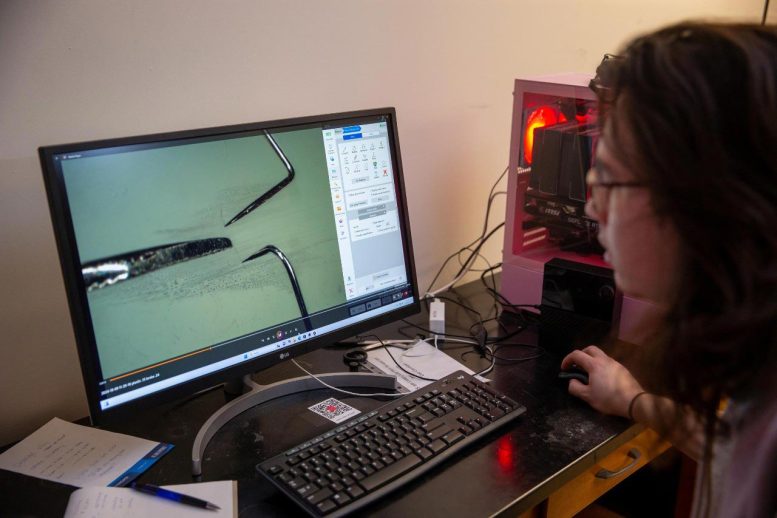
    Ben Miller Manipulating Lab Grown Crystals
    UC student Ben Miller manipulates lab-grown crystals under magnification in a chemistry lab. Credit: Andrew Higley

    Light reveals molecular secrets

    She received a $550,000 grant from the National Science Foundation to examine the properties of crystals that UC students “grow” in the chemistry lab. They react to light in different ways depending on the way the molecules are packed inside them.

    “It fascinates me that the same molecules can create different crystals,” UC doctoral student Fiona Wasson said.

    When irradiated with light, some crystals bend at either end with the strength to lift objects hundreds of times their size. Others twist into a helix of more than 360 degrees. Others practically hop off the microscopic slide like a tiny jumping bean.
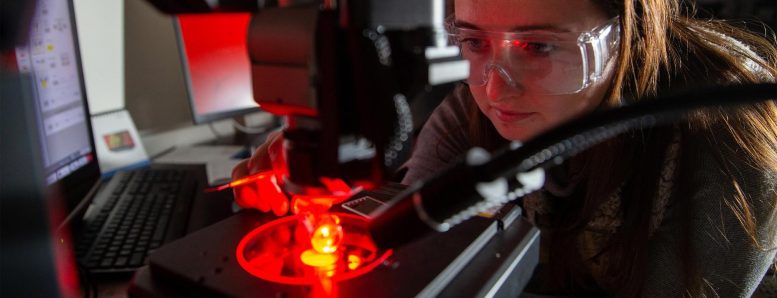
    Fiona Wasson Studies Photo Explosive Crystals in Red Light
    University of Cincinnati doctoral student Fiona Wasson studies photoexplosive crystals in red light under a microscope. Credit: Andrew Higley

    “I’m amazed by what the students have been able to do with these crystals,” Gudmundsdottir said. “We don’t yet understand a lot of it. We’re the first ones to experiment with the gas release, so the discovery makes it a lot of fun for the students.”

    What causes this reaction?

    Gudmundsdottir said the light prompts the crystals to expel atmospheric nitrogen trapped when the crystals form.

    Documenting the explosive effect

    For his undergraduate research fellowship, UC student Ben Miller spent a semester in a lab darkroom Gudmundsdottir built for the express purpose of documenting photo-explosive reactions in crystals. Students use adjustable red lights to focus the microscope’s cameras on the tiny crystals before hitting them with a variety of LED lights.

    Miller learned that the crystals that bend from light can also be manipulated with mechanical force using tiny needles and tweezers. Experimenting with them was a lot of fun, he said.

    Professor Anna Gudmundsdottir
    UC Professor Anna Gudmundsdottir teaches chemistry in UC’s College of Arts and Sciences. Credit: Andrew Higley

    “What’s cool about it is it bends and when it snaps back, there’s no damage to the surface or anything. That’s pretty unique for crystals,” he said. “I learned a lot. Sometimes I think, ‘I know something about science that nobody else knows.’ And that’s very interesting.”

    Typically, the crystals UC students grow in the lab only put on a show once before their nitrogen escapes. But other crystals can perform their bending or twisting show again and again, raising the possibility of creating light-powered muscle fibers or sensor actuators, Gudmundsdottir said.

    She sees even more potential for crystals that release oxygen when activated with light. These could be used to create a safer, lightweight oxygen system for airplanes that suffer a loss of cabin pressure at altitude, she said.

    Or even some day for space exploration, Wasson said.

    “There is lots of light in space,” Wasson said. “It’s exciting to study this. We’re just in the first few years of exploring it.”

    Funding: U.S. National Science Foundation

    Never miss a breakthrough: Join the SciTechDaily newsletter.
    Follow us on Google and Google News.

    Crystals Molecular Chemistry University of Cincinnati
    Share. Facebook Twitter Pinterest LinkedIn Email Reddit

    Related Articles

    Calcium’s Cosmic Secret: How a Common Mineral May Have Sparked Life on Earth

    Scientists Thought They Made a Mistake – But It Led to a Groundbreaking “Molecular Einstein” Discovery

    Revolutionizing Drug Discovery: Scientists Develop World’s First Single-Atom Editing Technology

    Shape-Shifting Membrane Transforms Carbon Capture Technology

    Breaking the Rules of Chemistry: New Theory Shatters Old Ideas About Crystal Formation

    125 Years After Its Discovery, Actinium’s Chemistry Still Baffles Scientists

    Lightning Bonds: Capturing Halogen Magic in the Blink of an Eye

    Inside the Crystal Matrix: New “X-Ray Vision” Technique Sees Inside Crystals

    Unlocking the Secrets of Space Chemistry With Cold Coulomb Crystals

    Leave A Reply Cancel Reply

    • Facebook
    • Twitter
    • Pinterest
    • YouTube

    Don't Miss a Discovery

    Subscribe for the Latest in Science & Tech!

    Trending News

    Largest-Ever Study Finds Medicinal Cannabis Ineffective for Anxiety, Depression, PTSD

    250-Million-Year-Old Egg Solves One of Evolution’s Biggest Mysteries

    Living With Roommates Might Be Changing Your Gut Microbiome Without You Knowing

    Century-Old Cleaning Chemical Linked to 500% Increased Risk of Parkinson’s Disease

    What if Your Memories Never Happened? Physicists Take a New Look at the Boltzmann Brain Paradox

    One of the Universe’s Largest Stars May Be Getting Ready To Explode

    Scientists Discover Enzyme That Could Supercharge Ozempic-Like Weight Loss Drugs

    Popular Sweetener Linked to DNA Damage – “It’s Something You Should Not Be Eating”

    Follow SciTechDaily
    • Facebook
    • Twitter
    • YouTube
    • Pinterest
    • Newsletter
    • RSS
    SciTech News
    • Biology News
    • Chemistry News
    • Earth News
    • Health News
    • Physics News
    • Science News
    • Space News
    • Technology News
    Recent Posts
    • Scientists Prove There Are Just Six Degrees of Separation in a Social Network
    • Bee Bacteria Could Fix a Major Flaw in Plant-Based Milk
    • Scientists Discover a Surprising Way To Make Bread Healthier and More Nutritious
    • Natural Compounds Boost Bone Implant Success While Killing Bacteria and Cancer Cells
    • After 60 Years, Scientists Uncover Unexpected Brain Effects of Popular Diabetes Drug Metformin
    Copyright © 1998 - 2026 SciTechDaily. All Rights Reserved.
    • Science News
    • About
    • Contact
    • Editorial Board
    • Privacy Policy
    • Terms of Use

    Type above and press Enter to search. Press Esc to cancel.