
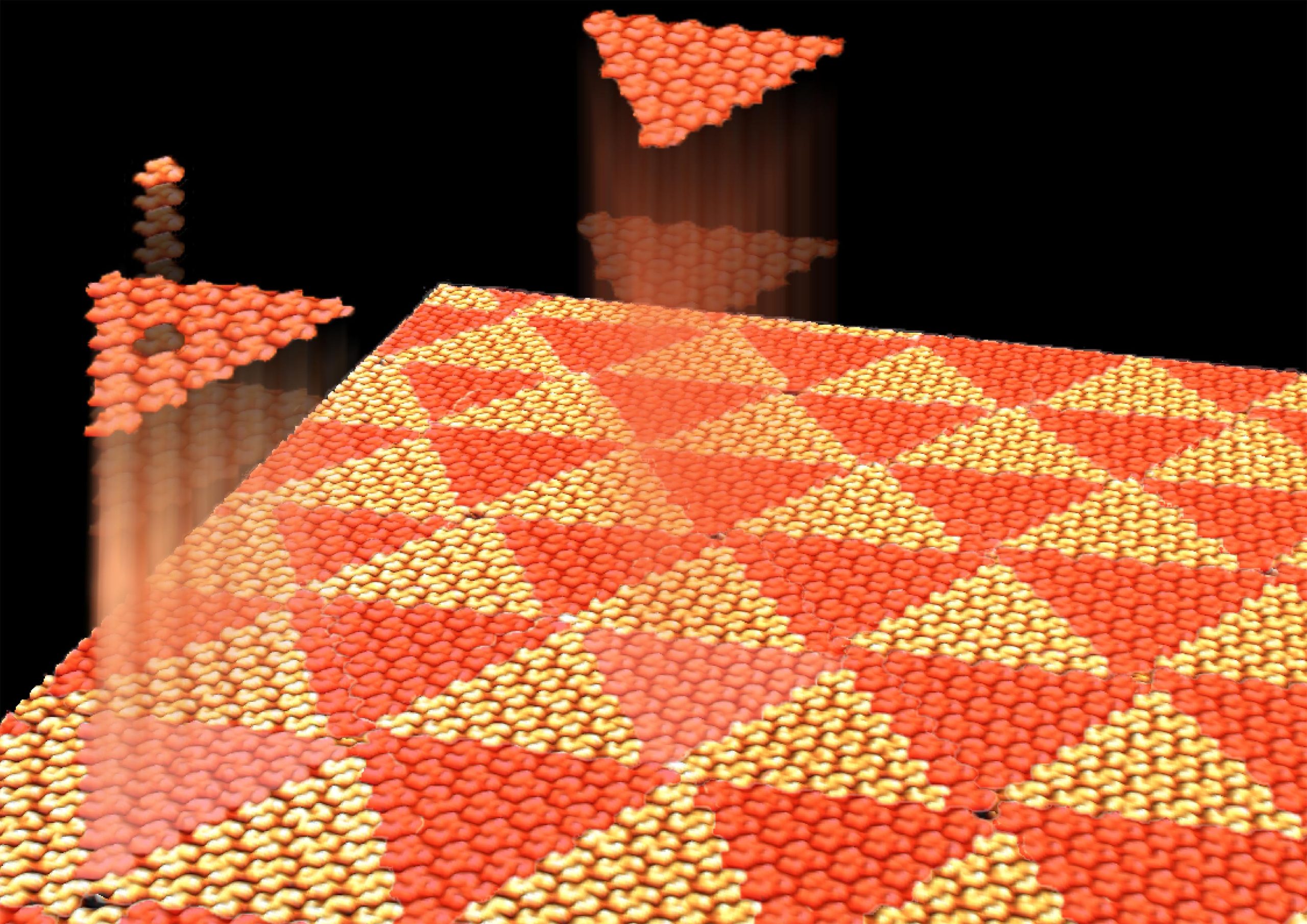
A strange molecular pattern, first mistaken for an error, led researchers to an unexpected discovery: molecules forming non-repeating structures similar to the einstein tiling problem.
This phenomenon, driven by chirality and energy balance, could pave the way for novel insights into molecular physics.
The Einstein Problem: A Tiling Mystery
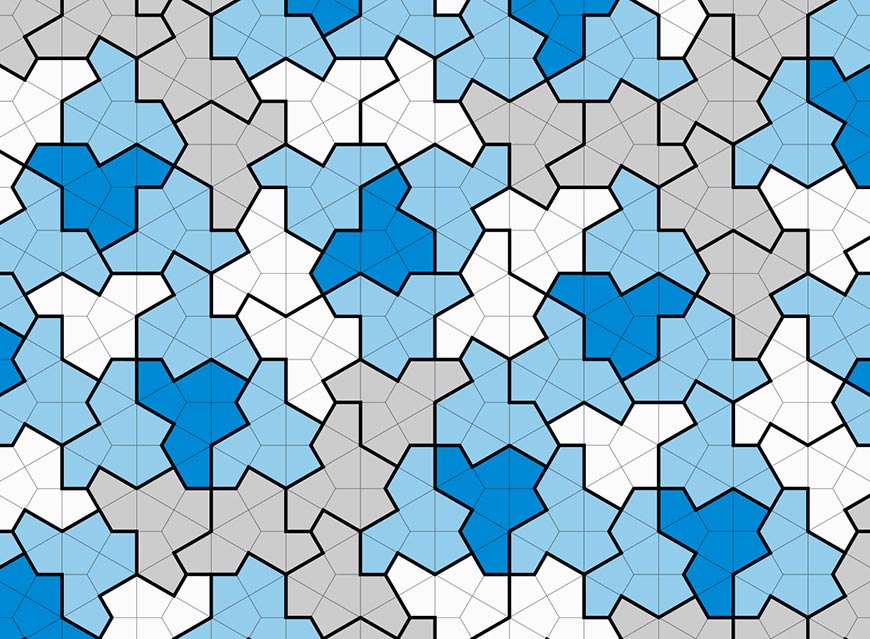
At the crossroads of mathematics and tiling lies the einstein problem—a puzzle that, despite its name, has nothing to do with Albert Einstein. The question is simple yet profound: Can a single shape tile an infinite surface without ever creating a repeating pattern? In 2022, English amateur mathematician David Smith discovered such a shape, known as a “proto-tile.”
Chemist Karl-Heinz Ernst of Empa never expected this mathematical challenge to cross into his field of research. His work focuses on how molecules crystallize on metal surfaces, not tiling problems. But that changed when his doctoral student, Jan Voigt, made an unusual discovery. In one experiment, a particular molecule crystallized on a silver surface—not in the expected orderly structure, but in an irregular pattern that never repeated. Even more astonishing, every time the experiment was repeated, a different aperiodic pattern emerged.
At first, Ernst and Voigt assumed there had been a mistake. But as they investigated further, they realized the patterns were real. The question became: Why were the molecules arranging themselves this way? The answer, now published in Nature Communications, reveals an unexpected link between chemistry and a long-standing mathematical puzzle.
The Curious Role of Chirality
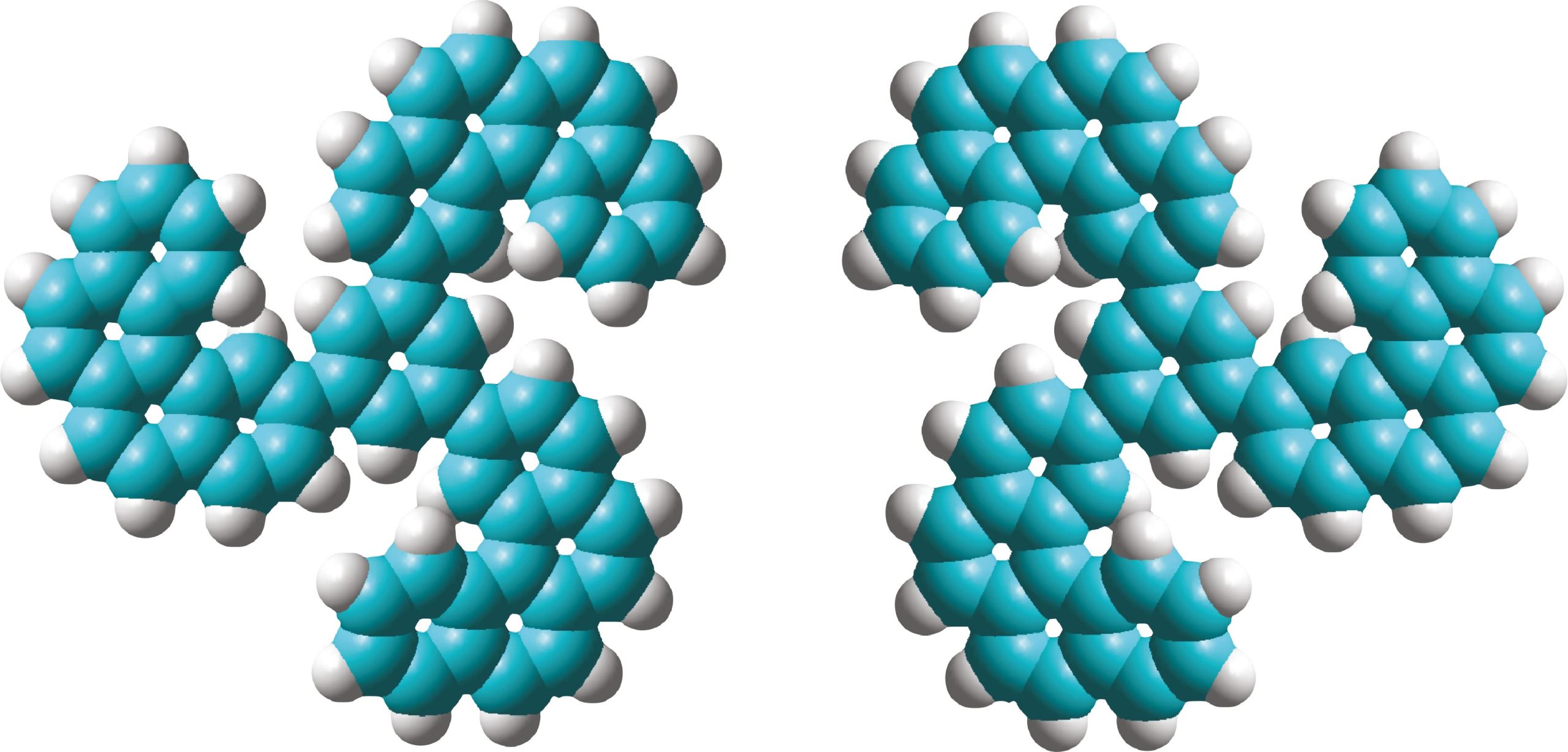
Ernst and Voigt are interested in so-called chirality, the “handedness” that characterizes many organic molecules. Although chiral structures are chemically identical, they cannot be rotated into one another – similar to our right and left hands. This property is particularly important in the pharmaceutical industry. More than half of all modern medicines are chiral. Since biomolecules such as amino acids, sugars, and proteins in our body all have the same handedness, active pharmaceutical ingredients must also be chiral. A drug with the wrong handedness is ineffective at best and at worst even harmful.
Controlling handedness during the synthesis of organic molecules is therefore of enormous interest in chemistry. One of the possibilities is the crystallization of chiral molecules. It is cheap, effective and widely used – and yet not fully understood. The Empa researchers originally wanted to further this understanding with their experiment. To do this, they took a very special molecule, one that easily changes its handedness at room temperature – something that most chiral molecules practically never do.
“We expected the molecules to arrange themselves in the crystal according to their handedness,” explains Karl-Heinz Ernst, ”that is, either alternating or in groups with the same handedness.” Instead, the molecules seemingly randomly arranged themselves into triangles of different sizes, which in turn formed irregular spirals on the surface – the non-repeating or aperiodic structure that the researchers initially thought was a mistake.
From Puzzle Pieces to Physics
After a lot of puzzling, Voigt and Ernst finally managed to decipher the molecular patterns – not only through physics and mathematics, but also by trying them out with actual puzzle pieces on the computer or even at home at the kitchen table. The arrangement of the molecules is not completely random. They form triangles that measure between two and 15 molecules per side. In each experiment, one triangle size dominated. What’s more, triangles one size larger and one size smaller were also represented – but no others.
“Under our experimental conditions, the molecules ‘want’ to cover the silver surface as densely as possible because this is the most energetically favorable outcome,” explains Ernst. “However, due to their chirality, the triangles they form do not fit together exactly at the edges and have to be slightly offset.” The smaller and larger triangles are needed to fill the surface as efficiently as possible. This arrangement also creates defects in some places – small inconsistencies or holes that can become the center of a spiral.
The Power of Entropy
“Defects are actually unfavorable in terms of energy,” Ernst continues. “In this case, however, they enable a denser arrangement of the triangles, which compensates for the ‘lost’ energy.” This balance also explains why the researchers never found the same pattern twice: If all patterns are the same in terms of their energy cost, entropy decides.
The mystery of the “molecular einstein” has been solved – but how does this insight benefit us? “Surfaces with defects at the atomic or molecular level can have unique properties,” explains Ernst. “For an aperiodic surface like ours in particular, it has been predicted that the electrons in it would behave differently and that this could give rise to a new kind of physics.”
To investigate this, however, the aperiodic molecule would have to be studied under the influence of magnetic fields on a different surface. Karl-Heinz Ernst, who has recently retired, is leaving this task to others. “I have a little too much respect for physics,” smiles the chemist.
Reference: “An aperiodic chiral tiling by topological molecular self-assembly” by Jan Voigt, Miloš Baljozović, Kévin Martin, Christian Wäckerlin, Narcis Avarvari and Karl-Heinz Ernst, 2 January 2025, Nature Communications.
DOI: 10.1038/s41467-024-55405-5
Never miss a breakthrough: Join the SciTechDaily newsletter.
Follow us on Google and Google News.
3 Comments
Hi there, I hope this message finds you well. I’ve been exploring scitechdaily.com and I’m interested in writing a guest post for it. Could you provide the guidelines and conditions for guest contributions? Thanks in advance, I’m eager to hear back from you.
(760) 440-8117
Email the editors of SciTechDaily by sending an email to: editor {at} scitechdaily {dot} com
Please let us know if you have any questions or if you want to contribute to SciTechDaily.
The image shows equilateral triangles. Could the triangles also be isosceles, scalene, right, acute, or obtuse? Which if any of these othr five shapes are ruled out ?