

At the edge of two exotic materials, researchers discovered a strange new quantum state where electrons flow in six unusual directions—something never seen before.
This “quantum liquid crystal” challenges what we know about matter and could lead to powerful new quantum devices.
A New Quantum State at Material Interfaces
Scientists have discovered a new way that matter can exist – one that is different from the usual states of solid, liquid, gas or plasma – at the interface of two exotic, materials made into a sandwich.
The new quantum state, called quantum liquid crystal, appears to follow its own rules and offers characteristics that could pave the way for advanced technological applications, the scientists said.
Reporting in the journal Science Advances, a Rutgers-led team of researchers described an experiment that focused on the interaction between a conducting material called the Weyl semimetal and an insulating magnetic material known as spin ice when both are subjected to an extremely high magnetic field. Both materials individually are known for their unique and complex properties.
“Although each material has been extensively studied, their interaction at this boundary has remained entirely unexplored,” said Tsung-Chi Wu, who earned his doctoral degree in June from the Rutgers graduate program in physics and astronomy and is the first author of the study. “We observed new quantum phases that emerge only when these two materials interact. This creates a new quantum topological state of matter at high magnetic fields, which was previously unknown.”
Magnetic Fields Unleash Unexpected Electron Flow
The team discovered that at the interface of these two materials, the electronic properties of the Weyl semimetal are influenced by the magnetic properties of the spin ice. This interaction leads to a very rare phenomenon called “electronic anisotropy” where the material conducts electricity differently in different directions. Within a circle of 360 degrees, the conductivity is lowest at six specific directions, they found. Surprisingly, when the magnetic field is increased, the electrons suddenly start flowing in two opposite directions.
This discovery is consistent with a characteristic seen in the quantum phenomenon known as rotational symmetry breaking and indicates the occurrence of a new quantum phase at high magnetic fields.
Toward Powerful Quantum Sensors
The findings are significant because they reveal new ways in which the properties of materials can be controlled and manipulated, Wu said. By understanding how electrons move in these special materials, scientists could potentially design new generations of ultra-sensitive quantum sensors of magnetic fields that work best in extreme conditions – such as in space or inside powerful machines.
Weyl semimetals are materials that allow electricity to flow in unusual ways with very high speed and zero energy loss because of special relativistic quasi-particles called Weyl fermions. Spin ice, on the other hand, are magnetic materials where the magnetic moments (tiny magnetic fields within the material) are arranged in a way that resembles the positions of hydrogen atoms in ice. When these two materials are combined, they create a heterostructure, composed of atomic layers of dissimilar materials.
New Matter from Extreme Conditions
Scientists have found that new states of matter appear under extreme conditions, including very low temperatures, high pressures, or high magnetic fields, and behave in strange and fascinating ways. Experiments such as the Rutgers-led one may lead to new, fundamental understanding of matter beyond the naturally occurring four states of matter, according to Wu.
“This is just the beginning,” Wu said. “There are multiple possibilities for exploring new quantum materials and their interactions when combined into a heterostructure. We hope our work will also inspire the physics community to explore these exciting new frontiers.”
The research was conducted using a combination of experimental techniques, led by the principal investigator for the project, Jak Chakhalian, the Claud Lovelace Endowed Professor of Experimental Physics in the Department of Physics and Astronomy and a co-author of the study. The work was theoretically supported by Jedediah Pixley, an associate professor in the Department of Physics and Astronomy, also a co-author of the study.
“The experiment-theory collaboration is what really makes the work possible,” Wu said. “It took us more than two years to understand the experimental results. The credit goes to the state-of-the-art theoretical modeling and calculations done by the Pixley group, particularly Jed Pixley and Yueqing Chang, a postdoctoral researcher. We are continuing our collaboration to push the frontier of the field as a Rutgers team.”
Unraveling the Data at MagLab
Most of the experiments were conducted at the National High Magnetic Field Laboratory (MagLab) in Tallahassee, Fla., which provided the unique conditions to study these materials at ultra-low temperatures and high magnetic fields.
“We had to initiate the collaboration and travel to the MagLab multiple times to perform these experiments, each time refining ideas and methods,” Wu said. “The ultra-low temperatures and high magnetic fields were crucial for observing these new phenomena.”
Building the Quantum Heterostructure
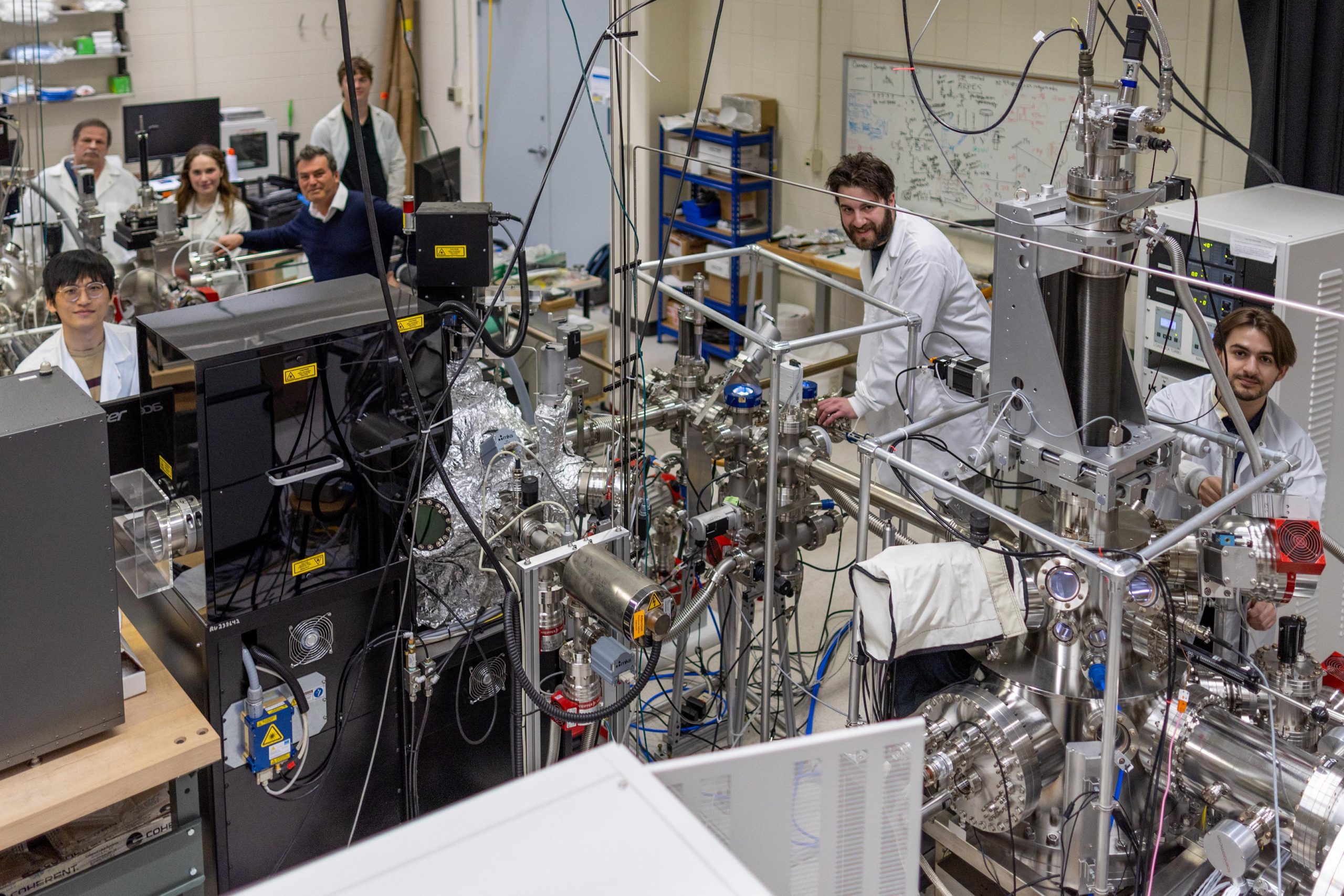
The research builds on previous Rutgers-led research published earlier this year by Chakhalian, Mikhail Kareev, Wu and other physicists. The report described how four years of continuous experimentation led to a novel method to design and build a unique, tiny, atoms-thick structure composed of a Weyl semimetal and spin ice. The quantum heterostructure was so difficult to create, the scientists developed a machine to make it: the Q-DiP, short for quantum phenomena discovery platform.
“In that paper, we described how we made the heterostructure,” said Chakhalian. “The new Science Advances paper is about what it can do.”
Reference: “Electronic anisotropy and rotational symmetry breaking at a Weyl semimetal/spin ice interface” by Tsung-Chi Wu, Yueqing Chang, Ang-Kun Wu, Michael Terilli, Fangdi Wen, Mikhail Kareev, Eun Sang Choi, David Graf, Qinghua Zhang, Lin Gu, Zhentao Wang, Jedediah H. Pixley and Jak Chakhalian, 13 June 2025, Science Advances.
DOI: 10.1126/sciadv.adr6202
In addition to Chakhalian, Wu, Chang and Pixley, Rutgers researchers on the study included Ang-Kun Wu, Michael Terilli, Fangdi Wen and Mikhail Kareev.
Never miss a breakthrough: Join the SciTechDaily newsletter.
Follow us on Google and Google News.
2 Comments
This interaction leads to a very rare phenomenon called “electronic anisotropy” where the material conducts electricity differently in different directions. Within a circle of 360 degrees, the conductivity is lowest at six specific directions, the researchers found.
VERY GOOD!
Please ask the researchers to think deeply:
Is the “electronic anisotropy” contradictory to the isotropy of space?
slurp