

Credit: Mate Csanad / ELTE Eötvös Loránd University
Particles in high-energy nuclear collisions move in a way that follows a pattern known as Lévy walks, a motion found across many scientific fields.
Named after mathematician Paul Lévy, Lévy walks (or, in some cases, Lévy flights) describe a type of random movement seen in nature and various scientific processes. This pattern appears in diverse phenomena, from how predators search for food to economic fluctuations, microbiology, chemical reactions, and even climate dynamics.
Lévy Walks in High-Energy Nuclear Collisions
In their latest research, Dániel Kincses, Márton Nagy, and Máté Csanád from ELTE’s Department of Atomic Physics and the Astro- and Particle Physics Programme of Excellence (TKP) have demonstrated that the motion of particles in high-energy nuclear collisions follows this same mathematical framework. Their findings emphasize the broad, interdisciplinary significance of Lévy walks in understanding complex systems.
“Our simulation-based studies have shown that if we follow the path of the particles, the length of the steps and the distribution of the final locations correspond to the mathematics of the Lévy walk,” summarizes Dániel Kincses, a postdoctoral researcher at ELTE.
Experimental Evidence from Particle Accelerators
A recent study published in Communications Physics confirms findings that ELTE researchers have observed in multiple large-scale experiments over the years. Using numerical simulations based on theoretical models, the study’s results align closely with data from ELTE’s measurements at several major particle accelerators, including the CERN SPS (NA61 experiment), BNL RHIC (PHENIX and STAR experiments), and CERN LHC (CMS experiment).
The research reveals that the distribution of particle positions after collisions does not follow a normal (Gaussian) distribution but instead follows a slowly decaying Lévy-stable distribution. “This also implies that the dynamics of the processes are similar to those observed in many other fields of science, from biology to earth sciences and economics,” adds Máté Csanád, professor at ELTE.
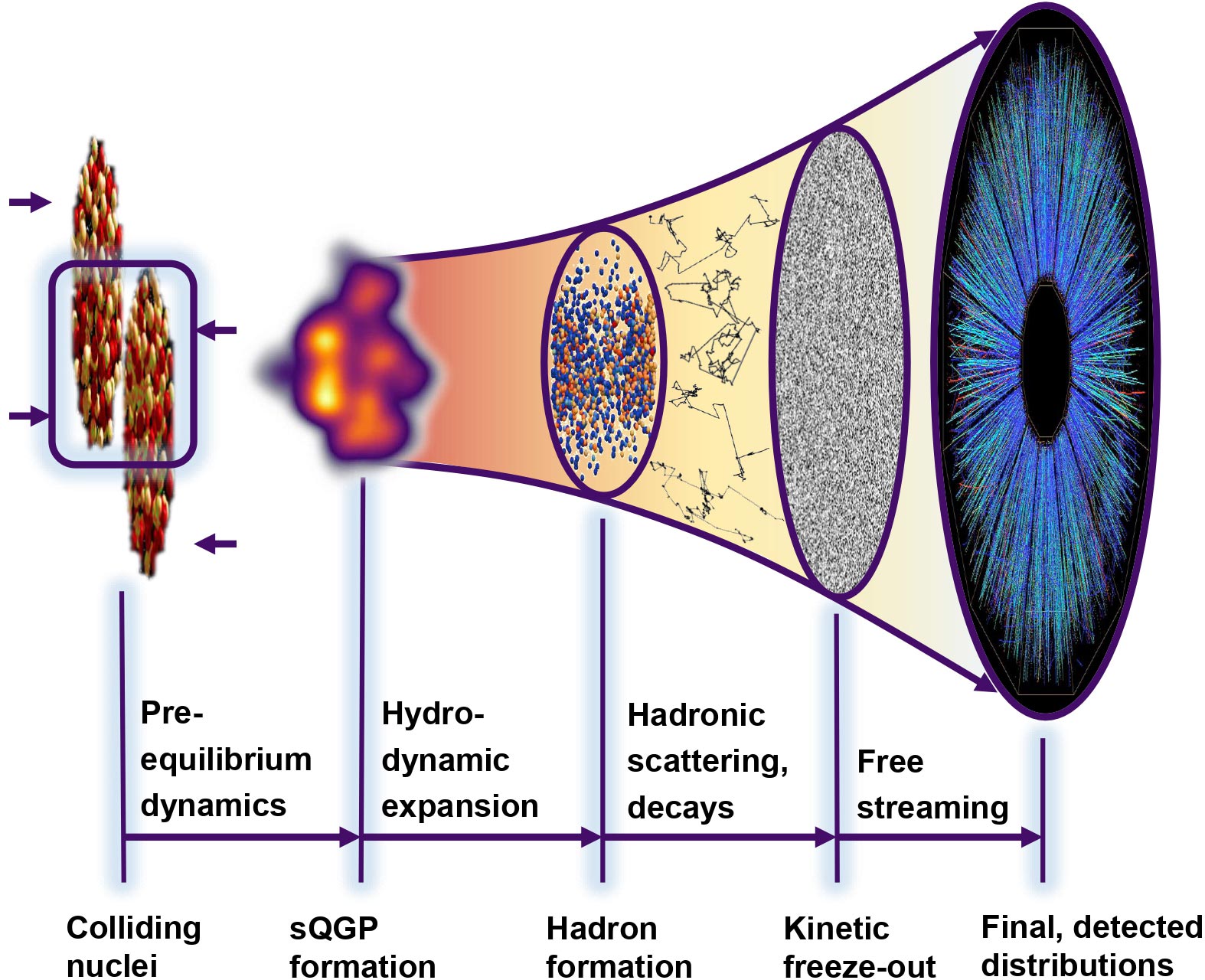
The subfield of heavy ion physics that addresses similar questions is called femtoscopy, because it deals with the femtosecond-scale exploration of the spatio-temporal structure of nuclear collisions. Researchers at ELTE are at the forefront of the femtoscopy discipline, participating in related research both experimentally and theoretically, and regularly presenting their related results at major international conferences. Their recently published paper may also give a new direction to experimental research by shedding light on the origin of the observed Lévy distributions.
Reference: “Lévy walk of pions in heavy-ion collisions” by Dániel Kincses, Márton Nagy and Máté Csanád, 5 February 2025, Communications Physics.
DOI: 10.1038/s42005-025-01973-x
Never miss a breakthrough: Join the SciTechDaily newsletter.
Follow us on Google and Google News.
9 Comments
The human mind often makes patterns where none actually exist.
Please think deeply:
What is the none actually exist?
Scientific research guided by correct theories can enable researchers to think more.
Topological Vortex Theory (TVT) is based on topology and fluid dynamics, which have solid mathematical and physical foundations. Under the topological vortex architecture, science and pseudoscience are clear at a glance. Topological Vortex Theory (TVT) can play a crucial role in elucidating the foundations of physics, establishing its principles, and combating pseudoscience.
However, some individuals, some AI (https://zhuanlan.zhihu.com/p/23079945169), and some so-called peer review publications (including PRL, PNAS, Nature, Science, etc.) stubbornly believe that two sets of cobalt-60 can form the mirror image of each other by rotating in opposite directions (https://scitechdaily.com/microscope-spacecrafts-most-precise-test-of-key-component-of-the-theory-of-general-relativity/#comment-854286), and stubbornly believe that the Topological Vortex Theory (TVT) currently lacks validation. This is because they have been misled by pseudoscientific information.
Vortex phenomena are ubiquitous in cosmic space, from vortices of quantum particles and living cells to tornados and black holes. The inviscid and incompressible spaces have been widely used in engineering simulation (https://scitechdaily.com/microscope-spacecrafts-most-precise-test-of-key-component-of-the-theory-of-general-relativity/#comment-870077). These all are the most powerful verification and validation.
Ask some so-called peer review publications (including PRL, PNAS, Nature, Science, etc.):
1. Does space not exist?
2. Does time not exist?
3. Does the ideal fluid not exist?
4. Do scientific experiments require time and space?
5. Do certain engineering simulations require ideal fluids?
6. If non-existent things are applied to scientific experiments and engineering simulations, and good results can be achieved. So, what is the difference between the non-existent thing and God?
Some individuals and some so-called peer review publications (including PRL, PNAS, Nature, Science, etc.) have been misleading the public with confusing concepts (https://pic2.zhimg.com/v2-4127b0b58fe8b88feb27c189fb705029_1440w.jpg?source=172ae18b), unscientific logic and reasoning, and self righteous Impact Factor (IF), hindering the progress of science and technology.
Fighting against rampant pseudoscience, physics still has a long way to go.
The subfield of heavy ion physics that addresses similar questions is called femtoscopy, because it deals with the femtosecond-scale exploration of the spatio-temporal structure of nuclear collisions.
Ask the scientists:
1. Do you really want to explore the spatio-temporal structure of nuclear collisions?
2. Is’ The Blind and the Elephant ‘just a fable?
Scientific research guided by correct theories can enable researchers to think more. Can you get an Interpretation of Quantum Theory within the Framework of Topological Vortex Theory (TVT)? (https://scitechdaily.com/microscope-spacecrafts-most-precise-test-of-key-component-of-the-theory-of-general-relativity/#comment-875168). Can you get an Interpretation of Einstein’s Relativity within the Framework of Topological Vortex Theory (TVT)? (https://scitechdaily.com/microscope-spacecrafts-most-precise-test-of-key-component-of-the-theory-of-general-relativity/#comment-875170).
A topological vortex is a concept in physics that describes the natural gravitational field or the fluid-body coupled system. A topological vortex is formed by the interaction and balance of vortex and anti-vortex field pairs, which can be set into resonance by the body motion and interaction.
Topological Vortex Theory (TVT) treats space as an ideal fluid, posits that the topological vortex gravitational field is fundamental to the structure of the universe, and emphasizes the importance of topological phase transitions in understanding mass, inertia, and energy.
According to the Topological Vortex Theory (TVT), spins create everything, spins shape the world. There are substantial distinctions between Topological Vortex Theory (TVT) and traditional physical theories. Grounded in the inviscid, incompressible, and isotropic spaces, TVT introduces the concept of topological phase transitions and employs topological principles to elucidate the formation and evolution of matter in the universe, as well as the impact of interactions between topological vortices and anti-vortices on spacetime dynamics and thermodynamics.
Within TVT, low-dimensional spacetime matter serves as the foundation for high-dimensional spacetime matter, and the hierarchical structure of matter and its interaction mechanisms challenge conventional macroscopic and microscopic interpretations. The conflict between Quantum Physics and Classical Physics can be attributed to their differing focuses: Quantum Physics emphasizes low-dimensional spacetime matter, whereas Classical Physics centers on high-dimensional spacetime matter.
Subatomic particles in the quantum world often defy the familiar rules of the physical world. The fact repeatedly suggests that the familiar rules of the physical world are pseudoscience. In the familiar rules of the physical world, two sets of cobalt-60 can form the mirror image of each other by rotating in opposite directions, and should receive the Nobel Prize for physics.
Please witness the grand performance of some so-called peer review publications (including PRL, PNAS, Nature, Science, etc.). https://scitechdaily.com/microscope-spacecrafts-most-precise-test-of-key-component-of-the-theory-of-general-relativity/#comment-854286. Some so-called academic publications (including PRL, PNAS, Nature, Science, etc.) are addicted to their own small circles and have deviated from science for a long time.
As the background of various material interactions and movements, space exhibits inviscid, absolutely incompressible and isotropic physical characteristics. It may form various forms of spacetime vortices through topological phase transitions. Hence, vortex phenomena are ubiquitous in cosmic space, from vortices of quantum particles and living cells to tornados and black holes. Stars and radioactive elements are one of the most active topological nodes in spacetime. Utilizing them is more valuable and meaningful than simulating them. Small or micro power topology intelligent batteries may be the direction of future energy research and development for human society.
Under the topological vortex architecture, science and pseudoscience are clear at a glance. Topological Vortex Theory (TVT) can play a crucial role in elucidating the foundations of physics, establishing its principles, and combating pseudoscience. Therefore, TVT has been strongly opposed and boycotted by traditional so-called peer review publications (such as PRL, PNAS, Nature, Science, etc.).
These so-called peer review publications (including PRL, PNAS, Nature, Science, etc.) mislead the direction of science and are known for their various absurdities and wonders. They collude together, reference each other, and use so-called Impact Factor (IF) or the Nobel Prize to deceive people around.
Ask the so-called peer review publications (including PRL, PNAS, Nature, Science, etc.):
1. What are your criteria for distinguishing science from pseudoscience?
2. Is your Impact Factor (IF) the standard for distinguishing science from pseudoscience?
3. Is the Nobel Prize the standard for distinguishing science from pseudoscience?
4. What is the most important aspect of academic publications?
5. Is the most important aspect of academic publications being flashy and impractical articles?
Pseudo academic publications (including PRL, PNAS, Nature, Science, etc.) are neither inclusivity nor openness, nor transparency and fairness, and have already had a serious negative impact on the progress of science and technology. Some so-called peer review publications (including PRL, PNAS, Nature, Science, etc.) are addicted to their own small circle and no longer know what science is. They hardly know what is dirty and ugly.
Publications that mislead the public under the guise of scholarship are more reprehensible than ordinary publications. The field of physics faces an ongoing challenge in maintaining scientific rigor and integrity in the face of pervasive pseudoscientific claims. Fighting against rampant pseudoscience, physics still has a long way to go.
While my comments may be lengthy, they are necessary to combat the proliferation of rampant pseudoscience and to promote the advancement of science and technology, and also is all I can do.
Appreciate the SciTechDaily for its inclusivity, openness, transparency, and fairness. If the researchers are truly interested in cosmic matter, please read: A Brief History of the Evolution of Cosmic Matter (https://scitechdaily.com/microscope-spacecrafts-most-precise-test-of-key-component-of-the-theory-of-general-relativity/#comment-873523).
Science and pseudoscience? Surely the clue is in the title, one is a repeatedly observed phenomenon, the other is not – that is like comparing feelings to facts, or predictable Newtonian mechanics with guessing.
It seems that we actually lack understanding in the interactions and events with matter; although we understand the main fields which carry the forces (the ones we know about), we currently don’t understand the fundamental mechanisms of the field interactions, although we are close because of our observations and predictions.
The elusive “dark matter and dark energy” which are obviously involved here, and you cannot abide adult rename them to anything you want, these fundamentals we are missing and whatever they are or how they interact is going to be the key to understanding “why” these events happen.
Your reply was long, I’d like to read your publications if you can give me links to them.
That a lot of words for a comment.
Thank you for your comment.
You are correct.
However, No matter how many words are written, the Blind can fail to see them. The blind people have gained countless benefits and honors through touch. Blind people are the best fig leaf for them to share their personal experiences. Some so-called peer review publications (including PRL, PNAS, Nature, Science, etc.) are no longer willing, even afraid of the moment they open their eyes.
Let us continue to witness the dirtiest and ugliest times in the history of science and humanities with facts, and continue to touch this world full of dark things with the so-called Influence Factor (IF) that emits the taste of money and desire.
The fluid mechanical recognition of the Hubble parameter (change in velocity with distance) as a fluid shear actually defines galactic and planetary system sizes.
We need to build a moon collider.
Muon, sorry.