

Astronomers have unveiled surprising new details about a small galaxy, NGC 300, challenging existing theories on galaxy formation.
By observing ancient, metal-poor stars and a vast stellar stream extending over 100,000 light-years, the study demonstrates that even dwarf galaxies engage in the accretion of mass from their surroundings, similar to their larger counterparts.
Galaxy Formation and Hierarchical Assembly
A team of astronomers, led by Catherine Fielder from the University of Arizona, has captured the most detailed images yet of a small galaxy and its surroundings. These images reveal features usually seen in much larger galaxies, offering a rare look into how smaller galaxies form and evolve. The findings suggest that the processes driving galaxy growth may be more universal than previously believed.
Fielder shared the research results last week at the 245th meeting of the American Astronomical Society in National Harbor, Maryland.
Galaxies, including our Milky Way, grow over billions of years by merging with smaller galaxies in a process known as hierarchical assembly. This “building block” approach is well documented in large galaxies, where streams of ancient stars — remnants of galaxies that were absorbed — help trace their history. These stellar streams, along with scattered older stars, form what is called a stellar halo. This vast, low-density cloud of stars surrounds the bright central disk of a galaxy and provides insight into its past.
According to traditional wisdom, smaller galaxies such as the nearby Large Magellanic Cloud may have fewer opportunities to attract mass and merge with smaller systems, including other dwarf galaxies, because of their weaker gravitational pull. Understanding how such galaxies acquire mass and grow in the context of hierarchical assembly remains an open question.
Insights from the DECam Local Volume Survey
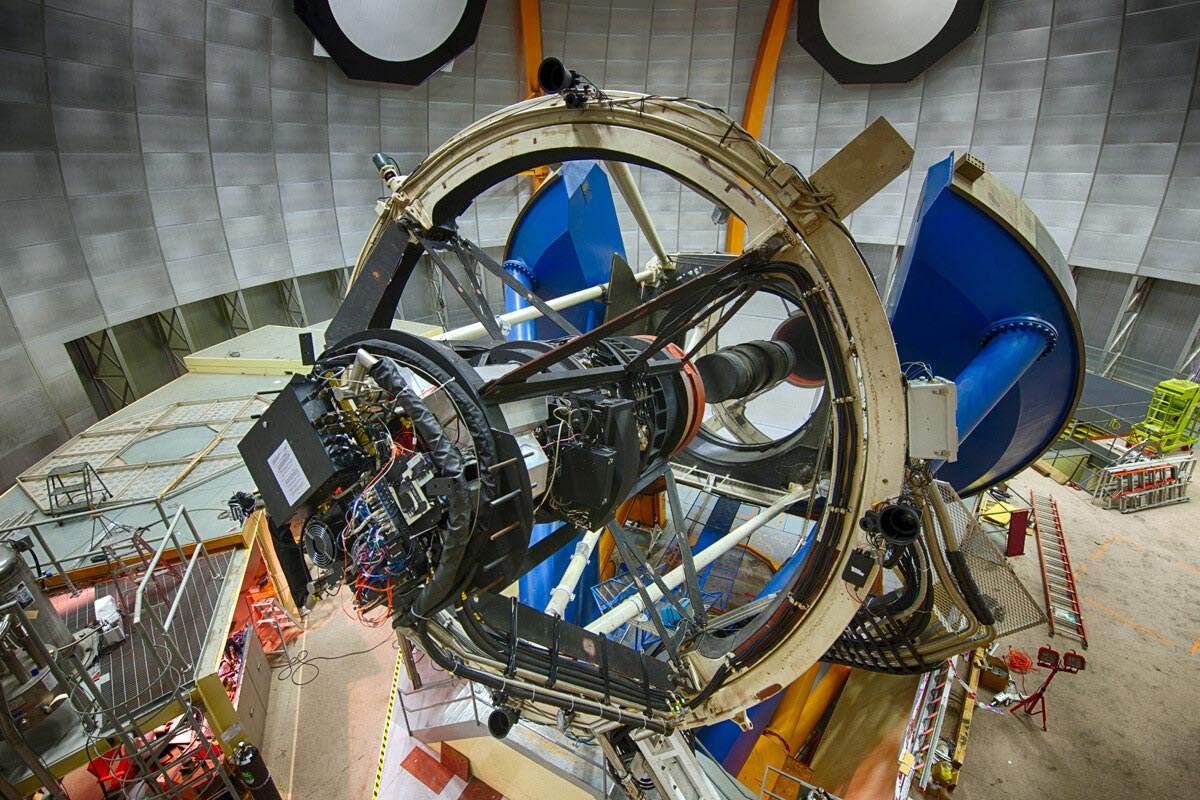
Researchers used the Dark Energy Camera, or DECam, on the 4-meter Blanco Telescope in Chile’s Cerro Tololo Inter-American Observatory to conduct a deep imaging survey of 11 dwarf galaxies, including the spiral galaxy NGC 300, which is similar in mass to the Large Magellanic Cloud. The observations were made as part of the DECam Local Volume Survey, or DELVE, and revealed unprecedented details of NGC 300’s features. Spanning about 94,000 light-years, NGC 300’s galactic disk is a little smaller than the Milky Way and packs only about 2% of its stellar mass.
“NGC 300 is an ideal candidate for such a study because of its isolated location,” said Fielder, a research associate at the U of A Steward Observatory. “This keeps it free from the influential effects of a massive companion like the Milky Way, which affects nearby small galaxies like the Large Magellanic Cloud. It’s almost a bit like looking at a cosmic ‘fossil record.'”
Discoveries Around NGC 300
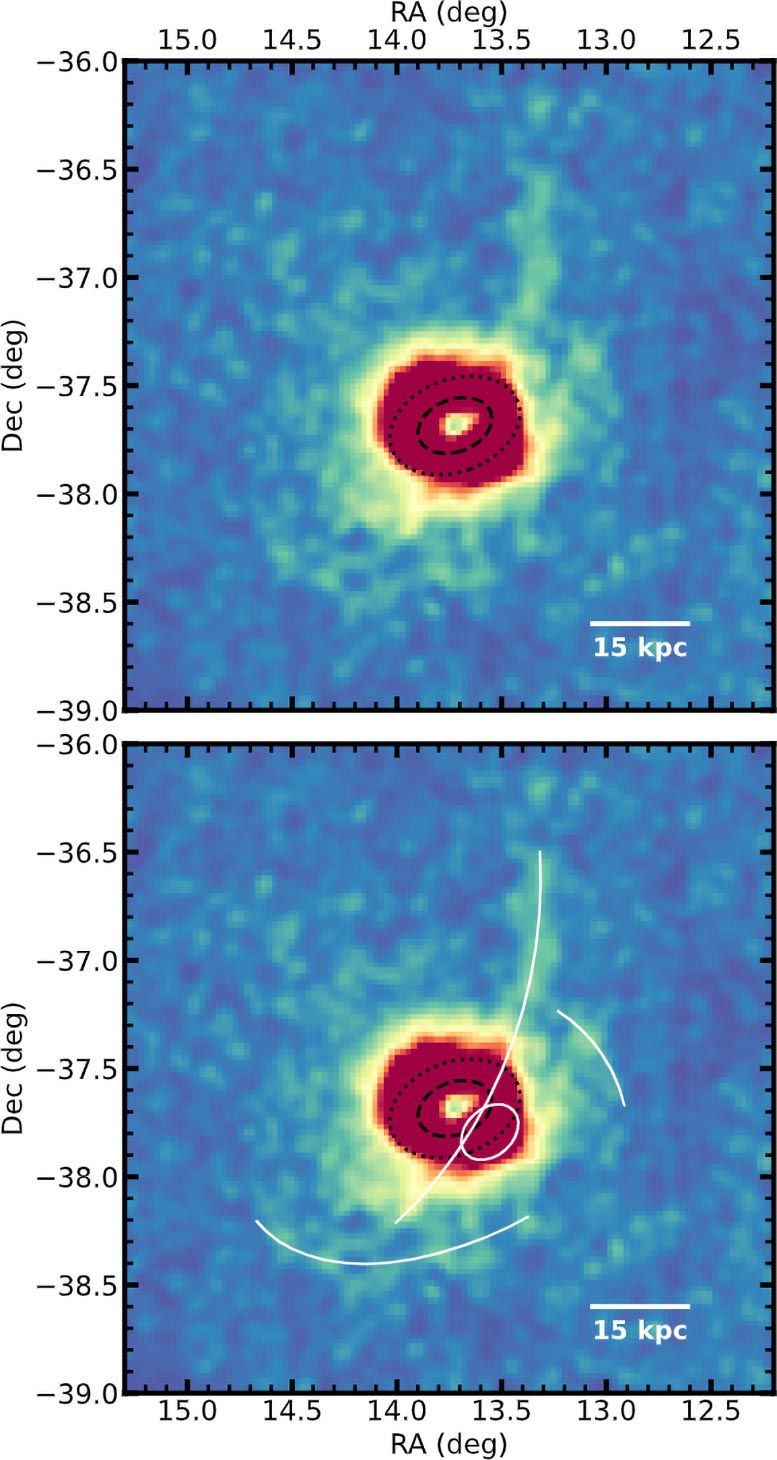
Fielder and her collaborators created stellar maps around the small galaxy and discovered a vast stellar stream extending more than 100,000 light-years from the galaxy’s center.
“We consider a stellar stream a telltale sign that a galaxy has accreted mass from its surroundings, because these structures don’t form as easily by internal processes,” said Fielder, whose findings will be published in The Astrophysical Journal.
In addition, the researchers found traces of stars arranged in shell-like patterns reminiscent of concentric waves emanating from the center of the galaxy, as well as hints of a stream wrap – evidence that whatever caused the stream may have changed direction in its orbit around NGC 300.
“We weren’t sure we were going to find anything in any of these small galaxies,” she said. “These features around NGC 300 provide us with ‘smoking gun’ evidence that it did accrete something.”
Understanding Galactic Evolution
The team also identified a previously unknown, metal-poor globular star cluster in the galaxy’s halo, another “smoking gun” of past accretion events.
When gauging the age of stellar populations, astronomers frequently turn to a feature known as “metallicity” – a term referring to the chemical elements present inside stars. Because heavier elements are forged mostly in more massive stars at or near the end of their lifespans, it takes several generations of star formation to enrich those elements. Therefore, stellar populations lacking heavier elements – or having low metallicity – are presumed to be older, Fielder explained.
“The stars in the features we observed around NGC 300 are ancient and metal-poor, telling a clear story,” Fielder said. “These structures likely originated from a tiny galaxy that was pulled apart and absorbed into NGC 300.”
Together, these findings clearly reveal that even dwarf galaxies can build stellar halos through the accretion of smaller galaxies, echoing the growth patterns seen in larger galaxies, Fielder said.
“NGC 300 now stands as one of the most striking examples of accretion-driven stellar halo assembly in a dwarf galaxy of its kind, shedding light on how galaxies grow and evolve across the universe.”
Reference: “Streams, Shells, and Substructures in the Accretion-Built Stellar Halo of NGC 300
Catherine E. Fielder, David J. Sand, Michael G. Jones, Denija Crnojević, Alex Drlica-Wagner, Paul Bennet, Jeffrey L. Carlin, William Cerny, Amandine Doliva-Dolinsky, Laura C. Hunter, Ananthan Karunakaran, Guilherme Limberg, Burçin Mutlu-Pakdil, Andrew B. Pace, Sarah Pearson, Adam Smercina, Kristine Spekkens, Tjitske Starkenburg, Jay Strader, Guy S. Stringfellow, Erik Tollerud, Clecio R. Bom, Julio A. Carballo-Bello, Astha Chaturvedi, Yumi Choi, David J. James, Clara E. Martínez-Vázquez, Alex Riley, Joanna Sakowska, Kathy Vivas, Accepted, The Astrophysical Journal.
arXiv:2501.04089
Funding for Fielder’s U of A team was provided by the National Science Foundation.
Never miss a breakthrough: Join the SciTechDaily newsletter.
Follow us on Google and Google News.
1 Comment
This is very interesting. Small galaxies merge together to form galaxies like the Milky Way. The age of the universe is much older than 13 billion years. It is possible that the Big Bang did not occur. This theory does not make sense, that an explosion took place in a large black hole