
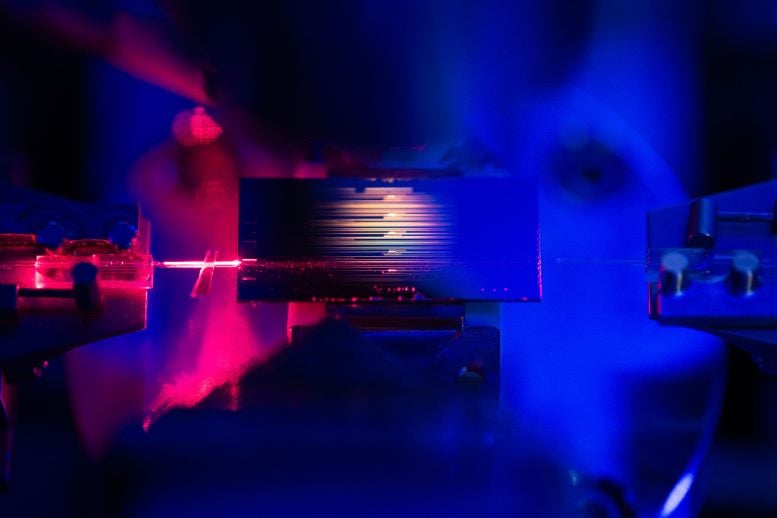
A new Stanford-designed optical amplifier uses energy recycling in a resonator to deliver strong, low-noise amplification with far less power.
Light underpins much of today’s technology, from televisions and satellites to the fiber optic cables that transmit internet data across continents. A team of Stanford physicists has now developed a way to push light-based systems even further. Their fingertip-sized optical amplifier operates with very low-energy demands and maintains full bandwidth performance.
Like an audio amplifier that boosts sound, an optical amplifier increases the strength of a light signal. Many compact amplifiers currently available require substantial power to operate. The new device, described in the journal Nature, overcomes this limitation by reusing much of the energy that powers it, greatly improving efficiency.
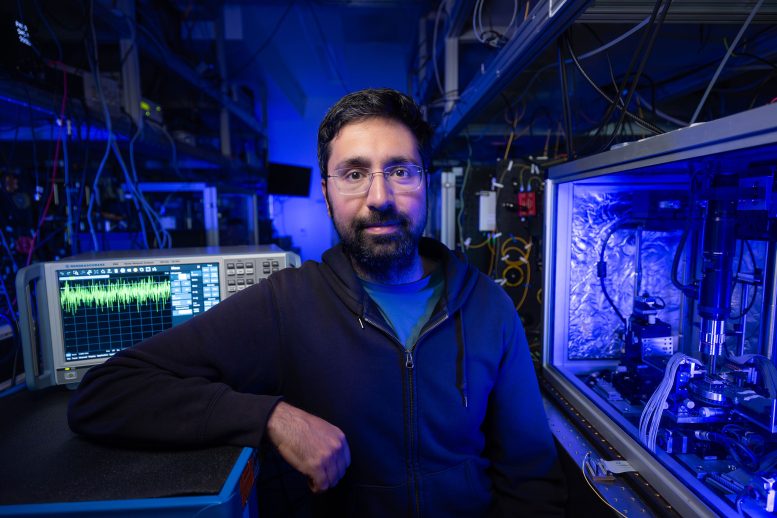
“We’ve demonstrated, for the first time, a truly versatile, low-power optical amplifier, one that can operate across the optical spectrum and is efficient enough that it can be integrated on a chip,” said Amir Safavi-Naeini, the study’s senior author and associate professor of physics in Stanford’s School of Humanities and Sciences. “That means we can now build much more complex optical systems than were possible before.”
High Efficiency and Chip-Scale Integration
The amplifier developed at Stanford can increase a light signal’s intensity by roughly 100 times while drawing only a few hundred milliwatts of power, far less than comparable devices of similar size. Because it combines strong performance with compact dimensions, it could run on battery power and be incorporated into laptops or smartphones.
Boosting signals often introduces unwanted noise, which can interfere with data transmission. The researchers showed that their amplifier keeps added noise to a minimum. It also supports a wider bandwidth than existing compact amplifiers, allowing it to handle a broader range of light frequencies. Together, these features translate into higher data capacity with reduced interference.
This amplifier relies on energy stored in a light beam known as a “pump.” Its effectiveness depends on how intense that pump beam becomes.
Resonator Design and Energy Recycling
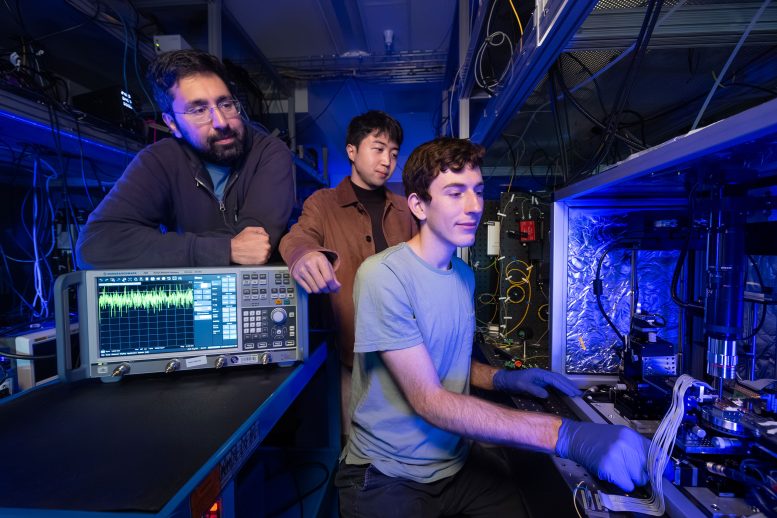
“By recycling the energy of the pump that powers this amplifier, we made it more efficient, and this doesn’t come at a cost to its other properties,” said Devin Dean, co-first author on the study and a doctoral student in Safavi-Naeini’s lab.
To achieve this, the team employed a resonant structure similar to designs used in lasers as an “energy recycling trick,” according to Dean. In such systems, light is reflected onto itself, increasing its strength in much the same way that light intensifies when it bounces between two mirrors.
In this amplifier, the pump light is created inside a resonator, where it circulates in a loop resembling a racetrack. As it travels around this path, its intensity builds, enabling it to amplify the target signal more effectively. By generating greater intensity from lower input power, the system achieves significantly improved efficiency.
Battery-Powered Devices and Future Applications
Thanks to its reduced power requirements and miniature scale, the amplifier could operate on battery power and fit into devices as small as smartphones.
“When you can do that, then the possibilities are really quite broad because they are so small that you can mass produce them and power them with batteries,” Dean said. “They could be used potentially for data communications, biosensing, making new light sources, or a host of different things.”
Reference: “Low-power integrated optical amplification through second-harmonic resonance” by Devin J. Dean, Taewon Park, Hubert S. Stokowski, Luke Qi, Sam Robison, Alexander Y. Hwang, Jason F. Herrmann, Martin M. Fejer and Amir H. Safavi-Naeini, 28 January 2026, Nature.
DOI: 10.1038/s41586-025-09959-z
This work was supported in part by the Defense Advanced Research Projects Agency, NTT Research, and the National Science Foundation.
Never miss a breakthrough: Join the SciTechDaily newsletter.
Follow us on Google and Google News.
5 Comments
By generating greater intensity from lower input power, the system achieves significantly improved efficiency.
VERY GOOD!
If we cease asking “whether observation disturbs the object” and instead ask “how observation participates in the topological variation of the object,” our understanding of scientific knowledge may enter a new realm.
—— Excerpted from https://zhuanlan.zhihu.com/p/2010973729556026200.
Are these science?
Example 1
Two sets of cobalt-60 are manually rotated in opposite directions, and even without detection, people around the world know that they will not be symmetrical because these two objects are not mirror images of each other at all. However, a group of so-called physicists and so-called academic publications do not believe it. They conducted experiments and the results were indeed asymmetric, but they still firmly believed that these two objects were mirror images of each other, and the asymmetry was due to a violation of the previous natural laws (CP violation). In the history of science, there can never be a dirtier and uglier operation and explanation than this.
—— Excerpted from https://scitechdaily.com/what-happens-when-light-gains-extra-dimensions/#comment-947619.
Example 2
Please see how the so-called “mystery of θ – τ” is explained: θ and τ are completely identical in all measurable physical properties such as mass, lifetime, charge, spin, etc. However, experimental observations have shown that the θ meson decays into two π mesons, while the τ meson decays into three π mesons, making it difficult for physicists to explain why they are so similar. Physicist Martin Block proposed a highly challenging idea: θ and τ are the same particle, but in weak interactions, parity is not conserved. An easy to understand explanation is the following analogy:: There are two boxes of apples with identical weight, color, and taste. However, when one box is opened, there are two apples, while when the other box is opened, there are three apples. This confuses the old farmer who buys apples. He circled around the orchard and came up with a highly challenging idea: these two boxes of apples are not from the same tree, so they are the same.
—— Excerpted from https://scitechdaily.com/what-happens-when-light-gains-extra-dimensions/#comment-947686.
Everyone who has a reverence for natural laws and regulations deserves respect.
In the physical world constructed by the American Physical Society (APS) and its publications using parity violation, particles from God, Demons, and Angels wander around, while dead and alive cats jump up and down, unconstrained by dynamics and thermodynamics, and unaware of what is dirty, ugly, and shameful in public. APS and its publications reject the possibility that spaces with zero viscosity, zero compression, and zero anisotropy in mathematics may form spatiotemporal vortices through topological transformations. They don’t know that space and non existence are not the same concept.
If a self proclaimed scientific society (such as American Physical Society) deviates from science without shame, it is highly likely to be heading towards the end.
Space is a physical entity with zero viscosity, zero compression, and zero anisotropy of ideal fluid characteristics, which is completely different from the philosophical concept of non existence. No object in space can be independent of space.
Mathematically, a space with ideal fluid physical characteristics can form spatiotemporal vortices through topological transformations. The formation of spacetime vortices marks the beginning of time. These spatiotemporal vortices self organize through complex interactions and may form extremely complex spatiotemporal structures. All particles in the Standard Model are emergent states of these spatiotemporal vortices, but definitely not all. All operations and observational behaviors in scientific experiments are related to the interaction of these spatiotemporal vortices.