
The finding has the potential to fundamentally change the nature of these items.
UC Irvine physicists have discovered nano-scale electronic devices that can change shapes and sizes in solid states, potentially revolutionizing electronic devices and atomic-scale quantum material research. The devices, made of graphene sheets and gold wires, enable flexible and dynamic movement on van der Waals material surfaces.
The nano-scale electronic parts in devices like smartphones are solid, static objects that once designed and built cannot transform into anything else. But University of California, Irvine physicists have reported the discovery of nano-scale devices that can transform into many different shapes and sizes even though they exist in solid states.
It’s a finding that could fundamentally change the nature of electronic devices, as well as the way scientists research atomic-scale quantum materials. The study was published recently in Science Advances.
Reconfigurable Nano-Devices
“What we discovered is that for a particular set of materials, you can make nano-scale electronic devices that aren’t stuck together,” said Javier Sanchez-Yamagishi, an assistant professor of physics & astronomy whose lab performed the new research. “The parts can move, and so that allows us to modify the size and shape of a device after it’s been made.”
The electronic devices are modifiable much like refrigerator door magnets – stuck on but can be reconfigured into any pattern you like.
“The significance of this research is that it demonstrates a new property that can be utilized in these materials that allows for fundamentally different types of devices architectures to be realized, including mechanically reconfigure parts of a circuit,” said Ian Sequeira, a Ph.D. student in Sanchez-Yamagishi’s lab.
If it sounds like science fiction, said Sanchez-Yamagishi, that’s because until now scientists did not think such a thing was possible.
Indeed, Sanchez-Yamagishi and his team, which also includes UCI Ph.D. student Andrew Barabas, weren’t even looking for what they ultimately discovered.
“It was definitely not what we were initially setting out to do,” said Sanchez-Yamagishi. “We expected everything to be static, but what happened was we were in the middle of trying to measure it, and we accidentally bumped into the device, and we saw that it moved.”
The Role of Gold and Graphene
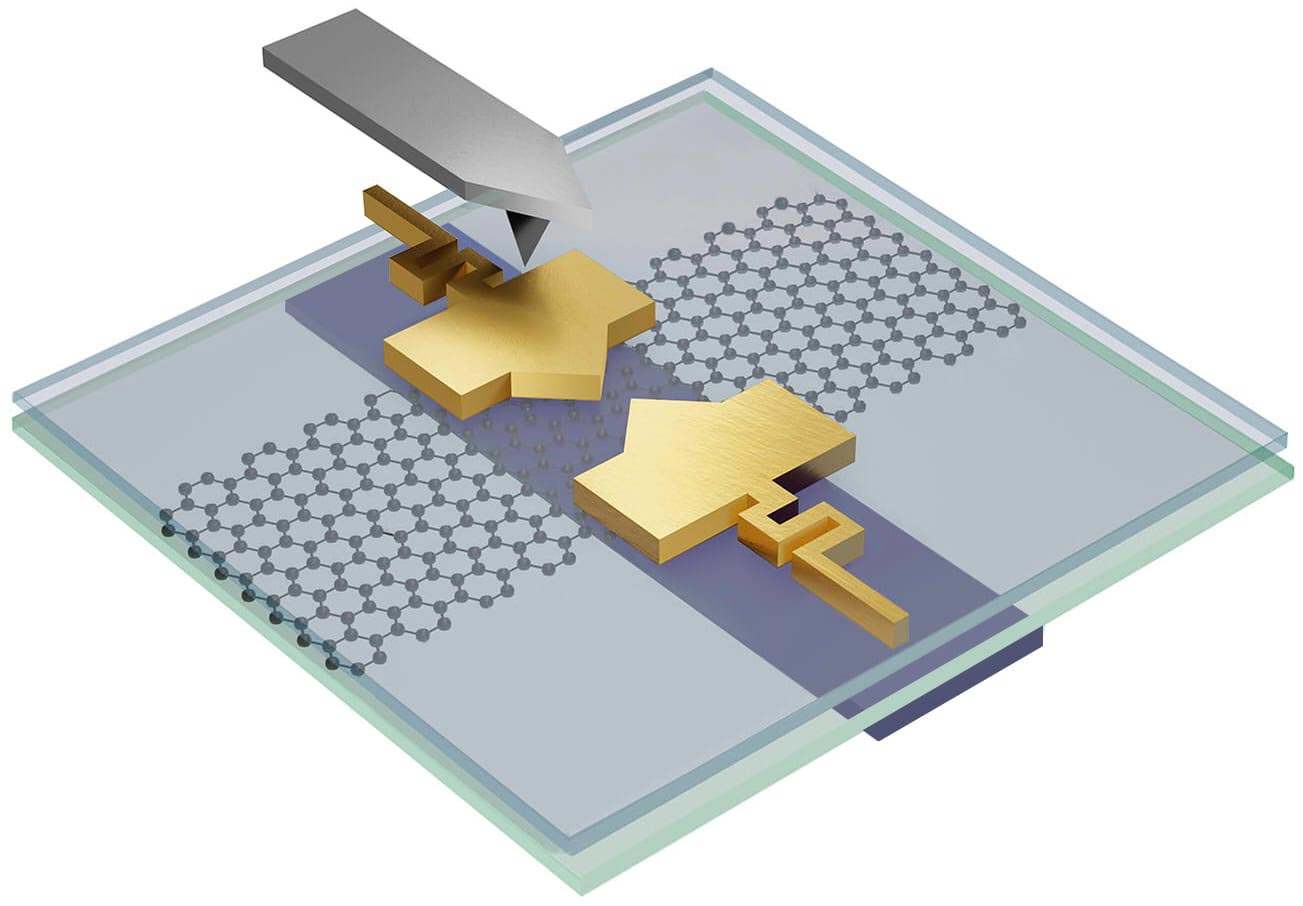
What they saw specifically was that tiny nano-scale gold wires could slide with very low friction on top of special crystals called “van der Waals materials.”
Taking advantage of these slippery interfaces, they made electronic devices made of single-atom-thick sheets of a substance called graphene attached to gold wires that can be transformed into a variety of different configurations on the fly.
Because it conducts electricity so well, gold is a common part of electronic components.
But exactly how the discovery could impact industries that use such devices is unclear.
“The initial story is more about the basic science of it, although it is an idea which could one day have an effect on industry,” said Sanchez-Yamagishi. “This germinates the idea of it.”
Meanwhile, the team expects their work could usher in a new era of quantum science research.
“It could fundamentally change how people do research in this field,” Sanchez-Yamagishi said.
“Researchers dream of having flexibility and control in their experiments, but there are a lot of restrictions when dealing with nanoscale materials,” he added. “Our results show that what was once thought to be fixed and static can be made flexible and dynamic.”
Reference: “Mechanically reconfigurable van der Waals devices via low-friction gold sliding” by Andrew Z. Barabas, Ian Sequeira, Yuhui Yang, Aaron H. Barajas-Aguilar, Takashi Taniguchi, Kenji Watanabe and Javier D. Sanchez-Yamagishi, 7 April 2023, Science Advances.
DOI: 10.1126/sciadv.adf9558
Other UCI co-authors include Yuhui Yang, a senior undergraduate at UCI, and postdoctoral scholar Aaron Barajas-Aguilar.
Never miss a breakthrough: Join the SciTechDaily newsletter.
Follow us on Google and Google News.
4 Comments
These are all interesting areas that will revolutionize the world
Regarding nanotechnology I think nanophotonics will allow in the future to overcome the limitation of binary counting in that through the frequencies of colors a value will be associated for each color including infrared and ultraviolet light.
If this would happen it would be a great revolution in that it would incredibly increase the computational capabilities of devices.
Then I think nanoholography and nanophotonics would allow unthinkable amounts of data to be stored on miniaturized devices.
In addition, I think that these technologies together with nanoelectronics will allow the construction of hardware that can be configured and upgraded through specific software.
Anyone have new ideas for future technology?
“We expected everything to be static, but what happened was we were in the middle of trying to measure it, and we accidentally bumped into the device, and we saw that it moved.”
This reminded me of how mechanical “ball-milling” is apparently having unexpected results in superconductivity experiments.
High pressures, low temperatures, some very mechanical quantum mechanics going on lately. I tend to think gravity is experimentally emerging as a quantum force distinct from light, distinct from electric and magnetic fields in general, through tiny externally-controllable mechanical interventions happening independently of the immediate neighboring demands of charged particles and thus being decidedly gravity-foundationally oriented. I could be totally wrong, of course.
Reminds me of “A Boy and His Atom” from 2013, also.
I don’t usually comment but I gotta state thankyou for the post on this one : D.