
Approximately 800 Million Years Ago, Our Brain Cell Components Began To Take Shape in Shallow Seas
Research published in the journal Cell offers new insights into the evolution of neurons, focusing on the placozoans, a millimeter-sized marine animal. Scientists from the Centre for Genomic Regulation in Barcelona discovered that the specialized secretory cells in these ancient and unique animals may have given rise to neurons in more complex animals.
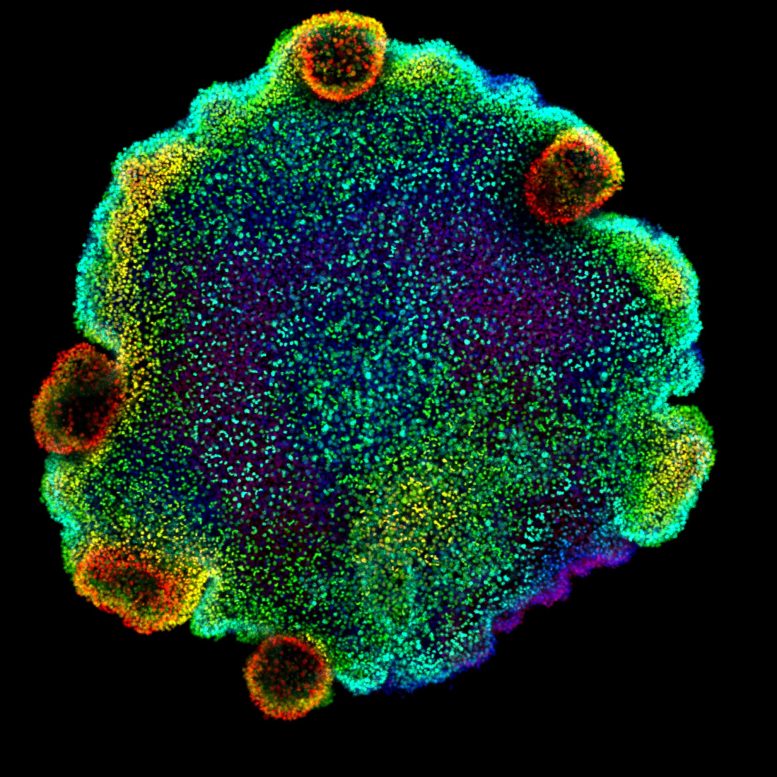
Placozoans are tiny animals, around the size of a large grain of sand, which graze on algae and microbes living on the surface of rocks and other substrates found in shallow, warm seas. The blob-like and pancake-shaped creatures are so simple that they live without any body parts or organs.
These animals, thought to have first appeared on Earth around 800 million years ago, are one of the five main lineages of animals alongside Ctenophora (comb jellies), Porifera (sponges), Cnidaria (corals, sea anemones, and jellyfish) and Bilateria (all other animals).
The sea creatures coordinate their behavior thanks to peptidergic cells, special types of cells that release small peptides that can direct the animal’s movement or feeding. Driven by the intrigue of the origin of these cells, the authors of the study employed an array of molecular techniques and computational models to understand how placozoan cell types evolved and piece together how our ancient ancestors might have looked and functioned.
Reconstructing Ancient Cell Types
The researchers first made a map of all the different placozoan cell types, annotating their characteristics across four different species. Each cell type has a specialized role that comes from certain sets of genes. The maps or ‘cell atlases’ allowed researchers to chart clusters or ‘modules’ of these genes. They then created a map of the regulatory regions in DNA that control these gene modules, revealing a clear picture of what each cell does and how they work together. Finally, they carried out cross-species comparisons to reconstruct how the cell types evolved.
Time-lapse video of a Trichoplax sp. H2 specimen observed under the microscope. Credit: Sebastian R. Najle/Centro de Regulación Genómica
The research showed that the main nine cell types in placozoans appear to be connected by many “in-between” cell types which change from one type to another. The cells grow and divide, maintaining the delicate balance of cell types required for the animal to move and eat. The researchers also found fourteen different types of peptidergic cells, but these were different from all other cells, showing no in-between types or any signs of growth or division.
Surprisingly, the peptidergic cells shared many similarities to neurons – a cell type that didn’t appear until many millions of years later in more advanced animals such as bilateria. Cross-species analyses revealed these similarities are unique to placozoans and do not appear in other early-branching animals such as sponges or comb jellies (ctenophores).
Evolutionary Stepping Stones
The similarities between peptidergic cells and neurons were threefold. First, the researchers found that these placozoan cells differentiate from a population of progenitor epithelial cells via developmental signals that resemble neurogenesis, the process by which new neurons are formed, in cnidaria and bilateria.
Second, they found that peptidergic cells have many gene modules required to build the part of a neuron that can send out a message (the pre-synaptic scaffold). However, these cells are far from being a true neuron, as they lack the components for the receiving end of a neuronal message (post-synaptic) or the components required for conducting electrical signals.
Finally, the authors used deep learning techniques to show that placozoan cell types communicate with each other using a system in cells where specific proteins, called GPCRs (G-protein coupled receptors), detect outside signals and start a series of reactions inside the cell. These outside signals are mediated by neuropeptides, chemical messengers used by neurons in many different physiological processes.
“We were astounded by the parallels,” says Dr. Sebastián R. Najle, co-first author of the study and postdoctoral researcher at the Centre for Genomic Regulation. “The placozoan peptidergic cells have many similarities to primitive neuronal cells, even if they aren’t quite there yet. It’s like looking at an evolutionary stepping stone.”
The Dawn of the Neuron
The study demonstrates that the building blocks of the neuron were forming 800 million years ago in ancestral animals grazing inconspicuously in the shallow seas of ancient Earth. From an evolutionary point of view, early neurons might have started as something like the peptidergic secretory cells of today’s placozoans.
These cells communicated using neuropeptides, but eventually gained new gene modules that enabled cells to create post-synaptic scaffolds, form axons and dendrites, and create ion channels that generate fast electrical signals – innovations that were critical for the dawn of the neuron around one hundred million years after the ancestors of placozoans first appeared on Earth.
However, the complete evolutionary story of nerve systems is still to be told. The first modern neuron is thought to have originated in the common ancestor of cnidarians and bilaterians around 650 million years ago. And yet, neuronal-like cells exist in ctenophores, although they have important structural differences and lack the expression of most genes found in modern neurons. The presence of some of these neuronal genes in the cells of placozoans and their absence in ctenophores raises fresh questions about the evolutionary trajectory of neurons.
“Placozoans lack neurons, but we’ve now found striking molecular similarities with our neural cells. Ctenophores have neural nets, with key differences and similarities with our own. Did neurons evolve once and then diverge, or more than once, in parallel? Are they a mosaic, where each piece has a different origin? These are open questions that remain to be addressed”, says Dr. Xavier Grau-Bové, co-first author of the study and postdoctoral researcher at the Centre for Genomic Regulation.
The authors of the study believe that, as researchers around the world continue to sequence high-quality genomes from diverse species, the origins of neurons and the evolution of other cell types will become increasingly clear.
“Cells are the fundamental units of life, so understanding how they come into being or change over time is key to explaining the evolutionary story of life. Placozoans, ctenophores, sponges, and other non-traditional model animals harbor secrets that we are only just beginning to unlock,” concludes ICREA Research Professor Arnau Sebé-Pedros, corresponding author of the study and Junior Group Leader at the Centre for Genomic Regulation.
Reference: “Stepwise emergence of the neuronal gene expression program in early animal evolution” by Sebastián R. Najle, Xavier Grau-Bové, Anamaria Elek, Cristina Navarrete, Damiano Cianferoni, Cristina Chiva, Didac Cañas-Armenteros, Arrate Mallabiabarrena, Kai Kamm, Eduard Sabidó, Harald Gruber-Vodicka, Bernd Schierwater, Luis Serrano and Arnau Sebé-Pedrós, 19 September 2023, Cell.
DOI: 10.1016/j.cell.2023.08.027
The study was funded by the European Research Council and the Ministerio de Ciencia e Innovación.
Never miss a breakthrough: Join the SciTechDaily newsletter.
Follow us on Google and Google News.
4 Comments
Apparently these things didn’t evolve because they still exist lol
So some of these things evolved and the ones alive today didn’t if that’s not absurd I don’t know what is lol
Yes, your claim is absurd, based on a strawman of evolution that you constructed to be so (by intent or by ignorance).
All populations evolve, as we can easily see in ourselves since two human faces are never quite the same. These differences will appear, proliferate or go extinct, depending on factors such as mutations, recombination, migration, genetic drift, selection and inbreeding. If two subpopulations get geographically separated they will eventually evolve to new species.
Despite that we haven’t been looking for long, we have already seen a couple of hundred new species evolve and many more go extinct. Evolution in progress.
Placozoa, Porifera (sponges), Cnidaria (jellies), and Cthenophora (box jellies) split within a hundred million years or so about 800 million years ago, so the order of things is studied still. That said, it was just discovered that cthenopores have associative learning [“How to train your jellyfish: brainless box jellies learn from experience”, Nature].