
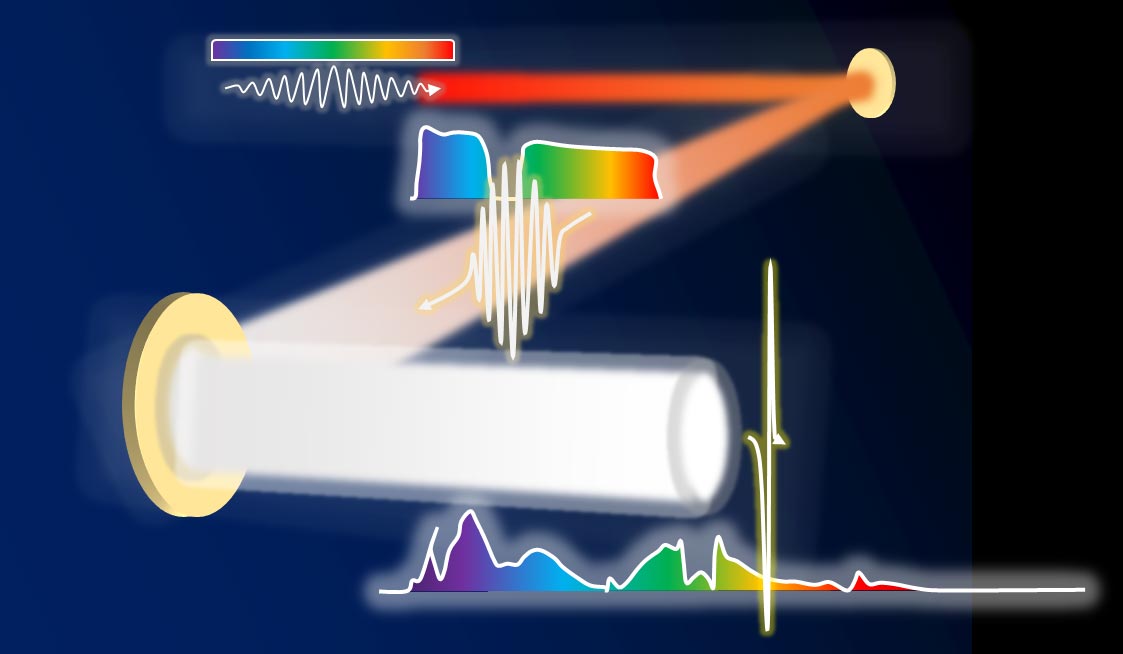
Researchers from Osaka University propose a concept for next-generation ultra-intense lasers, possibly increasing the current record from 10 Petawatts to 500 Petawatts.
Ultra-intense lasers with ultra-short pulses and ultra-high energies are powerful tools for exploring unknowns in physics, cosmology, material science, etc. With the help of the famous technology “Chirped Pulse Amplification (CPA)” (2018 Nobel Prize in Physics), the current record has reached 10 Petawatts (or 10^16 Watts). In a study recently published in Scientific Reports, researchers from Osaka University proposed a concept for next-generation ultra-intense lasers with a simulated peak power up to the Exawatt class (1 Exawatt equals 1000 Petawatts).
The laser, which was invented by Dr. T. H. Maiman in 1960, has one important characteristic of high intensity (or high peak power for pulse lasers): historically, laser peak power has experienced two-stage development. Just after the birth of the laser, Q-switching and mode-locking technologies increased laser peak power to Kilowatt (10^3 Watt) and Gigawatt (10^9 Watt) levels. After CPA technology was invented by Gérard Mourou and Donna Strickland in 1985, by which material damage and optical nonlinearity were avoided, laser peak power was dramatically increased to Terawatt (10^12 Watt) and Petawatt (10^15 Watt) levels. Today, two 10-Petawatt CPA lasers have been demonstrated in Europe (ELI-NP laser) and China (SULF laser), respectively.
The Next Leap: Compression over Energy
At present, the facility scale of Petawatt lasers around the world is very large and project investment is also very high. The next step for future ultra-intense lasers is to further increase the peak power by compressing the pulse duration instead of increasing the pulse energy.
In their previous study (OSA Continuum, DOI: 10.1364/OSAC.2.001125), this group developed a new design, “Wide-angle Non-collinear Optical Parametric Chirped Pulse Amplification (WNOPCPA),” to increase the amplified spectrum and accordingly reduce the compressed pulse. The key mechanism of WNOPCPA is to increase the overall bandwidth by using a multiple-beam pump, which corresponds to different amplified spectra. “However, the pump interference, in addition to induced possible damage, is a potential problem in applying WNOPCPA to a huge project,” explains corresponding author Zhaoyang Li.
Two-Beam Pumping and Optimized Phase-Matching
In this newly improved design, by using a two-beam pumped WNOPCPA and carefully optimized phase-matching, pump interference is completely avoided, and an ultra-broadband bandwidth with two broad spectra is accomplished, resulting in <10 fs high-energy laser amplification. When this laser is combined with post-compression technology, the spectral broadening induced by nonlinear effects is significantly enhanced, and the simulation shows the record of the highest peak power can be pushed to the Exawatt class.
“This design has two advantages: one is ultra-broadband amplification in WNOPCPA and the other is enhancement of nonlinear spectral broadening in post-compression. This research may provide a possible way to further increase laser peak power, even up to the Exawatt class,” says Zhaoyang Li.
Reference: “Simulating an ultra-broadband concept for Exawatt-class lasers” by Zhaoyang Li, Yoshiaki Kato and Junji Kawanaka, 8 January 2021, Scientific Reports.
DOI: 10.1038/s41598-020-80435-6
Never miss a breakthrough: Join the SciTechDaily newsletter.
Follow us on Google and Google News.