
Close Menu
    Facebook X (Twitter) Instagram
    SciTechDaily
    • Biology
    • Chemistry
    • Earth
    • Health
    • Physics
    • Science
    • Space
    • Technology
    Facebook X (Twitter) Pinterest YouTube RSS
    SciTechDaily
    Home»Science»Triassic Megapredator’s Last Meal Was a Massive Marine Reptile
    Science

    Triassic Megapredator’s Last Meal Was a Massive Marine Reptile

    By University of California - DavisAugust 22, 2020No Comments4 Mins Read
    Facebook Twitter Pinterest Telegram LinkedIn WhatsApp Email Reddit
    Share
    Facebook Twitter LinkedIn Pinterest Telegram Email Reddit
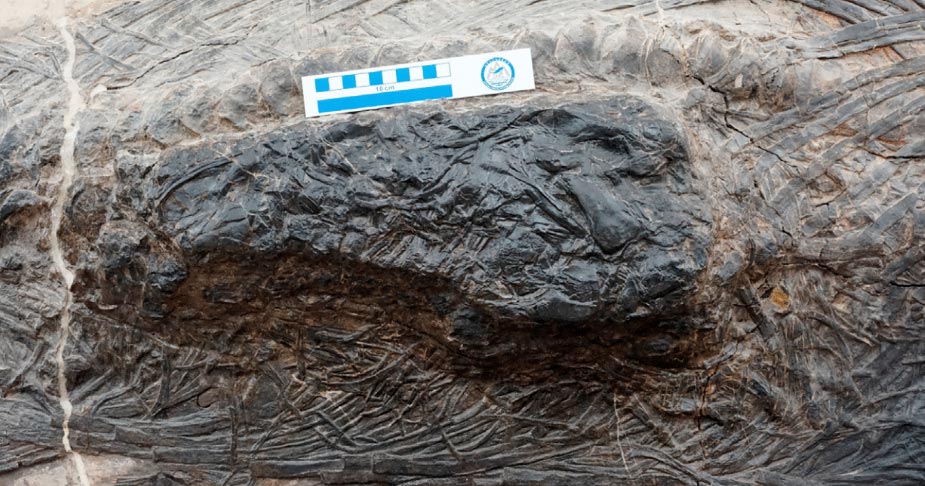
    Fossil Ichthyosaur Guizhouichthyosaurus Stomach
    Closeup of the stomach area of a fossil ichthyosaur, Guizhouichthyosaurus, showing part of the body of another large marine reptile. The ichthyosaur had swallowed its prey shortly before it died and was fossilized. This is the oldest known direct evidence of megapredation, or a large animal eating another large animal. Credit: Da-Yong Jiang, et al.

    Some 240 million years ago, a dolphinlike ichthyosaur ripped to pieces and swallowed another marine reptile only a little smaller than itself. Then it almost immediately died and was fossilized, preserving the first evidence of megapredation, or a large animal preying on another large animal. The fossil, discovered in 2010 in southwestern China, is described in a paper published on August 20, 2020 in the journal iScience.

    The ichthyosaurs were a group of marine reptiles that appeared in the oceans after the Permian mass extinction, about 250 million years ago. They had fishlike bodies similar to modern tuna, but breathed air like dolphins and whales. Like modern orcas or great white sharks, they may have been apex predators of their ecosystems, but until recently there has been little direct evidence of this.

    When a specimen of the ichthyosaur Guizhouichthyosaurus was discovered in Guizhou province, China, in 2010, researchers noticed a large bulge of other bones within the animal’s abdomen. On examination, they identified the smaller bones as belonging to another marine reptile, Xinpusaurus xingyiensis, which belonged to a group called thalattosaurs. Xinpusaurus was more lizardlike in appearance than an ichthyosaur, with four paddling limbs.
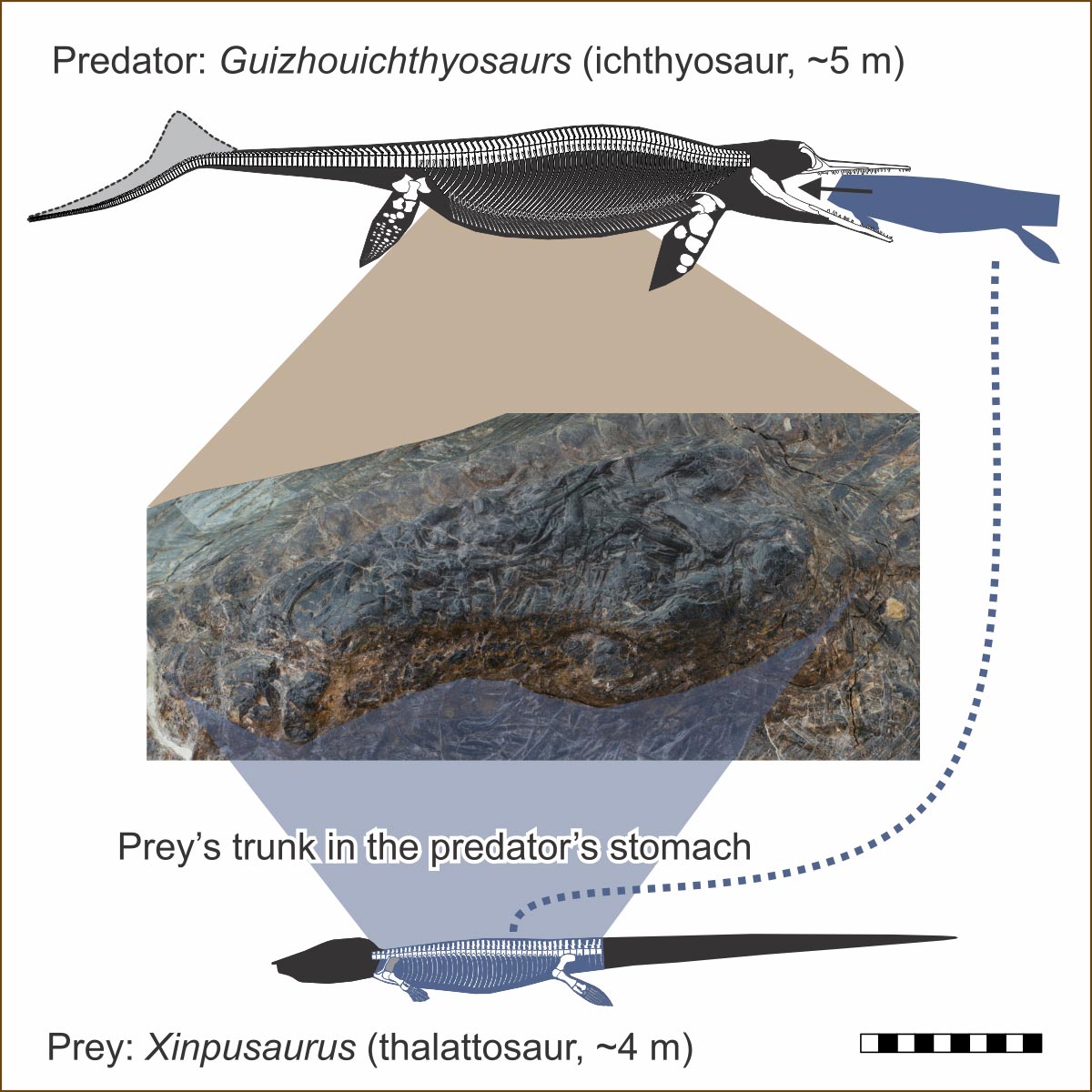
    Ichthyosaur's Last Meal
    The stomach of this 240-million year old fossil ichthyosaur contains the mid-section of another marine reptile that in life would have been only slight smaller. It’s the first direct evidence of ancient megapredation — one large animal eating another. Credit: Da-Yong Jiang, et al, iScience

    “We have never found articulated remains of a large reptile in the stomach of gigantic predators from the age of dinosaurs, such as marine reptiles and dinosaurs,” said Ryosuke Motani, professor of earth and planetary sciences at the University of California, Davis, and co-author on the paper. “We always guessed from tooth shape and jaw design that these predators must have fed on large prey but now we have direct evidence that they did.”

    The Guizhouichthyosaurus was almost 5 meters (15 feet) long, while the researchers calculate its prey was about 4 meters (12 feet) long, although thalattosaurs had skinnier bodies than ichythosaurs. The predator’s last meal appears to be the middle section of the thalattosaur, from its front to back limbs. Interestingly, a fossil of what appears to be the tail section of the animal was found nearby.

    Predators that feed on large animals are often assumed to have large teeth adapted for slicing up prey. Guizhouichthyosaurus had relatively small, peglike teeth, which were thought to be adapted for grasping soft prey such as the squidlike animals abundant in the oceans at the time. However, it’s clear that you don’t need slicing teeth to be a megapredator, Motani said. Guizhouichthyosaurus probably used its teeth to grip the prey, perhaps breaking the spine with the force of its bite, then ripped or tore the prey apart. Modern apex predators such as orcas, leopard seals, and crocodiles use a similar strategy.

    Read Massive Reptile Discovered in the Belly of a Triassic Megapredator for more on this research.

    Reference: “Evidence Supporting Predation of 4-m Marine Reptile by Triassic Megapredator” by Da-Yong Jiang, Ryosuke Motani, Andrea Tintori, Olivier Rieppel, Cheng Ji, Min Zhou, Xue Wang, Hao Lu and Zhi-Guang Li, 20 August 2020, iScience.
    DOI: 10.1016/j.isci.2020.101347

    Co-authors on the study: Da-Yong Jiang, Min Zhou, Xue Wang, and Hao Lu, Peking University, China; Andrea Tintori, Università degli Studi di Milano, Italy; Olivier Rieppel, The Field Museum, Chicago; Cheng Ji, Nanjing Institute of Geology and Palaeontology, China; and Zhi-Guang Li, The Geoscience Museum, Hebei GEO University, China. Funding was provided by the National Natural Science Foundation of China, the Ministry of Science and Technology, and the National Geographic Society.

    Never miss a breakthrough: Join the SciTechDaily newsletter.
    Follow us on Google and Google News.

    Dinosaurs Fossils Paleontology UC Davis
    Share. Facebook Twitter Pinterest LinkedIn Email Reddit

    Related Articles

    Research Reveals First Complete Chemical Analysis of ‘Dinobird’ Feathers

    World’s Oldest Dinosaur Bonebed Reveals How Dinosaur Embryos Grew and Developed

    Stubby-Tailed Oviraptors Had Tails for Courtship Displays

    Xenoceratops, A New Species of Horned Dinosaur Discovered in Canada

    How Tyrannosaurus Rex Ate Triceratops Horridus

    Fossils Reveal Headbutts May Have Been Used as a Dinosaur Courtship Behavior

    Cretaceous Period Sankofa Pyrenaica Fossilized Eggs Are Unusually Shaped

    Microraptor Feathers Were Black With Iridescent Sheen

    Jurassic Period Super-Sized Fleas Had Armored Mouthparts to Attack the Thick Hide of Dinosaurs

    Leave A Reply Cancel Reply

    • Facebook
    • Twitter
    • Pinterest
    • YouTube

    Don't Miss a Discovery

    Subscribe for the Latest in Science & Tech!

    Trending News

    Enormous Prehistoric Insects Puzzle Scientists

    Scientists Develop Bioengineered Chewing Gum That Could Help Fight Oral Cancer

    After 37 Years, the World’s Longest-Running Soil Warming Experiment Uncovers a Startling Climate Secret

    NASA Satellite Captures First-Ever High-Res View of Massive Pacific Tsunami

    ADHD Isn’t Just a Deficit: Study Reveals Powerful Hidden Strengths

    Scientists Discover Stem Cells That Could Regrow Teeth and Bone

    Early Cannabis Use May Stall Key Brain Skills in Teens

    Popular Vitamin D Supplement Has “Previously Unknown” Negative Effect, Study Finds

    Follow SciTechDaily
    • Facebook
    • Twitter
    • YouTube
    • Pinterest
    • Newsletter
    • RSS
    SciTech News
    • Biology News
    • Chemistry News
    • Earth News
    • Health News
    • Physics News
    • Science News
    • Space News
    • Technology News
    Recent Posts
    • One in Five at Risk: Scientists Identify a Hidden Blood Particle Linked to Higher Risk of Stroke and Death
    • Darwin’s Islands Still Evolving: Giant Daisies Rewrite the Rules of Evolution
    • Ancient Document Confirms “Legendary” African King Actually Existed
    • First-of-Its-Kind Discovery: Homer’s Iliad Found Embedded in a 1,600-Year-Old Egyptian Mummy
    • Beyond Inflammation: Scientists Uncover New Cause of Persistent Rheumatoid Arthritis
    Copyright © 1998 - 2026 SciTechDaily. All Rights Reserved.
    • Science News
    • About
    • Contact
    • Editorial Board
    • Privacy Policy
    • Terms of Use

    Type above and press Enter to search. Press Esc to cancel.