

Close Menu
    Facebook X (Twitter) Instagram
    SciTechDaily
    • Biology
    • Chemistry
    • Earth
    • Health
    • Physics
    • Science
    • Space
    • Technology
    Facebook X (Twitter) Pinterest YouTube RSS
    SciTechDaily
    Home»Chemistry»Turning Seawater Into Fuel With a Low-Cost Catalyst
    Chemistry

    Turning Seawater Into Fuel With a Low-Cost Catalyst

    By University of RochesterJuly 15, 20201 Comment4 Mins Read
    Facebook Twitter Pinterest Telegram LinkedIn WhatsApp Email Reddit
    Share
    Facebook Twitter LinkedIn Pinterest Telegram Email Reddit
    USNS Henry J Kaiser
    A replenishment oiler, left, refuels a naval ship at sea. The Porosoff research group at the University of Rochester has demonstrated that a potassium-promoted molybdenum carbide catalyst can help the US Navy achieve its goal of converting seawater to fuel, effectively eliminating the need for traditional refueling operations. Credit: US Navy

    For the first time, Rochester chemical engineers have demonstrated a ‘potassium-promoted’ catalyst’s potential for use on an industrial scale.

    Now, the Navy’s quest to power its ships by converting seawater into fuel is nearer to fruition.
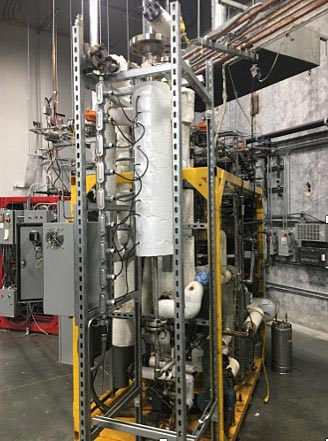
    OxEon Energy Reactor
    This reactor at OxEon Energy was used to validate the effectiveness of the potassium-promoted molybdenum carbide catalyst on an industrial scale. Credit: OxEon Energy

    University of Rochester chemical engineers—in collaboration with researchers at the Naval Research Laboratory, the University of Pittsburgh, and OxEon Energy—have demonstrated that a potassium-promoted molybdenum carbide catalyst efficiently and reliably converts carbon dioxide to carbon monoxide, a critical step in turning seawater into fuel.

    “This is the first demonstration that this type of molybdenum carbide catalyst can be used on an industrial scale,” says Marc Porosoff, assistant professor in the Department of Chemical Engineering at Rochester. In a paper in the journal Energy & Environmental Science, the researchers describe an exhaustive series of experiments they conducted at molecular, laboratory, and pilot scales to document the catalyst’s suitability for scale-up.

    If navy ships could create their own fuel from the seawater they travel through, they could remain in continuous operation. Other than a few nuclear-powered aircraft carriers and submarines, most navy ships must periodically align themselves alongside tanker ships to replenish their fuel oil, which can be difficult in rough weather.

    In 2014, a Naval Research Laboratory team led by Heather Willauer announced it had used a catalytic converter to extract carbon dioxide and hydrogen from seawater and then converted the gases into liquid hydrocarbons at a 92 percent efficiency rate.

    Since then, the focus has been on increasing the efficiency of the process and scaling it up to produce fuel in sufficient quantities.

    A key step in the seawater-to-fuel conversion process

    The carbon dioxide extracted from seawater is extremely difficult to convert directly into liquid hydrocarbons with existing methods. So, it is necessary to first convert carbon dioxide into carbon monoxide via the reverse water-gas shift (RWGS) reaction. The carbon monoxide can then be converted into liquid hydrocarbons via Fischer-Tropsch synthesis.
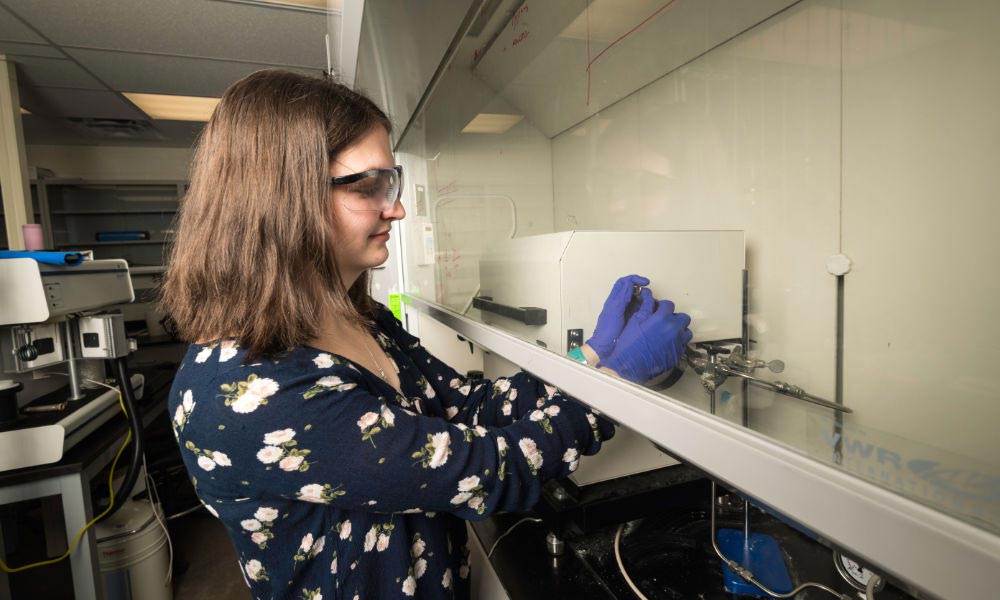
    Madeline Vonglis
    Madeline Vonglis ’20, who interned with the Porosoff research group last summer, conducted many of the laboratory-scale experiments to characterize the potassium-promoted molybdenum carbide catalyst and is the second author on the Energy & Environmental Science paper. She’ll begin her Ph.D. in chemical engineering this fall at Pennsylvania State University. Credit: University of Rochester / J. Adam Fenster

    Typically, catalysts for RWGS contain expensive precious metals and deactivate rapidly under reaction conditions. However, the potassium-modified molybdenum carbide catalyst is synthesized from low-cost components and did not show any signs of deactivation during the continuous operation of the 10-day pilot-scale study. That’s why this demonstration of the molybdenum carbide catalyst is important.

    Porosoff, who first began working on the project while serving as a postdoctoral research associate with Willauer’s team, discovered that adding potassium to a molybdenum carbide catalyst supported on a surface of gamma alumina could serve as a low-cost, stable, and highly selective catalyst for converting carbon dioxide into carbon monoxide during RWGS.

    The potassium lowers the energy barrier associated with the RWGS reaction, while the gamma alumina—marked with grooves and pores, much like a sponge—helps ensure that the molybdenum carbide catalyst particles remain dispersed, maximizing the surface area available for reaction, Porosoff says.

    To determine whether potassium-promoted molybdenum carbide might also be useful for capturing and converting carbon dioxide from power plants, the research group will conduct further experiments to test the catalyst’s stability when exposed to common contaminants found in flue gas such as mercury, sulfur, cadmium, and chlorine.

    Reference: “Assessing the viability of K-Mo2C for reverse water–gas shift scale-up: molecular to laboratory to pilot scale” by Mitchell Juneau, Madeline Vonglis, Joseph Hartvigsen, Lyman Frost, Dylan Bayerl, Mudit Dixit, Giannis Mpourmpakis, James R. Morse, Jeffrey W. Baldwin, Heather D. Willauer and Marc D. Porosoff, 7 July 2020, Energy & Environmental Science.
    DOI: 10.1039/D0EE01457E

    Rochester coauthors include lead author Mitchell Juneau, a Ph.D. student in the Porosoff research group, and Madeline Vonglis ’20, a former undergraduate researcher.

    An Office of Naval Research award supported this project.

    Never miss a breakthrough: Join the SciTechDaily newsletter.
    Follow us on Google and Google News.

    Catalysts Energy Popular University of Rochester
    Share. Facebook Twitter Pinterest LinkedIn Email Reddit

    Related Articles

    Artificial Photosynthesis Promises Clean, Sustainable Source of Energy

    Unusual Property in Hydrogen Fuel Device Discovered – Could Be Ultimate Guide to Self-Improvement

    Unprecedented Nanoscale Look at Reaction That Limits the Efficiency of Generating Clean Hydrogen Fuel

    Double-Duty: New Catalyst Generates Hydrogen Fuel While Cleaning Up Wastewater

    High Efficiency at Low Cost: New Catalyst Moves Seawater Desalination, Hydrogen Production Closer to Commercialization

    Ultra-Efficient Catalyst: Making Biodiesel From Dirty Old Cooking Oil Just Got Way Easier

    New Electrocatalyst Turns Carbon Dioxide Into Liquid Fuel

    Gasification Goes Green: Low-Temp Photocatalyst Slashes Carbon Footprint for Syngas

    Solving a Riddle That Would Provide the World With Entirely Clean, Renewable Energy

    1 Comment

    1. Pierre Ordinaire on August 29, 2020 7:50 pm

      How does one extract CO2 from H2O?

      Reply
    Leave A Reply Cancel Reply

    • Facebook
    • Twitter
    • Pinterest
    • YouTube

    Don't Miss a Discovery

    Subscribe for the Latest in Science & Tech!

    Trending News

    First-of-Its-Kind Discovery: Homer’s Iliad Found Embedded in a 1,600-Year-Old Egyptian Mummy

    Beyond Inflammation: Scientists Uncover New Cause of Persistent Rheumatoid Arthritis

    A Simple Molecule Could Unlock Safer, Easier Weight Loss

    Scientists Just Built a Quantum Battery That Charges Almost Instantly

    Researchers Unveil Groundbreaking Sustainable Solution to Vitamin B12 Deficiency

    Millions of People Have Osteopenia Without Realizing It – Here’s What You Need To Know

    Researchers Discover Boosting a Single Protein Helps the Brain Fight Alzheimer’s

    World-First Study Reveals Human Hearts Can Regenerate After a Heart Attack

    Follow SciTechDaily
    • Facebook
    • Twitter
    • YouTube
    • Pinterest
    • Newsletter
    • RSS
    SciTech News
    • Biology News
    • Chemistry News
    • Earth News
    • Health News
    • Physics News
    • Science News
    • Space News
    • Technology News
    Recent Posts
    • Magnesium Magic: New Drug Melts Fat Even on a High-Fat, High-Sugar Diet
    • Weight-Loss Drugs Like Ozempic May Come With an Unexpected Cost
    • After Decades, MIT Researchers Capture the First 3D Atomic View of a Mysterious Material
    • Your Favorite Fishing Spot Is Turning Brown – and the Fish Are Changing
    • 380-Million-Year-Old Fish Fossil Reveals Secrets of Life’s First Steps Onto Land
    Copyright © 1998 - 2026 SciTechDaily. All Rights Reserved.
    • Science News
    • About
    • Contact
    • Editorial Board
    • Privacy Policy
    • Terms of Use

    Type above and press Enter to search. Press Esc to cancel.