

Jupiter wasn’t always the planet we know today—it was once twice as big, had a magnetic field 50 times stronger, and its early might shaped the very architecture of our solar system.
Using the orbits of two tiny inner moons, scientists have reverse-engineered a snapshot of Jupiter’s turbulent youth, sidestepping typical uncertainties and adding vivid detail to our cosmic origin story.
Jupiter’s Role in Shaping the Solar System
Jupiter’s early life holds powerful clues about how our solar system came to be. Often called the “architect” of the planets, Jupiter’s immense gravity helped shape the orbits of its neighbors and sculpt the swirling disk of gas and dust that eventually formed the Sun’s planetary family.
Now, a new study published on May 20 in Nature Astronomy offers a deeper look into Jupiter’s mysterious beginnings. Researchers Konstantin Batygin of Caltech and Fred C. Adams of the University of Michigan have traced the gas giant’s ancient form back to a pivotal time about 3.8 million years after the first solid particles in the solar system appeared. This moment marked the fading of the protoplanetary nebula—the giant cloud of material that surrounded the newborn Sun.
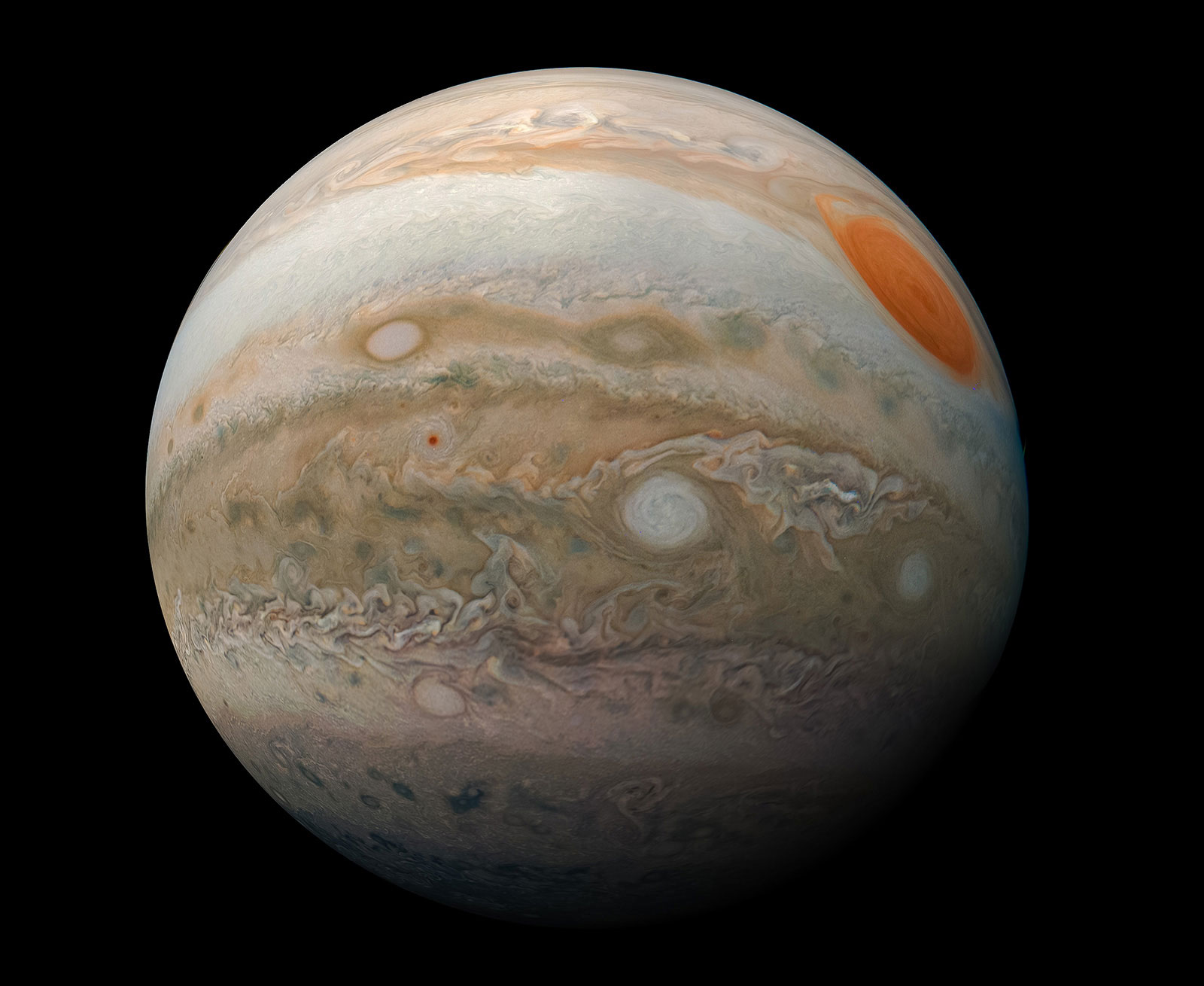
At that time, Jupiter was a cosmic giant even more massive than today. According to the researchers’ calculations, it was nearly twice its current size and had a magnetic field about 50 times stronger than what we see now.
“Our ultimate goal is to understand where we come from, and pinning down the early phases of planet formation is essential to solving the puzzle,” Batygin says. “This brings us closer to understanding how not only Jupiter but the entire solar system took shape.”
Tracking Origins Through Moons
To uncover Jupiter’s original state, the team looked to some of its smallest and closest moons: Amalthea and Thebe. These tiny moons orbit even closer to the planet than Io, the smallest of Jupiter’s four large Galilean moons.
Interestingly, Amalthea and Thebe don’t orbit in perfectly flat paths. Their slight tilts offered the researchers valuable clues. By studying these subtle orbital wobbles, Batygin and Adams were able to work backward and estimate how large and powerful Jupiter once was.
Their findings suggest that early Jupiter had a volume equivalent to more than 2,000 Earths and was wrapped in a magnetic field strong enough to shape its surroundings in dramatic ways.
Echoes From 4.5 Billion Years Ago
Adams highlights the remarkable imprint the past has left on today’s solar system: “It’s astonishing that even after 4.5 billion years, enough clues remain to let us reconstruct Jupiter’s physical state at the dawn of its existence.”
Importantly, these insights were achieved through independent constraints that bypass traditional uncertainties in planetary formation models—which often rely on assumptions about gas opacity, accretion rate, or the mass of the heavy element core. Instead, the team focused on the orbital dynamics of Jupiter’s moons and the conservation of the planet’s angular momentum—quantities that are directly measurable. Their analysis establishes a clear snapshot of Jupiter at the moment the surrounding solar nebula evaporated, a pivotal transition point when the building materials for planet formation disappeared and the primordial architecture of the solar system was locked in.
Building on Planet Formation Theories
The results add crucial details to existing planet formation theories, which suggest that Jupiter and other giant planets around other stars formed via core accretion, a process by which a rocky and icy core rapidly gathers gas. These foundational models were developed over decades by many researchers, including Caltech’s Dave Stevenson, the Marvin L. Goldberger Professor of Planetary Science, Emeritus. This new study builds upon that foundation by providing more exact measurements of Jupiter’s size, spin rate, and magnetic conditions at an early, pivotal time.
A New Benchmark in Solar History
Batygin emphasizes that while Jupiter’s first moments remain obscured by uncertainty, the current research significantly clarifies our picture of the planet’s critical developmental stages. “What we’ve established here is a valuable benchmark,” he says. “A point from which we can more confidently reconstruct the evolution of our solar system.”
Reference: “Determination of Jupiter’s primordial physical state” by Konstantin Batygin, and Fred C. Adams, 20 May 2025, Nature Astronomy.
DOI: 10.1038/s41550-025-02512-y
Funding was provided by Caltech, the David and Lucile Packard Foundation, the National Science Foundation, the University of Michigan, and the Leinweber Center for Theoretical Physics at the University of Michigan.
Never miss a breakthrough: Join the SciTechDaily newsletter.
Follow us on Google and Google News.