
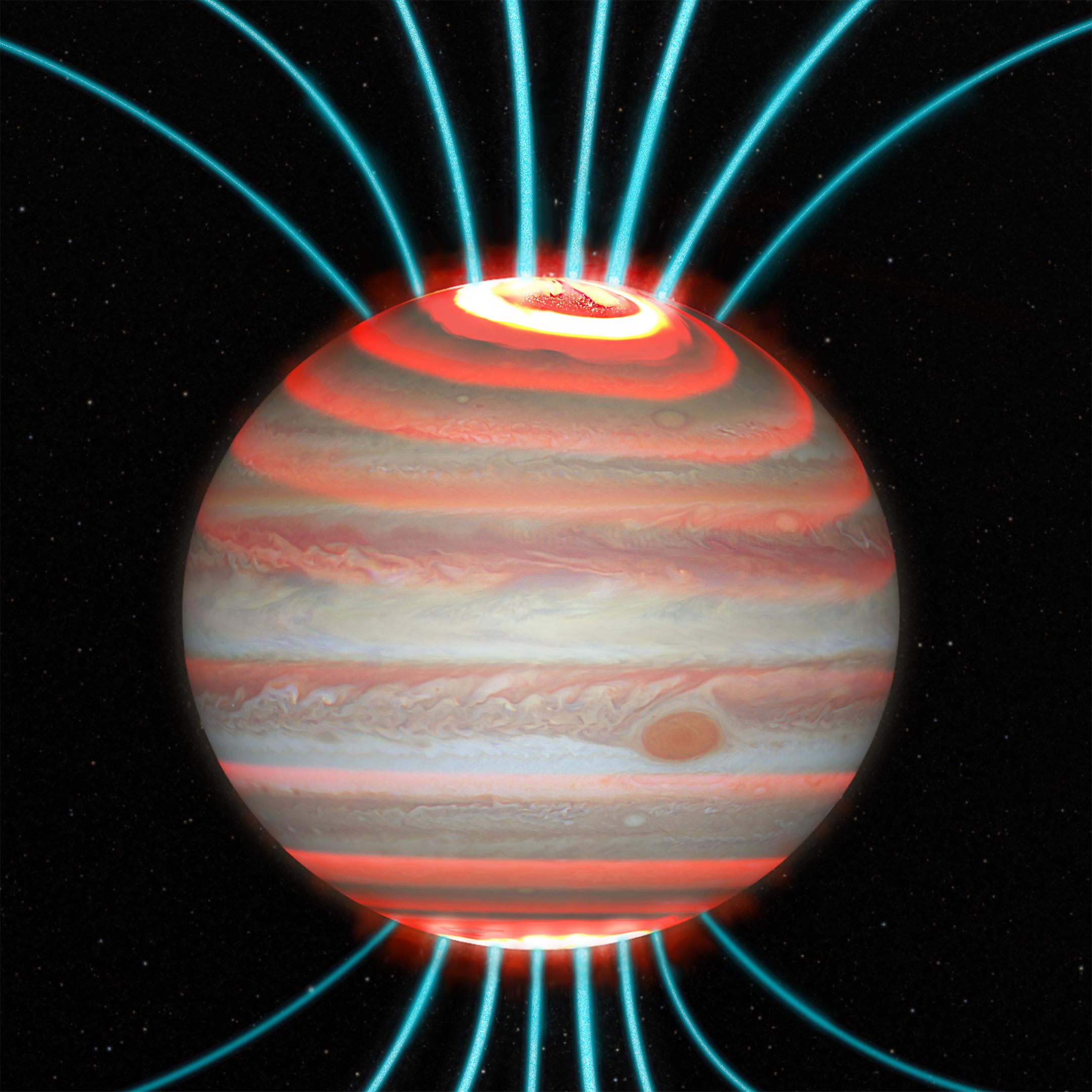
Jupiter may have once been more than twice its current size, with a magnetic field 50 times stronger, say scientists who analyzed its tiny inner moons. These new findings offer a rare and powerful window into how Jupiter—and by extension, the entire Solar System—first formed.
Jupiter has long been known as the heavyweight champion of the Solar System, but new research suggests it was once even more massive than we imagined. Scientists believe that Jupiter played a crucial role in shaping the early Solar System—its powerful gravity helped sculpt the orbits of other planets, guided the formation of the asteroid belt, and may have even protected Earth by deflecting dangerous asteroids.
Unveiling Jupiter’s Primordial Power
Now, a new study has taken us deeper into Jupiter’s mysterious beginnings. Astronomers Konstantin Batygin and Fred C. Adams have revealed that Jupiter was once between two and two-and-a-half times its current size. Even more astonishing, its magnetic field may have been up to 50 times stronger than it is today. These findings help paint a vivid picture of the young Solar System during its most chaotic and formative phase.
Batygin is a planetary science and astrophysics professor at Caltech, while Adams serves as a physics professor and director of the Leinweber Center for Theoretical Physics at the University of Michigan. Their groundbreaking paper, titled “Determination of Jupiter’s Primordial Physical State,” was published on May 20, 2025, in the journal Nature Astronomy.

Rethinking Solar System Formation Models
In celestial mechanics, the traditional paradigm where the evolution of the Solar System was attributed solely to the influence of Jupiter and the Sun is deeply rooted. However, observations have increasingly highlighted the importance of Jupiter in sculpting the Solar System’s architecture. As such, the full history of Jupiter’s origins and structural evolution is viewed as a key milestone in the early evolution of the Solar System. However, the details and timing of Jupiter’s formation remain elusive largely because of the inherent uncertainties of accretionary models.
Jupiter’s Inner Moons Reveal Ancient Secrets
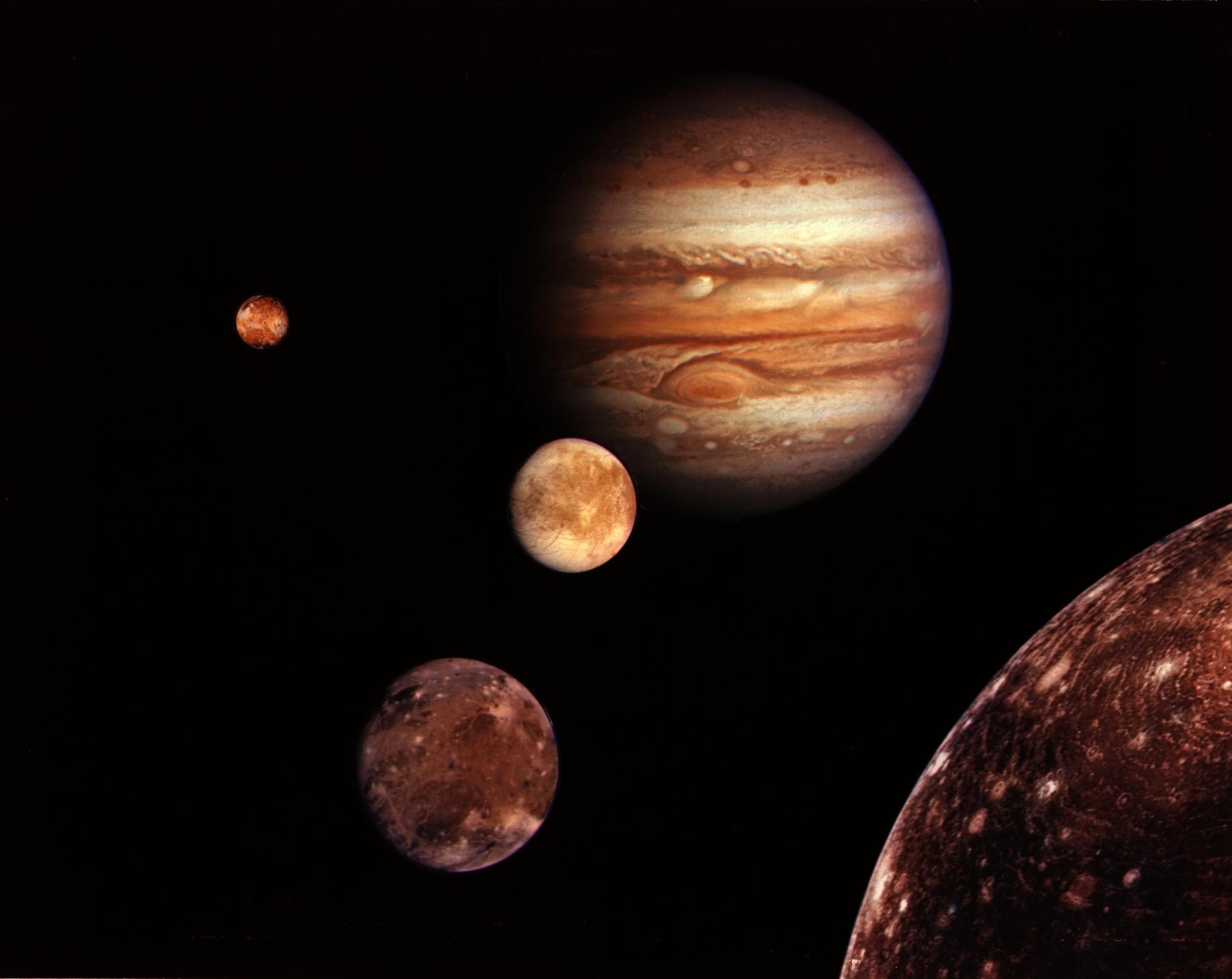
For their study, Batygin and Adams examined Amalthea and Thebe, two of Jupiter’s inner satellites. This family of satellites is low-mass and orbits even closer to Jupiter than Io, the smallest and closest-orbiting of Jupiter’s Galilean Moons. Both of these satellites have slightly tilted orbits and small orbital discrepancies, which allowed Batygin and Adams to calculate Jupiter’s original size. According to their results, Jupiter once had a volume of more than 2,000 Earths, roughly twice its current volume of 1,321 Earths. As Batygin said in a Caltech news story:
“Our ultimate goal is to understand where we come from, and pinning down the early phases of planet formation is essential to solving the puzzle. This brings us closer to understanding how not only Jupiter but the entire solar system took shape. What we’ve established here is a valuable benchmark. A point from which we can more confidently reconstruct the evolution of our solar system.”
A New Benchmark in Planetary Science
These insights are especially significant because they bypass traditional uncertainties in planetary formation models. These often rely on assumptions concerning the ability of a gas to absorb or scatter electromagnetic radiation, rates of accretion, and the mass of Jupiter’s core (composed of rock and metal). Instead, the team focused on directly measurable quantities, including the conservation of Jupiter’s angular momentum and the orbital dynamics of its moons.
Batygin and Adams’ analysis provides a crucial picture of one of Jupiter’s critical development stages, which has been subject to uncertainty in the past. In essence, it provides insight into the period when the solar nebula from which the planets formed evaporated. This was a critical transition point when the building blocks of the planets disappeared and the primordial architecture of the Solar System emerged. “It’s astonishing that even after 4.5 billion years, enough clues remain to let us reconstruct Jupiter’s physical state at the dawn of its existence,” said Adams.
These results could also add new insight into theories about planet formation, which could have implications for exoplanet studies. These theories suggest that Jupiter and the gas giants formed as rocky and icy material (which formed the core of these planets) rapidly accreted gas from the solar nebula. This new study builds on traditional models by providing more exact measurements of Jupiter’s size, spin rate, and magnetic conditions when it was still in a primordial state.
Explore Further: Twice the Size and 50x the Power: Jupiter’s Primordial Past Revealed
Reference: “Determination of Jupiter’s primordial physical state” by Konstantin Batygin, and Fred C. Adams, 20 May 2025, Nature Astronomy.
DOI: 10.1038/s41550-025-02512-y
Their research was funded by Caltech, the David and Lucile Packard Foundation, the National Science Foundation (NSF), the University of Michigan, and the Leinweber Center for Theoretical Physics.
Adapted from an article originally published on Universe Today.
Never miss a breakthrough: Join the SciTechDaily newsletter.
Follow us on Google and Google News.