

A new all-optical switch uses circularly polarized light and an innovative semiconductor to process data faster and more efficiently in fiber-optic systems.
This technology facilitates significant energy savings and introduces a method to control quantum properties in materials, promising major advancements in optical computing and fundamental science.
Modern high-speed internet relies on light to transmit large amounts of data quickly and reliably through fiber-optic cables. However, when data needs to be processed, the light signals face a bottleneck. They must first be converted into electrical signals for processing before they can continue being transmitted.
An all-optical switch offers a solution. It uses light to control other light signals without the need for electrical conversion, which saves both time and energy in fiber-optic communication systems.
“Our results open doors to a lot of new possibilities.”
Hui Deng
Breakthrough in Optical Switch Technology
A research team led by the University of Michigan has demonstrated an ultrafast all-optical switch using pulsing circularly polarized light, which twists like a helix, through an optical cavity lined with an ultrathin semiconductor. Their study was recently published in Nature Communications.
This device can operate as a standard optical switch, where turning a control laser on or off switches the signal beam of the same polarization. It can also function as a logic gate known as an Exclusive OR (XOR) switch, which generates an output signal when one light input twists clockwise and the other counterclockwise, but not when both twist in the same direction.
“Because a switch is the most elementary building block of any information processing unit, an all-optical switch is the first step towards all-optical computing or building optical neural networks,” said Lingxiao Zhou, a physics doctoral student at U-M and lead author of the study.
“Extremely low power consumption is a key to optical computing’s success. The work done by our team addresses just this problem.”
Stephen Forrest
Optical computing’s low loss makes it more desirable than electronic computing.
Advancements in Optical Computing
“Extremely low power consumption is a key to optical computing’s success. The work done by our team addresses just this problem, using unusual two-dimensional materials to switch data at very low energies per bit,” said Stephen Forrest, the Peter A. Franken Distinguished University Professor of Electrical Engineering at U-M and contributing author of the study.
To achieve this, the researchers pulsed a helical laser at regular intervals through an optical cavity—a set of mirrors that trap and bounce light back and forth multiple times—boosting the strength of the laser by two orders of magnitude.
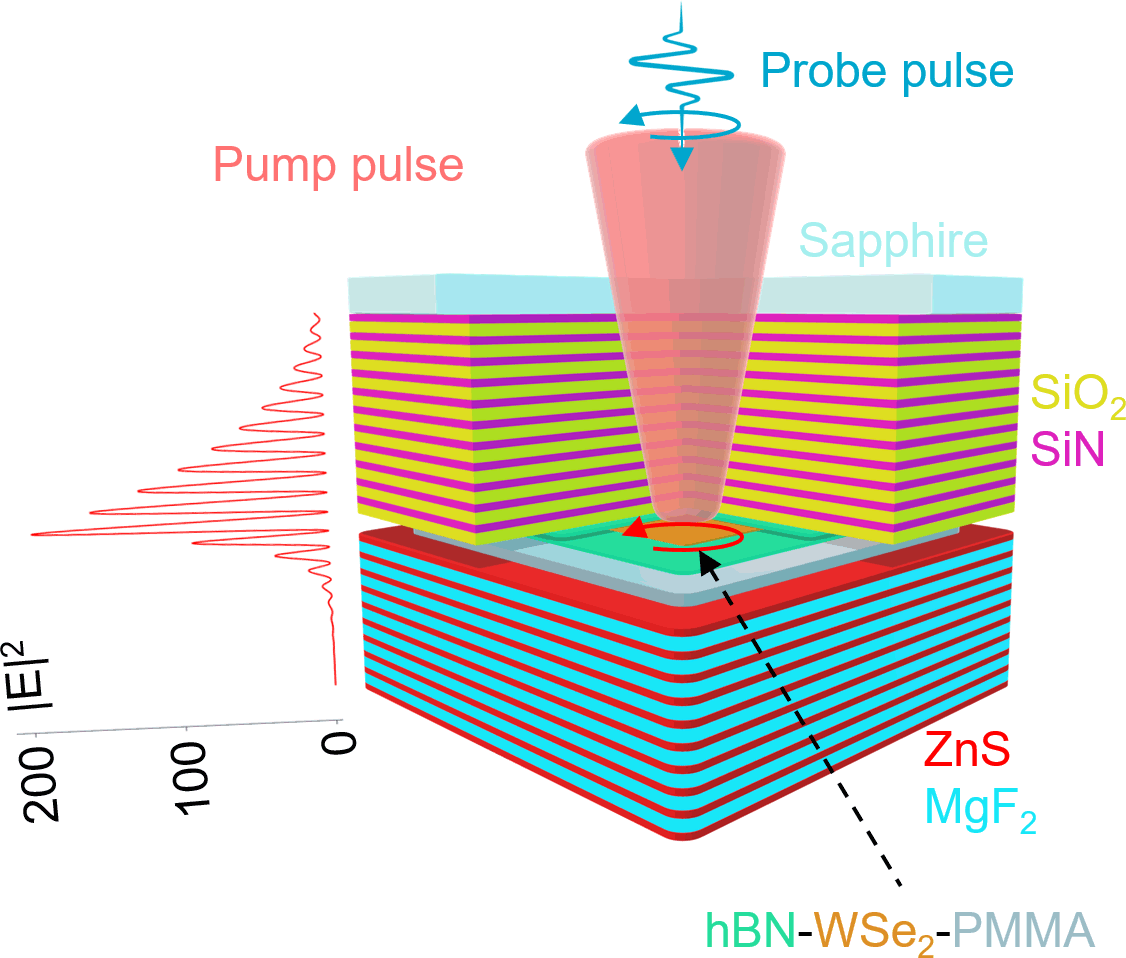
When a one-molecule-thick layer of the semiconductor tungsten diselenide (WSe2) is embedded within the optical cavity, the strong, oscillating light enlarges the electronic bands of the available electrons in the semiconductor—a nonlinear optical effect known as the optical Stark effect. This means that when an electron jumps to a higher orbital, it absorbs more energy, and it emits more energy when it jumps down, known as blue shifting. This in turn modifies the signal light’s fluence, the amount of energy delivered or reflected per unit area.
Impact on Quantum Physics and Technology
In addition to modulating the signal light, the optical Stark effect produced a pseudo-magnetic field, which influences electronic bands similarly to those of a magnetic field. Its effective strength was 210 Tesla, far stronger than Earth’s strongest magnet with a strength of 100 Tesla. The enormously strong force is felt only by electrons whose spins are aligned with the helicity of the light, temporarily splitting the electronic bands of different spin orientations, and directing the electrons in the aligned bands all in the same orientation.
The team could change the ordering of the electronic bands of different spins by changing the direction the light twists.
The brief uniform spin directionality of the electrons in different bands also breaks something called time reversal symmetry. Essentially, time reversal symmetry means that the physics underlying a process is the same forwards and backward, implying conservation of energy.
While we typically can’t observe this in the macroscopic world due to the way energy dissipates through forces like friction, if you could take a video of electrons spinning, it would obey the laws of physics whether you played it forward or backward—the electron spinning one way would turn into an electron spinning the opposite way with the same energy. But in the pseudo-magnetic field, time reversal symmetry is broken because if rewound, the electron spinning in the opposite direction has a different energy—and the energy of different spins can be controlled through the laser.
“Our results open doors to a lot of new possibilities, both in fundamental science where controlling time reversal symmetry is a requirement for creating exotic states of matter and for technology, where leveraging such a huge magnetic field becomes possible,” said Hui Deng, a professor of physics and electrical and computer engineering at U-M and corresponding author of the study.
Reference: “Cavity Floquet engineering” by Lingxiao Zhou, Bin Liu, Yuze Liu, Yang Lu, Qiuyang Li, Xin Xie, Nathanial Lydick, Ruofan Hao, Chenxi Liu, Kenji Watanabe, Takashi Taniguchi, Yu-Hsun Chou, Stephen R. Forrest and Hui Deng, 6 September 2024, Nature Communications.
DOI: 10.1038/s41467-024-52014-0
This work was funded by the Army Research Office (W911NF-17-1-0312); the Air Force Office of Scientific Research (FA2386-21-1-4066) the National Science Foundation (DMR 2132470); the Office of Naval Research (N00014-21-1-2770); and the Gordon and Betty Moore Foundation (GBMF10694).
Forrest is also the Paul G. Goebel Professor of Engineering and professor of electrical engineering and computer science, materials science and engineering, and physics.
Never miss a breakthrough: Join the SciTechDaily newsletter.
Follow us on Google and Google News.