
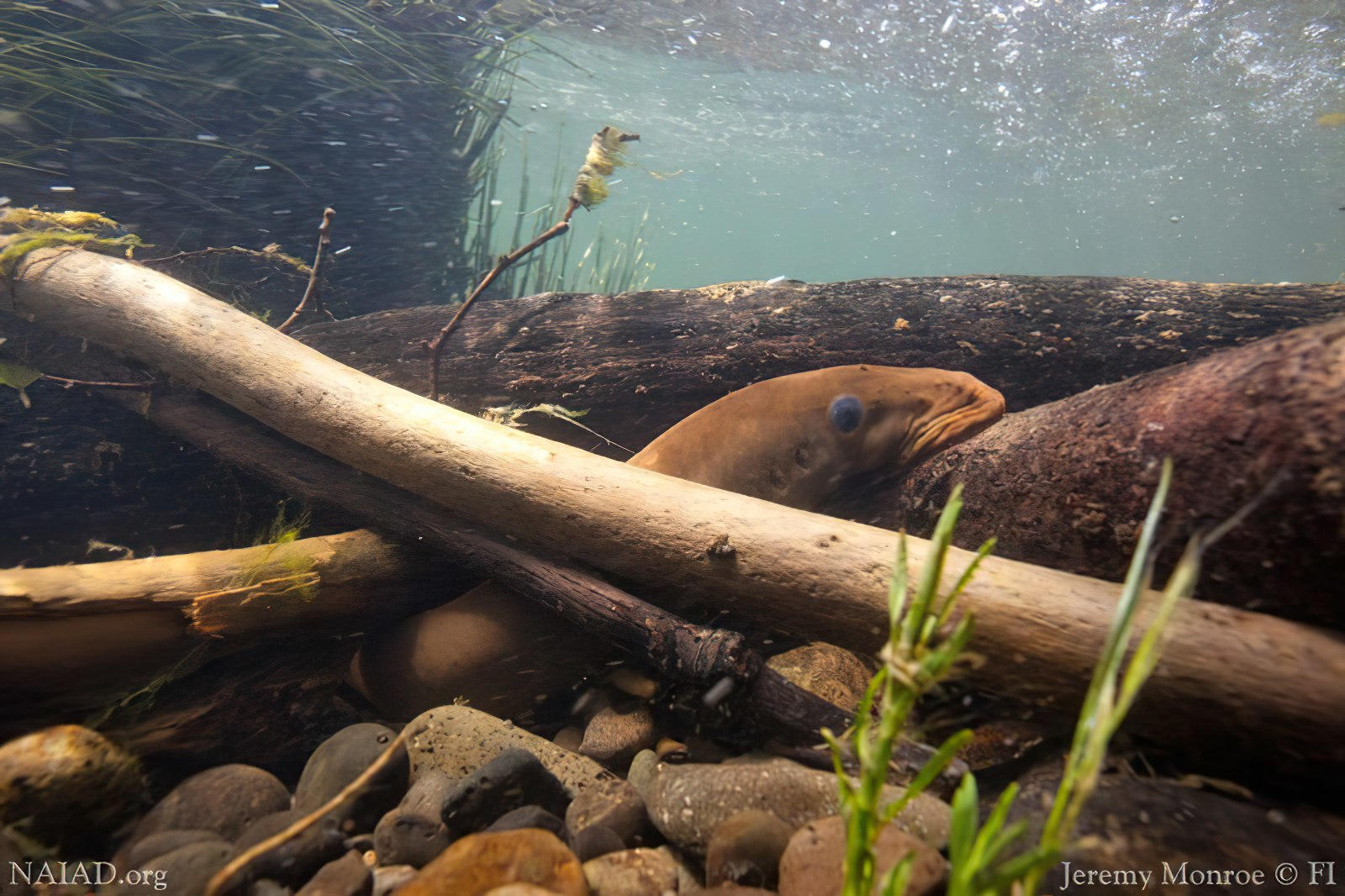
These jawless fish play a crucial role in the ecosystem.
A study from the University of California, Davis, has identified two potential new species of lamprey fish in the waters of California. The research is part of a special section on native lampreys recently published in the North American Journal of Fisheries Management.
The findings suggest that the ancient animal has far more diversity in California than once thought, which could have implications for managing these jawless fish. Lamprey species play a key role in the food chain as well as improving water quality and adding nutrients to waterways.
“We found diversity that has never been reported,” said Ph.D. candidate Grace Auringer, who is the lead author on the journal paper. “We found two groups of fish in Napa River and Alameda Creek that are very genetically different from other samples along the West Coast.”
The study found that of the eight known species in the state, some that were thought to be separate species likely are not. It recommends additional research to further define the new species.
“This is a really understudied group of fish,” said Auringer, who is in the UC Davis Genomic Variation Lab.
A long history
Lampreys are boneless, jawless fish with eel-like bodies that date back over 350 million years, said Matthew “Mac” Campbell, a research affiliate in the lab.
Larval stages last from three to nine years, with lampreys ranging from the size of a fingernail to about 6 inches long, and one species is not discernible from the next. At that stage, they are filter feeders. As they age, some lampreys become parasitic and suck blood and flesh out of prey via a circle of sharp teeth while others stop feeding entirely, likely living off stored energy. Some adult lampreys are migratory, and others are not.
The lab’s research focused on 19 areas in the Sacramento-San Joaquin River Basin, San Francisco Bay, and Klamath River basin and sought to do three things: identify the species in each area, determine if current classifications accurately reflect the diversity of lamprey in California and compare the distribution of lamprey to other native fish.
Staff from water and conservation districts, state agencies, and utilities visited watersheds, clipped small pieces of lamprey fins, and preserved them in ethanol for analysis at UC Davis. The researchers also received archived tissue samples from the Columbia River Inter-Tribal Fish Commission.
DNA barcoding
The scientists isolated a specific mitochondrial gene — cytochrome b — from those samples. Using a short section of DNA, they were able to identify the species type and the evolutionary relationships of the samples based on shared or divergent DNA sequences.
“The amount of diversity that we saw is quite remarkable,” Auringer said. “This opens up endless possibilities for future study.”
Lamprey populations have long been thought to be declining in the West, and the eight documented lamprey species — in the Lampetra and Entosphenus genera — in California are listed as species of special concern.
“I think it’s very important to identify and learn about these unique populations before we lose them,” she said.
The two newly discovered lamprey species from the research are part of the Lampetra genus, adding more complexity to the lamprey story in the state.
Knowing the exact species can help refine management practices and protect the populations, as well as support ecosystems and the food web. For some Indigenous peoples, lampreys are both culturally significant and a source of nutrition.
Ecosystem benefits
Lamprey larvae filter and feed on algae and other organic matter, helping to improve water quality, maintain streambeds and cycle nutrients throughout the system. The migrating adults transport nutrients after spawning. And birds, fish, and some aquatic mammals feed on juvenile and adult lampreys.
“Healthy trout streams in California often have lamprey, so conservation measures benefiting lamprey also benefit trout,” said Amanda “Mandi” Finger, the Genetic Variation Lab’s associate director.
The research highlights the need for more study, including genomic sequencing, to better understand and define the new potential lamprey species and the rest of the population.
“Maintaining lamprey species complexity and fostering resilience cannot begin without an understanding of their underlying genetic diversity,” the paper said.
Pascale Goertler, who worked at the Delta Stewardship Council and is now with the state Department of Water Resources, contributed to the research.
Reference: “Lampreys in California (Lampetra spp. and Entosphenus spp.): Mitochondrial phylogenetic analysis reveals previously unrecognized lamprey diversity” by Grace Auringer, Matthew A. Campbell, Pascale A. L. Goertler and Amanda J. Finger, 30 September 2023, North American Journal of Fisheries Management.
DOI: 10.1002/nafm.10959
Funding for the research came from the California Sea Grant College Program Project and the California Department of Water Resources.
Never miss a breakthrough: Join the SciTechDaily newsletter.
Follow us on Google and Google News.