
The unexpected findings were a result of data collected for more than a decade at the NSF facility, which is managed by the University of Central Florida, and from data from NASA’s Fermi Large Area Space Telescope.
An international team of researchers using data from Arecibo Observatory and the Fermi Space Telescope have discovered what they call a “gamma-ray heartbeat” coming from a cosmic gas cloud.
The cloud is in the constellation Aquilla and “beats” in rhythm with a black hole 100 light-years away in a microquasar system known as SS 433. The results were published in August 2020 in the journal Nature Astronomy.
“This result challenges obvious interpretations and is unexpected from previously published theoretical models,” says Jian Li, a Humboldt Fellow with the Deutsches Elektronen-Synchrotron in Zeuthen, Germany, and study co-author. “It provides us with a chance to unveil the particle transport from SS 433 and to probe the structure of the magnetic field in its vicinity.”
In the SS 433 system, a black hole orbits a giant star, 30 times the mass of Earth’s sun. The black hole sucks matter from the giant star while orbiting it, forming a swirling accretion disc that drains into the black hole, like water into a bathtub drain.
Some of the matter doesn’t fall into the hole though, but rather jets out in high speed spirals from the disc’s center in both directions, top and bottom, like pegs on a wheel.
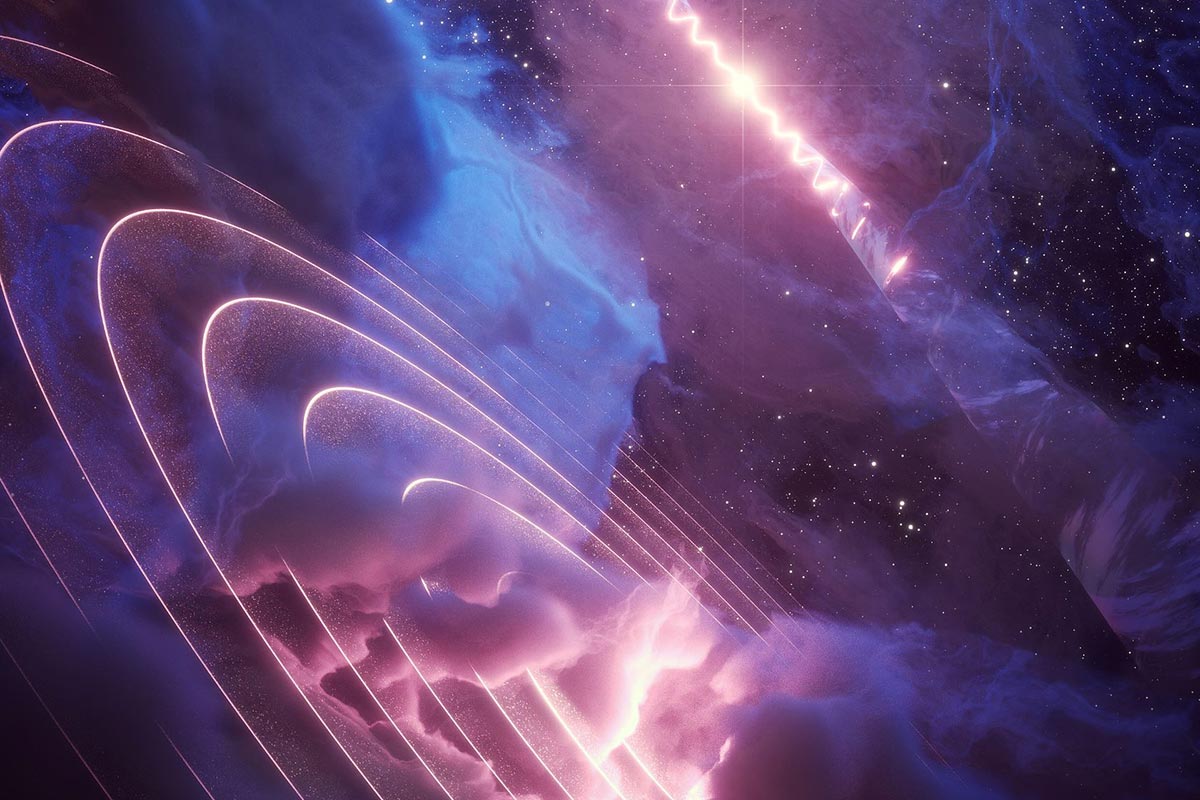
The microquasar SS 433 consists of a black hole and a giant star orbiting each other, with the black hole constantly sucking matter from the star. This matter collects on an accretion disk before falling into the black hole. However, some of the matter does not fall into the black hole, but is hurled out into space in two narrow jets at the top and bottom. As the accretion disk does not lie exactly in the orbital plane of the two partners, it sways like a spinning top set at an angle, and with it the jets do so as well, describe spirals in space. In the same rhythm as the tumbling jets and accretion disk, an inconspicuous gas cloud about 100 light years away shines in the light of the gamma radiation. This temporal correspondence suggests a direct connection, but it is not clear exactly how the microquasar drives the gamma-ray “heartbeat” of the gas cloud. Animation: DESY, Science Communication Lab
The researchers made the discovery by analyzing more than a decade of data from NASA’s Fermi Large Area Space Telescope and from Galactic ALFA HI survey data collected with the Arecibo Observatory’s 1,000-foot-wide radio telescope. The observatory was recently damaged and is currently offline, but scientists continue to have access to data previously collected. Engineers are assessing what caused a cable to break and plans for repairs.
The researchers found that the precession, or wobble, of the black hole’s jets matched with a gamma-ray signal emitted from a gas cloud. The researchers have labeled the position in the gas cloud Fermi J1913+0515. The position was revealed using Arecibo Observatory’s telescope, and Fermi provided data about the SS 433 system.
“The consistent periods indicate the gas cloud’s emission is powered by the micro quasar,” Li says.
Scientists still do not fully know how the jets overcome the black hole’s pull and are emitted from the disc, and the current study presents a new question – How does the black hole power the gas cloud’s heartbeat?
The study’s researchers say further observations and theoretical work are needed, but one suggestion is that the cloud’s gamma-ray emissions are caused by the injection of the nuclei of hydrogen atoms, known as fast protons, that are produced at the end of the jets, or near the black hole.
“SS 433 continues to amaze observers at all frequencies and theoreticians alike,” Li says. “And it is certain to provide a testbed for our ideas on cosmic-ray production and propagation near microquasars for years to come.”
Read Mysterious Gamma-Ray Heartbeat Coming From Cosmic Gas Cloud Leaves Scientists Baffled for more on this research.
Reference: “Gamma-ray heartbeat powered by the microquasar SS 433” by Jian Li, Diego Torres, Ruo-Yu Liu, Matthew Kerr, Emma de Oña Wilhelmi and Yang Su, 17 August 2020, Nature Astronomy.
DOI: 10.1038/s41550-020-1164-6
Study co-authors also included Diego Torres with the Institute of Space Sciences, Barcelona, Spain, the Institució Catalana de Recerca i Estudis Avançats in Barcelona, and the Institut d’Estudis Espacials de Catalunya in Barcelona; Ruo-Yu Liu with the School of Astronomy and Space Science, at Nanjing University in China and the Key Laboratory of Modern Astronomy and Astrophysics at Nanjing University, Ministry of Education, in China; Matthew Kerr with the Space Science Division of the Naval Research Laboratory in Washington, D.C.; Emma de Oña Wilhelmi with Deutsches Elektronen-Synchrotron in Zeuthen, Germany, and the Institute of Space Sciences in Barcelona, Spain; and Yang Su with Purple Mountain Observatory and Key Laboratory of Radio Astronomy in the Chinese Academy of Sciences in Nanjing, China.
UCF manages the National Science Foundation’s Arecibo Observatory under a cooperative agreement with Universidad Ana G. Méndez and Yang Enterprises Inc. The facility, which is home to one of the most powerful telescopes on the planet, is used by scientists around the world to conduct research in the areas of atmospheric sciences, space weather research, planetary sciences, radio astronomy and radar astronomy.
Arecibo is also home to a team that runs the Planetary Radar Project supported by NASA’s Near-Earth Object Observations Program in NASA’s Planetary Defense Coordination Office through a grant awarded to UCF.
Funding for the research came from NASA, the U.S. Department of Energy, the Commissariat à l’Energie Atomique and the Centre National de la Recherche Scientifique/Institut National de Physique Nucléaire et de Physique des Particules in France; the Agenzia Spaziale Italiana and the Istituto Nazionale di Fisica Nucleare in Italy; the Ministry of Education, Culture, Sports, Science and Technology, High Energy Accelerator Research Organization and Japan Aerospace Exploration Agency in Japan and the K. A. Wallenberg Foundation, the Swedish Research Council and the Swedish National Space Board in Sweden.
Additional support for science analysis was from the Istituto Nazionale di Astrofisica in Italy and the Centre National d’Études Spatiales in France. The work was performed in part under DOE Contract Number DE-AC02-76SF00515 and from support from the Alexander von Humboldt Foundation and the National Natural Science Foundation of China via grant numbers NSFC-11673013 and NSFC-11733009 and by grant numbers PGC2018-095512-B-I00, SGR2017-1383 and AYA2017-92402-EXP.
Never miss a breakthrough: Join the SciTechDaily newsletter.
Follow us on Google and Google News.
3 Comments
“This result challenges obvious interpretations and is unexpected from previously published theoretical models,”
That’s because you’re theoretical models are wrong, hello.
“jets out in high speed spirals from the disc’s center in both directions, top and bottom” – classical electrical physics, you’re detecting electrical phenomena.
“discovered what they call a “gamma-ray heartbeat” coming from a cosmic gas cloud”
If you step outside of these scientist’s imaginary world of undetectable supernatural cosmic forces based on obscure mathematics, computer simulations, and unfalsifiable musings, the easiest, most efficient, most common way that NATURE produces gamma rays is without question through electricity.
https://phys.org/news/2017-10-lightning-afterglow-gamma.html
The easiest, most efficient, most common way that NATURE produces magnetic fields is also without question through electricity, which are also being found everywhere in the universe.
https://www.thunderbolts.info/wp/2020/08/14/donald-scott-no-magnetic-universe-w-o-electric-currents-space-news/
How many times do we have to read over and over similar statements to “This result challenges obvious interpretations and is unexpected from previously published theoretical models?” Time for a change. It’s time to take scientifically verified principles as a starting point when investigating phenomena such as this instead of the purely speculative and outlandish models currently all the rage in cosmology.
…
“Some of the matter doesn’t fall into the hole though, but rather jets out in high speed spirals from the disc’s center in both directions, top and bottom, like pegs on a wheel.”
A time for a happy thought, could that be just matter recycling in scientists eyes!
…
… A much as I know, one should consider winner takes all approach to this, not like that idea of lets stick to our idea to the end.
In the world of chess ” let’s play till the kings are bare…”. The Albert is half naked!