
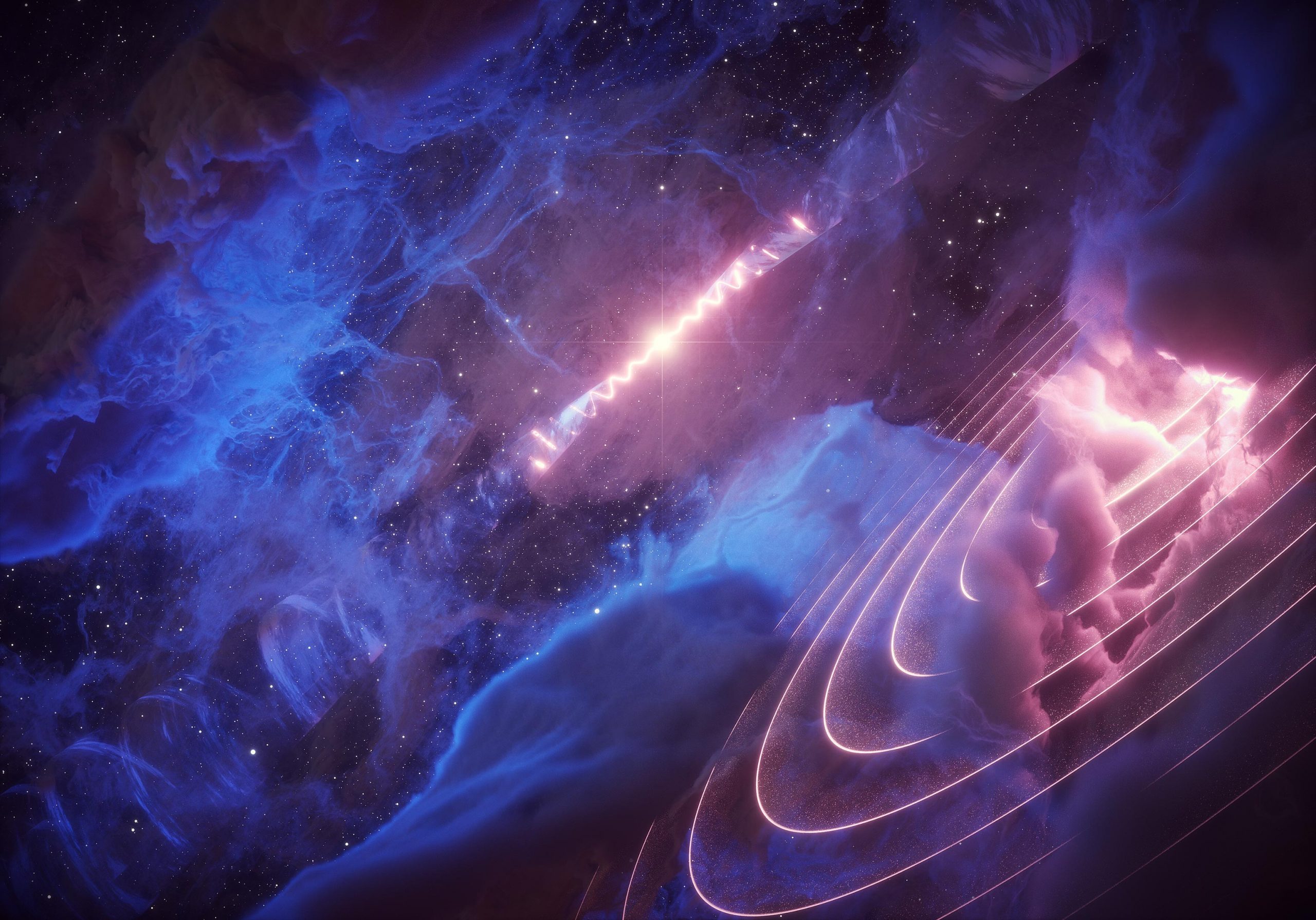
Cosmic gas cloud blinks in sync with circling black hole.
Scientists have detected a mysterious gamma-ray heartbeat coming from a cosmic gas cloud. The inconspicuous cloud in the constellation Aquila is beating with the rhythm of a neighboring precessing black hole, indicating a connection between the two objects, as the team led by DESY Humboldt Fellow Jian Li and ICREA Professor Diego F. Torres from the Institute of Space Sciences (IEEC-CSIC) reports in the journal Nature Astronomy. Just how the black hole powers the cloud’s gamma-ray heartbeat over a distance of about 100 light-years remains enigmatic.
The research team, comprising scientists from Germany, Spain, China, and the U.S., rigorously analyzed more than ten years of data from the US space administration NASA’s Fermi gamma-ray space telescope, looking at a so-called micro quasar. The system cataloged as SS 433 is located some 15 000 light-years away in the Milky Way and consists of a giant star with about 30 times the mass of our sun and a black hole with about 10 to 20 solar masses. The two objects are orbiting each other with a period of 13 days, while the black hole sucks matter from the giant star.
“This material accumulates in an accretion disc before falling into the black hole, like water in the whirl above the drain of a bathtub,” explains Li. “However, a part of that matter does not fall down the drain but shoots out at high speed in two narrow jets in opposite directions above and below the rotating accretion disk.” This setting is known from active galaxies called quasars with monstrous black holes with millions of solar masses at their centers that shoot jets tens of thousands of light-years into the cosmos. As SS 433 looks like a scaled-down version of these quasars, it has been dubbed a micro quasar.
The microquasar SS 433 consists of a black hole and a giant star orbiting each other, with the black hole constantly sucking matter from the star. This matter collects on an accretion disk before falling into the black hole. However, some of the matter does not fall into the black hole, but is hurled out into space in two narrow jets at the top and bottom. As the accretion disk does not lie exactly in the orbital plane of the two partners, it sways like a spinning top set at an angle, and with it the jets do so as well, describe spirals in space. In the same rhythm as the tumbling jets and accretion disk, an inconspicuous gas cloud about 100 light-years away shines in the light of the gamma radiation. This temporal correspondence suggests a direct connection, but it is not clear exactly how the microquasar drives the gamma-ray “heartbeat” of the gas cloud. Animation: DESY, Science Communication Lab
The high-speed particles and the ultra-strong magnetic fields in the jet produce X-rays and gamma rays. “The accretion disc does not lie exactly in the plane of the orbit of the two objects. It precesses, or sways, like a spinning top that has been set up slanted on a table,” says Torres. “As a consequence, the two jets spiral into the surrounding space, rather than just forming a straight line.”
The precession of the black hole’s jets has a period of about 162 days. Meticulous analysis revealed a gamma-ray signal with the same period from a position located relatively far from the micro quasar’s jets, which has been labeled as Fermi J1913+0515 by the scientists. It is located at the position of an unremarkable gas enhancement. The consistent periods indicate the gas cloud’s emission is powered by the micro quasar.
“Finding such an unambiguous connection via timing, about 100 light-years away from the micro quasar, not even along the direction of the jets is as unexpected as amazing,” says Li. “But how the black hole can power the gas cloud’s heartbeat is unclear to us.” Direct periodic illumination by the jet seems unlikely. An alternative that the team explored is based on the impact of fast protons (the nuclei of hydrogen atoms) produced at the ends of the jets or near the black hole, and injected into the cloud, where these subatomic particles hit the gas and produce gamma rays. Protons could also be part of an outflow of fast particles from the edge of the accretion disc. Whenever this outflow strikes the gas cloud, it lights up in gamma rays, which would explain its strange heartbeat. “Energetically, the outflow from the disc could be as powerful as that of the jets and is believed to precess in solidarity with the rest of the system,” explains Torres.
Further observations as well as theoretical work are required to fully explain the strange gamma-ray heartbeat of this unique system beyond this initial discovery. “SS 433 continues to amaze observers at all frequencies and theoreticians alike,” emphasizes Li. “And it is certain to provide a testbed for our ideas on cosmic-ray production and propagation near micro quasars for years to come.”
Reference: “Gamma-ray heartbeat powered by the microquasar SS 433” by Jian Li, Diego Torres, Ruo-Yu Liu, Matthew Kerr, Emma de Oña Wilhelmi and Yang Su, 17 August 2020, Nature Astronomy.
DOI: 10.1038/s41550-020-1164-6
Scientists from DESY (Germany), ICE (Spain), Nanjing University (China), the U.S. Naval Research Laboratory (USA) and Purple Mountain observatory (China) contributed to this research.
Never miss a breakthrough: Join the SciTechDaily newsletter.
Follow us on Google and Google News.
1 Comment
Hmm, instead of the highly speculative and scientifically unsupported explanations of this article, electricity has absolutely been proven ad nauseum to produce “high-speed particles,” “magnetic fields,” “jets,” “X-rays and gamma rays,” and “spirals.” But hey, why spoil a good thing like being forever baffled by new cosmic discoveries by getting a clue about the basic properties of electricity and it’s applications to space.