
Close Menu
    Facebook X (Twitter) Instagram
    SciTechDaily
    • Biology
    • Chemistry
    • Earth
    • Health
    • Physics
    • Science
    • Space
    • Technology
    Facebook X (Twitter) Pinterest YouTube RSS
    SciTechDaily
    Home»Technology»Energy-Efficient Tuning of Spintronic Neurons to Imitate the Non-linear Oscillatory Neural Networks of the Human Brain
    Technology

    Energy-Efficient Tuning of Spintronic Neurons to Imitate the Non-linear Oscillatory Neural Networks of the Human Brain

    By Tohoku UniversityAugust 17, 2020No Comments4 Mins Read
    Facebook Twitter Pinterest Telegram LinkedIn WhatsApp Email Reddit
    Share
    Facebook Twitter LinkedIn Pinterest Telegram Email Reddit
    Spintronic Neurons Concept
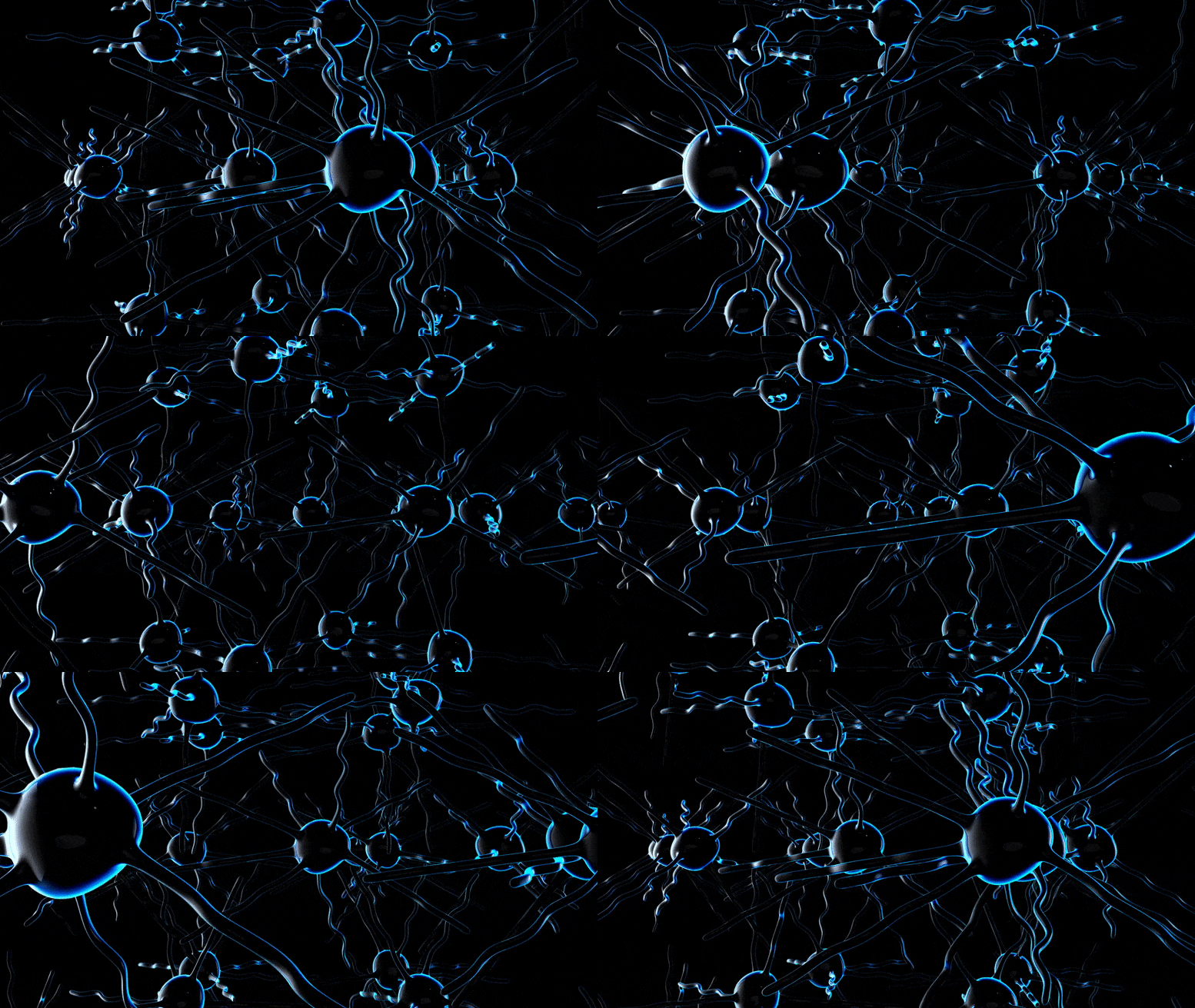
    Researchers have developed a voltage-controlled spintronic microwave oscillator that closely mimics the non-linear oscillatory neural networks of the human brain.

    The human brain efficiently executes highly sophisticated tasks, such as image and speech recognition, with an exceptionally lower energy budget than today’s computers can. The development of energy-efficient and tunable artificial neurons capable of emulating brain-inspired processes has, therefore, been a major research goal for decades.

    Researchers at the University of Gothenburg and Tohoku University jointly reported on an important experimental advance in this direction, demonstrating a novel voltage-controlled spintronic microwave oscillator capable of closely imitating the non-linear oscillatory neural networks of the human brain.

    The research team developed a voltage-controlled spintronic oscillator, whose properties can be strongly tuned, with negligible energy consumption. “This is an important breakthrough as these so-called spin Hall nano-oscillators (SHNOs) can act as interacting oscillator-based neurons but have so far lacked an energy-efficient tuning scheme — an essential prerequisite to train the neural networks for cognitive neuromorphic tasks,” proclaimed Shunsuke Fukami, co-author of the study. “The expansion of the developed technology can also drive the tuning of the synaptic interactions between each pair of spintronic neurons in a large complex oscillatory neural network.”
    Energy Efficient Tuning of Spintronic Neurons
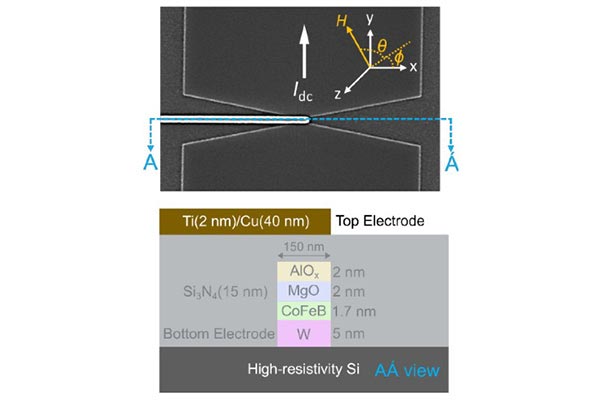
    Scanning electron microscopy image and schematic of cross-sectional structure of the created spin-Hall nano-oscillator device with the gate electrode. Credit: Johan Åkerman and Shunsuke Fukami

    Earlier this year, the Johan Åkerman group at the University of Gothenburg demonstrated, for the first time, 2D mutually synchronized arrays accommodating 100 SHNOs while occupying an area of less than a square micron. The network can mimic neuron interactions in our brain and carry out cognitive tasks. However, a major bottleneck in training such artificial neurons to produce different responses to different inputs has been the lack of the scheme to control individual oscillator inside such networks.

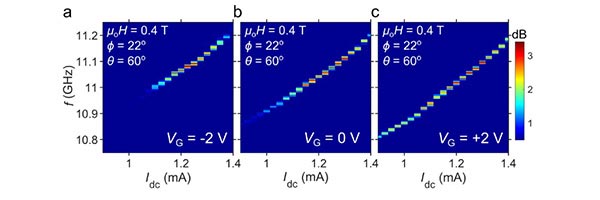
    The Johan Åkerman group teamed up with Hideo Ohno and Shunsuke Fukami at Tohoku University to develop a bow tie-shaped spin Hall nano-oscillator made from an ultrathin W/CoFeB/MgO material stack with an added functionality of a voltage controlled gate over the oscillating region [Fig. 1]. Using an effect called voltage-controlled magnetic anisotropy (VCMA), the magnetic and magnetodynamic properties of CoFeB ferromagnet, consisting of a few atomic layers, can be directly controlled to modify the microwave frequency, amplitude, damping, and, thus, the threshold current of the SHNO [Fig. 2].
    Spintronic Neurons Experimental Result
    Experimental result of oscillation property under various gate voltages. Red and yellow regions mean a strong oscillation taking place. One can see that the oscillation property changes with the gate voltage. Credit: Johan Åkerman and Shunsuke Fukami

    The researchers also found a giant modulation of SHNO damping up to 42% using voltages from -3 to +1 V in the bow-tied geometry. The demonstrated approach is, therefore, capable of independently turning individual oscillators on/off within a large synchronized oscillatory network driven by a single global drive current. The findings are also valuable since they reveal a new mechanism of energy relaxation in patterned magnetic nanostructures.

    Fukami notes that “With readily available energy-efficient independent control of the dynamical state of individual spintronic neurons, we hope to efficiently train large SHNO networks to carry out complex neuromorphic tasks and scale up oscillator-based neuromorphic computing schemes to much larger network sizes.”

    Collaboration between Tohoku University and the University of Gothenburg will continue to strengthen as Tohoku University has recently joined the Sweden-Japan collaborative network MIRAI 2.0, a project that aims to enhance research collaborations between Swedish and Japanese universities.

    Reference: “Giant voltage-controlled modulation of spin Hall nano-oscillator damping” by Himanshu Fulara, Mohammad Zahedinejad, Roman Khymyn, Mykola Dvornik, Shunsuke Fukami, Shun Kanai, Hideo Ohno and Johan Åkerman, 11 August 2020, Nature Communications.
    DOI: 10.1038/s41467-020-17833-x

    Never miss a breakthrough: Join the SciTechDaily newsletter.
    Follow us on Google and Google News.

    Nanotechnology Spintronics Tohoku University
    Share. Facebook Twitter Pinterest LinkedIn Email Reddit

    Related Articles

    One Step Closer to Unparalleled Computational Power: Spintronics Technology Meets Brain-Inspired Computing

    A New Self-Assembly Method for Fabricating Graphene Nanoribbons

    Scientists Create New Electronic Material with Potential for Flexible Light-Based Electronics

    Researchers Develop Transistors without Semiconductors

    Improving Magnetic Memory by Controlling Spin Orientation

    3D Microchip Allows Information to Travel in Three Dimensions

    HARPES Technique Reveals Ferromagnetic Secrets of Dilute Magnetic Semiconductors

    Electronic Read-Out of the Quantum State of an Atom

    Converting Heat to Electricity in a Non-Magnetic Semiconductor

    Leave A Reply Cancel Reply

    • Facebook
    • Twitter
    • Pinterest
    • YouTube

    Don't Miss a Discovery

    Subscribe for the Latest in Science & Tech!

    Trending News

    AI Could Detect Early Signs of Alzheimer’s in Under a Minute – Far Before Traditional Tests

    What if Dark Matter Has Two Forms? Bold New Hypothesis Could Explain a Cosmic Mystery

    This Metal Melts in Your Hand – and Scientists Just Discovered Something Strange

    Beef vs. Chicken: Surprising Results From New Prediabetes Study

    Alzheimer’s Breakthrough: Scientists Discover Key Protein May Prevent Toxic Protein Clumps in the Brain

    Quantum Reality Gets Stranger: Physicists Put a Lump of Metal in Two Places at Once

    Scientists May Have Found the Key to Jupiter and Saturn’s Moon Mystery

    Scientists Uncover Brain Changes That Link Pain to Depression

    Follow SciTechDaily
    • Facebook
    • Twitter
    • YouTube
    • Pinterest
    • Newsletter
    • RSS
    SciTech News
    • Biology News
    • Chemistry News
    • Earth News
    • Health News
    • Physics News
    • Science News
    • Space News
    • Technology News
    Recent Posts
    • Scientists Discover Enzyme That Could Supercharge Ozempic-Like Weight Loss Drugs
    • Asthma and Depression Don’t Mix the Way Scientists Expected
    • Why Promising Cancer Drugs Failed: Scientists Uncover the Missing Piece
    • Popular Sweetener Linked to DNA Damage – “It’s Something You Should Not Be Eating”
    • Ancient “Rock” Microbes May Reveal How Complex Life Began
    Copyright © 1998 - 2026 SciTechDaily. All Rights Reserved.
    • Science News
    • About
    • Contact
    • Editorial Board
    • Privacy Policy
    • Terms of Use

    Type above and press Enter to search. Press Esc to cancel.