
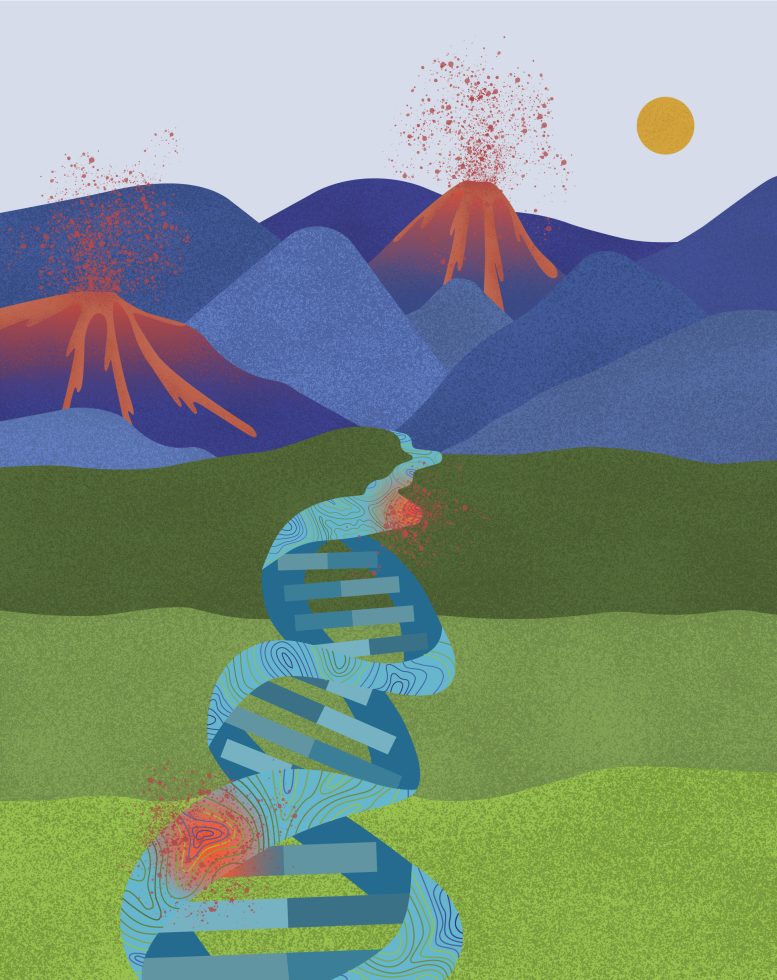
A study reveals that the 3D genome structure shapes cancer mutations, unexpectedly linking alcohol-related mutations to early-replicated DNA and providing a new research resource.
Scientists from the University of California San Diego have discovered a link between the topography of the human genome and the presence of mutations in human cancer. They found that certain regions of the genome, which exhibit unique features, act as hotspots for the accumulation of mutations.
These insights, recently published in the journal Cell Reports, highlight the potential influence of the human genome’s 3D structure in the development of various forms of cancer.
Beyond the Double Helix: The Complex Topography of the Genome
The human genome is often visualized as the iconic DNA double helix, composed of long sequences of the letters A, C, G, and T. “However, the genome is far more than that,” explained study senior author Ludmil Alexandrov, professor of bioengineering and cellular and molecular medicine at UC San Diego. “Like Earth with its diverse landscapes, the genome has a rich topography made up of different structures, shapes and features.”
For example, the genome contains sections where DNA tightly coils, as well as sections where it coils more loosely. Some sections are looped. The genome also possesses various features, such as one called replication timing, where certain regions of the genome are copied early during cell division, while other regions are copied much later.
Mutational Hotspots in the Genome
Alexandrov’s team performed a comprehensive study of how this genomic topography influences where mutations in cancer arise across the human genome. Just as different terrains on Earth foster distinct ecosystems, certain topographic features in the genome seem to provide an environment for specific mutations to thrive.
“When studying the genome of a cancer, we usually assume that mutations accumulate randomly across that genome. However, this is not the case as different parts of the genome have different features,” said Alexandrov.
“With our topographic analysis, we show that certain mutations in cancer preferentially accumulate in certain regions of the genome,” said study first author Burçak Otlu, a former postdoctoral researcher in Alexandrov’s lab.
The researchers examined all the known genome topographical features and looked for connections with specific patterns of mutations, known as mutational signatures, across all human cancers. In total, they analyzed the effects of 516 topographical features on mutational signatures across 5,120 whole-genome sequenced tumors from 40 cancer types.
The Unexpected Link Between Alcohol-Related Mutations and DNA Replication
One of this study’s key findings is that several mutational signatures linked to alcohol consumption accumulate in regions of the genome that are copied early during cell division. This connection was specifically seen in three types of cancers: esophageal, head and neck, and liver.
This finding is unexpected, the researchers noted, because mutations tend to arise in regions that are copied in the later stages of cell division, as this is where errors occur more frequently. DNA replication during early cell division is more precise, affording early-replicated genome segments greater protection from mutations. However, the researchers found that the opposite is happening when it comes to alcohol consumption-related mutational signatures.
How APOBEC3 Enzymes Contribute to Mutational Patterns
The researchers also observed something interesting with mutational signatures tied to the antiviral activity of a set of enzymes known as APOBEC3 deaminases. They found that these mutational signatures accumulate in both early- and late-replicated regions of the genome.
“These findings are significant because a lot of essential genes live in the early-replicated regions of the genome,” said Alexandrov. “Our research shows that certain mutagenic processes are not playing by the regular rules, so they could potentially be hitting key genes and pathways that are normally protected.”
The team compiled the findings of this study in the form of an online resource. Researchers can use it to look up which topographical features are linked to which mutational signatures, and vice versa. It also shows which cancer types exhibit these connections.
“Such a resource will be invaluable for future studies focused on understanding the role of topographical features in cancer development, evolution, and treatment,” said Otlu.
Reference: “Topography of mutational signatures in human cancer” by Burçak Otlu, Marcos Díaz-Gay, Ian Vermes, Erik N. Bergstrom, Maria Zhivagui, Mark Barnes and Ludmil B. Alexandrov, 4 August 2023, Cell Reports.
DOI: 10.1016/j.celrep.2023.112930
This work is supported in part by a Cancer Research UK Grand Challenge Award (C98/A24032) and the National Institutes of Health (R01ES030993, R01ES032547 and R01CA269919).
Disclosures: Ludmil Alexandrov is a compensated consultant and has an equity interest in io9, LLC and Genome Insight. His spouse is an employee of Biotheranostics, Inc. He is also an inventor of U.S. Patent 10,776,718 for source identification by non-negative matrix factorization and declares U.S. provisional applications with serial numbers: 63/366,392, 63/412,835, and 63/492,348. Alexandrov and Erik Bergstrom declare U.S. provisional applications with serial numbers 63/289,601, 63/269,033, and 63/438,237.
Never miss a breakthrough: Join the SciTechDaily newsletter.
Follow us on Google and Google News.
1 Comment
Well,the baseline of Cancers Worldwide is mostly related to today’s environment and the food we consume these days mainly industrialized food.So it is a matter of changing all of these.