

Much higher percentages of possible addiction to processed food are seen among older adults who are overweight or experiencing poor mental health or isolation.
Whether you call them comfort foods, highly processed foods, junk foods, empty calories, or just some of Americans’ favorite foods and drinks, a sizable percentage of older Americans have an unhealthy relationship with them, according to a new poll.
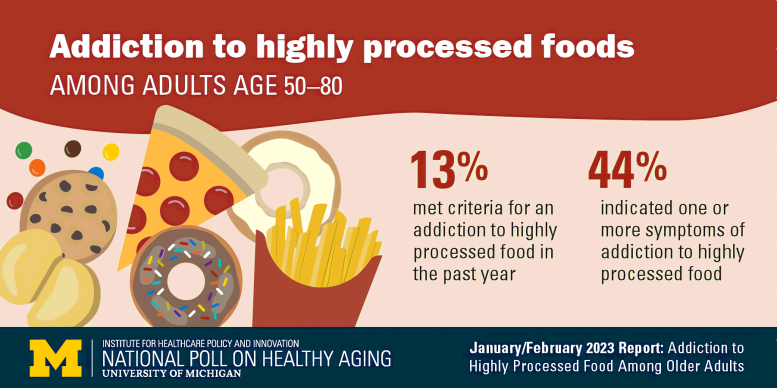
In fact, about 13% of people aged 50 to 80 showed signs of addiction to such foods and beverages in the past year, the new data from the National Poll on Healthy Aging suggest.
The percentage is much higher among women than men – especially women in their 50s and early 60s. It was also higher in older adults who say they are overweight, lonely, or in fair or poor physical or mental health.
Credit: University of Michigan
The poll is based at the University of Michigan Institute for Healthcare Policy and Innovation and supported by AARP and Michigan Medicine, U-M’s academic medical center.
The poll team and U-M psychologist Ashley Gearhardt, Ph.D., used a set of 13 questions to measure whether, and how often, older adults experienced the core indicators of addiction in their relationship with highly processed foods such as sweets, salty snacks, sugary drinks and fast food. These addiction indicators include intense cravings, an inability to cut down on intake, and signs of withdrawal.
Based on their findings, Gearhardt suggests that the same set of standard questions should become part of screening at doctors’ offices. This could help identify older adults with addictive eating habits who could benefit from referrals to nutrition counseling or programs that help people address addictive eating or get affordable access to healthier foods.
Gearhardt, an associate professor in the U-M Department of Psychology and member of IHPI, co-developed the standardized questionnaire used in the poll, called the Yale Food Addiction Scale.
The Brain’s Response to Processed Foods
“The word addiction may seem strong when it comes to food, but research has shown that our brains respond as strongly to highly processed foods, especially those highest in sugar, simple starches, and fat, as they do to tobacco, alcohol and other addictive substances,” says Gearhardt.
“Just as with smoking or drinking, we need to identify and reach out to those who have entered unhealthy patterns of use and support them in developing a healthier relationship with food.”
In order to meet the criteria for an addiction to highly processed food on the scale used in the poll, older adults had to report experiencing at least two of 11 symptoms of addiction in their intake of highly processed food, as well as report significant eating-related distress or life problems multiple times a week. These are the same criteria used to diagnose addiction-related problems with alcohol, tobacco and other addictive substances.
By these criteria, addiction to highly processed foods was seen in:
- 17% of adults age 50 to 64, and 8% of adults age 65-80
- 22% of women age 50 to 64 and 18% of women age 50 to 80,
- 32% of women who say their physical health is fair or poor, and 14% of men who say the same – more than twice as high as the percentages among those who say their physical health is excellent, very good or good
- 45% of women who say their mental health is fair or poor, and 23% of men who say the same – three times as high as the percentages among those who say their mental health is excellent, very good or good
- 17% of men who self-report they are overweight, compared with 1% of men who indicate they’re around the right weight
- 34% of women who self-report they are overweight, compared with 4% who indicate they’re around the right weight
- 51% of women who say they often feel isolated from others, and 26% of men who say the same – compared with 8% of women and 4% of men who say they rarely feel isolated
High-Risk Groups and Symptom Patterns
The most commonly reported symptom of an addiction to highly processed foods in older adults was intense cravings. Almost 1 in 4 (24%) said that at least once a week they had such a strong urge to eat a highly processed food that they couldn’t think of anything else. And 19% said that at least 2 to 3 times a week they had tried and failed to cut down on, or stop eating, these kinds of foods.
Twelve percent said that their eating behavior caused them a lot of distress 2 to 3 times a week or more.
“Clinicians need a better understanding of how food addiction and problematic eating intertwines with their patients’ physical and mental health, including chronic conditions such as diabetes, heart disease and certain types of cancer,” says poll director Jeffrey Kullgren, M.D., M.P.H., M.S., an associate professor of internal medicine at Michigan Medicine and physician and researcher at the VA Ann Arbor Healthcare System. “We need to understand that cravings and behaviors around food are rooted in brain chemistry and heredity, and that some people may need additional help just as they would to quit smoking or drinking.”
The poll report is based on findings from a nationally representative survey conducted by NORC at the University of Chicago for IHPI and administered online and via phone in July 2022 among 2,163 adults aged 50 to 80. The sample was subsequently weighted to reflect the U.S. population.
Never miss a breakthrough: Join the SciTechDaily newsletter.
Follow us on Google and Google News.