
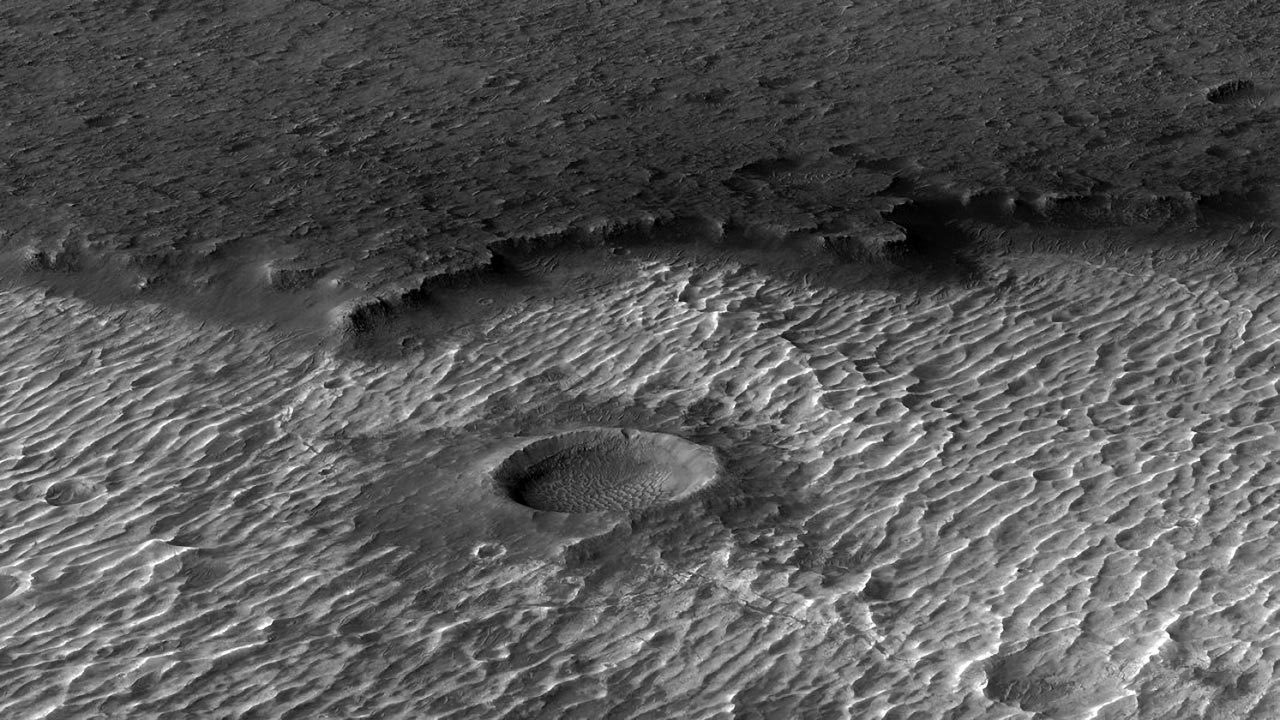
A new study on Mars’ paleo-bedforms has mapped various ancient landscape features shaped by climatic forces like wind and water.
By examining these features, researchers aim to understand Mars’ geological and environmental history, noting how these bedforms have been preserved or eroded over time.
Martian Landscape Evolution
Long ago, flowing wind and water shaped Mars’ malleable sand and sediment into dunes, ripples, and other landscape patterns, called bedforms. Over billions of years, some of these landforms hardened into rock – scientists then call them paleo-bedforms. Frozen in time, change only comes in the form of the slow erosion by dusty winds, burial by ancient lava flows, or the occasional meteorite impact.
A team of researchers led by Planetary Science Institute Senior Scientist Matthew Chojnacki mapped and characterized paleo-bedforms across the red planet to better understand their diversity and Mars’ ancient climate. The paper was published in the journal Geomorphology.
Since 2013 Chojnacki has worked on HiRISE, the High-Resolution Imaging Science Experiment on NASA’s Mars Reconnaissance Orbiter, or MRO.
“I pulled together a collection of HiRISE images that had these weird features that looked like bedforms, but they were cratered and covered in rocks. They looked decrepit and fossilized,” Chojnacki said. “We wanted to investigate further.”
Research on Mars’ Bedforms
Their research turned up paleo-bedforms across landscapes of varying age, latitude, and geologic context, including craters, canyons, and basins. They can be classified into groups called paleo-dunes and paleo-megaripples, which were shaped by wind; fluvial paleo-dunes, which were shaped by water; and dune cast pits, which were paleo-dunes so eroded that only a shallow depression is left behind.
Paleo-bedforms were found all around the planet, but most were concentrated in Valles Marineris and Athabasca Valles, near the equator; Noctis Labyrinthus, west of Valles Marineris; Arcadia Planitia on the northern lowlands; Hellas Planitia in the southern hemisphere, and the highland-lowland transition between Arabia Terra and Apollinaris Mons.
“The most compelling and unambiguous paleo-bedforms were the dunes,” Chojnacki said. “A lot of these paleo-dunes are dead ringers for the modern dunes, they just look more decrepit.”
The most widespread paleo-bedforms were paleo-megaripples, which look like large fields of parallel ridges. These smaller bedforms occur when wind blows over abundant coarse sand.
“Paleo-megaripples are also compelling, but slightly less so than the dunes, because there are other geologic processes that could have formed similar looking landforms,” Chojnacki said.
Insights Into Martian Climate
Based on what the team knew about modern megaripples, they proposed an evolutionary model for these features: The wind first shapes them, then eventually stops, allowing for the hardening and cementing of the sand into rock, leading to their preservation and eventually degradation.
The rarest and most heavily degraded paleo-bedforms were likely shaped by ancient water, called fluvial paleo-bedforms. The team only found these in what are thought to be the remnants of ancient megafloods.
Chojnacki said he was surprised they didn’t find more of these fluvial paleo-bedforms.
“Mars has an abundance of dry river channels where more fluvial bedforms may have formed, but it appears their small size and channel infilling were not conducive for their preservation,” he said.
Future Studies and Implications
The team estimates that most of the paleo-bedforms were cemented into the geological record about 2 billion years ago or more recently. Most bedforms were likely buried following their formation and transport, likely by volcanic activity like lava flows or ash fall, until erosion revealed them again, while others cemented into rock without ever being buried.
“In other cases, active sand dunes along the north polar cap are migrating over older paleo-dunes, leading to their erosion. Seasonal ice can also erode the dunes,” Chojnacki said. “The variety of these bedforms speaks to the diversity of dynamics and conditions operating in the Solar System.”
Now that this survey has revealed a large sample of paleo-bedforms on Mars, the team hopes to identify modern dune fields that may be headed in a similar direction.
“While many bedforms on Mars are active and migrating today, other fields are static and show evidence for some sort of stabilization process that may eventually lead to lithification,” Chojnacki said. “Understanding this continuum will hopefully allow us to better understand the changing climatic conditions of the red planet.”
Reference: “Global survey of paleo-bedforms on Mars” by Matthew Chojnacki, Lori K. Fenton, Lauren A. Edgar, Mackenzie Day, Christopher S. Edwards, Aaron R. Weintraub, Amber L. Gullikson and Matt W. Telfer, 17 September 2024, Geomorphology.
DOI: 10.1016/j.geomorph.2024.109428
This research was supported by an award to PSI from NASA’s Mars Data Analysis Program (80NSSC21K0040) and a subcontract to PSI from the University of Arizona, funded by the NASA MRO mission.
Never miss a breakthrough: Join the SciTechDaily newsletter.
Follow us on Google and Google News.